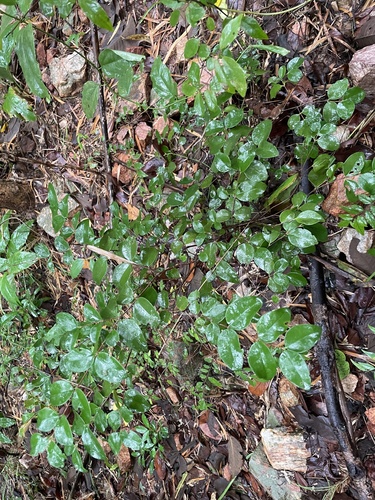
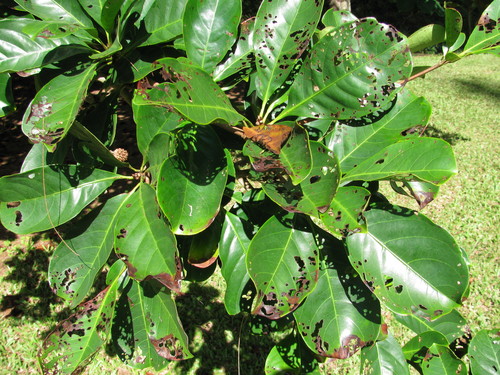
Combretum hereroense
Schinz
Russet bush-willow, Mouse-eared combretum
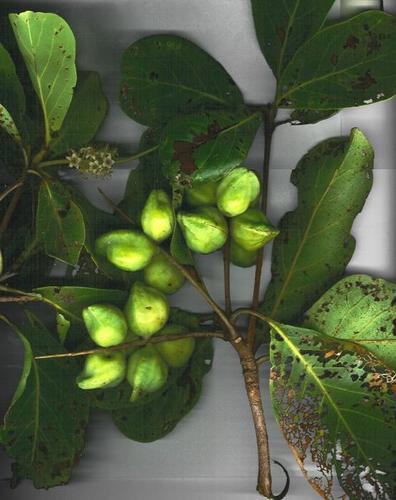
iNaturalist· cc-by-nc
(c) Troos van der Merwe, some rights reserved (CC BY-NC), uploaded by Troos van der Merwe
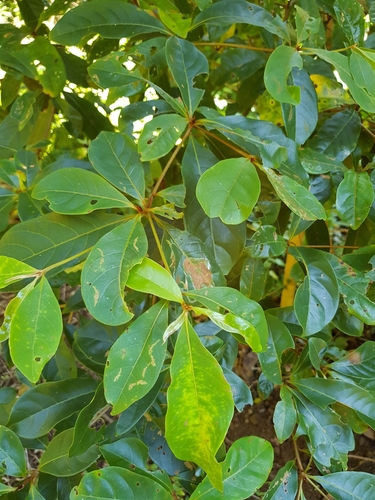
iNaturalist· cc-by-nc
(c) Linda Loffler, some rights reserved (CC BY-NC), uploaded by Linda Loffler
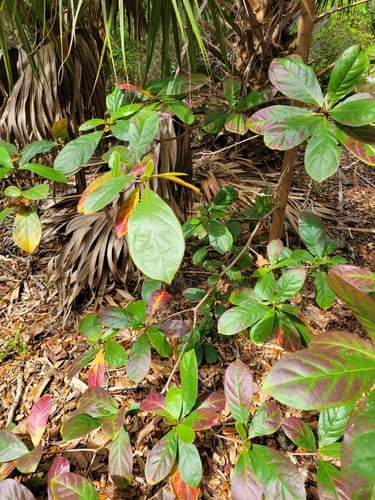
iNaturalist· cc-by-nc
(c) Troos van der Merwe, some rights reserved (CC BY-NC), uploaded by Troos van der Merwe
Summary
Source: WikipediaCombretum hereroense, commonly known as the russet bushwillow and the mouse-eared combretum, is a deciduous shrub or small tree that is found from eastern Africa to northern South Africa. Over its extensive range it is variable with respect to leaf shape, fruit size and indumentum.
Description
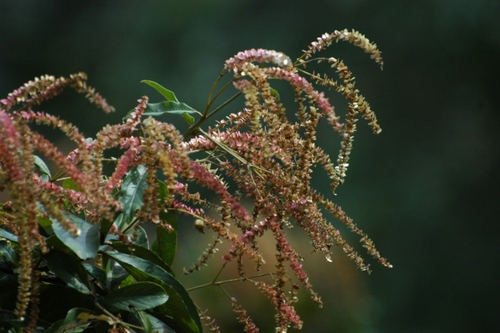
A small tree. It can be up to 11 m tall, but is often 3-5 m tall. The trunk is often crooked and can be 23 cm across. The leaves can be oval or heart shaped. The leaves are 1.9-5 cm long by 1.3-2.5 cm wide. The are dark green and shiny above and yellow-green underneath. Often there are dense velvety hairs underneath. The flowers are small and white or greenish-yellow. They occur in long spikes. The fruit are 2.5 cm long by 1.9 cm wide. They have 4 wings. They are bright red.
Edible Uses
The dried fruit are used as a tea substitute and can also be eaten fresh. The leaves are dried and used for tea. A gum from the plant is also edible. The seeds must be removed as they are considered poisonous.
Traditional Uses
The dried fruit are used as a tea substitute. The seeds are considered poisonous and are removed. The fruit are also eaten fresh. The leaves are dried and used for tea.
Medicinal Uses
Dried leaves are used for tea, the gum is eaten, the wood is harvested for fuel, and the roots are used in traditional medicine.
Known Hazards
The seeds are poisonous and must be removed before consuming the fruit.
Distribution
A tropical plant. It often grows in stony and shallow soils. It grows at medium to low altitudes in open wooded grassland. It can grow in salty soils. It can tolerate drought. It grows between 30-1,465 m above sea level. It can grow in arid places.
Where It Grows
Africa, Angola, Botswana, Central Africa, East Africa, Eswatini, Ethiopia, Kenya, Malawi, Mozambique, Namibia, Somalia, South Africa, Southern Africa, Sudan, Swaziland, Tanzania, Uganda, Zambia, Zimbabwe,
Cultivation
Plants can be grown from seeds. The seeds are best removed from the outer covering and soaked in water for a few hours. Seeds germinate in 1-2 weeks. Seedlings can be transplanted at the 3 leaf stage. It can be cut back and will re-grow.
Propagation
Seed - The seed of most, if not all, species can be stored inside the fruit for several years without losing viability.
Other Uses
The branches are used to make a musical instrument, a string instrument known as a Ilaihn. It is used primarily by traditional healers during healing ceremonies, and sometimes also by hunters.
Production
It is slow growing. Seedlings can reach one metre in 18-24 months.
Notes
There are about 255 Combretum species.
Synonyms
Also Known As
Fiti-tonga, Ithetshane, Kierieklapper, Livimbela, Macucumi, Mokabe, Mucandi, Murovamhuru, Mutechani, Mutumba, N'nari, Nacucuni, Naguegue, Naturua, Nkamouzoaye, Norupanari, Sihlalavane, Umdvubu, Umklalavane, Umphulumbu
References (24)
- Facciola, S., 1998, Cornucopia 2: a Source Book of Edible Plants. Kampong Publications, p 80
- Fowler, D. G., 2007, Zambian Plants: Their Vernacular Names and Uses. Kew. p 19
- Fox, F. W. & Young, M. E. N., 1982, Food from the Veld. Delta Books. p 157
- Grivetti, 1976, 1979,
- Grivetti, L. E., 1980, Agricultural development: present and potential role of edible wild plants. Part 2: Sub-Saharan Africa, Report to the Department of State Agency for International Development. p 79 (As Combretum transvaalense)
Show all 24 references Hide references
- Lee, 1979,
- Long, C., 2005, Swaziland's Flora - siSwati names and Uses http://www.sntc.org.sz/flora/
- Mannheimer, C. A. & Curtis. B.A. (eds), 2009, Le Roux and Muller's Field Guide to the Trees and Shrubs of Namibia. Windhoek: Macmillan Education Namibia. p 358
- Palgrave, K.C., 1996, Trees of Southern Africa. Struik Publishers. p 668
- Palmer, E and Pitman, N., 1972, Trees of Southern Africa. Vol. 3. A.A. Balkema, Cape Town p 1639
- Peters, C. R., O'Brien, E. M., and Drummond, R.B., 1992, Edible Wild plants of Sub-saharan Africa. Kew. p 85
- Pickering, H., & Roe, E., 2009, Wild Flowers of the Victoria Falls Area. Helen Pickering, London. p 50
- Plowes, N. J. & Taylor, F. W., 1997, The Processing of Indigenous Fruits and other Wildfoods of Southern Africa. in Smartt, L. & Haq. (Eds) Domestication, Production and Utilization of New Crops. ICUC p 188
- Roodt, V., 1998, Trees & Shrubs of the Okavango Delta. Medicinal Uses and Nutritional value. The Shell Field Guide Series: Part 1. Shell Botswana. p 101
- Royal Botanic Gardens, Kew (1999). Survey of Economic Plants for Arid and Semi-Arid Lands (SEPASAL) database. Published on the Internet; http://www.rbgkew.org.uk/ceb/sepasal/internet [Accessed 10th April 2011]
- Ruiters-Welcome, A. K., 2019, Food plants of southern Africa. Ph.D. thesis. Univ. of Johannesburg p 45
- Swaziland's Flora Database http://www.sntc.org.sz/flora
- van Wyk, B, van Wyk, P, and van Wyk B., 2000, Photographic guide to Trees of Southern Africa. Briza. p 90
- Venter, F & J., 2009, Making the most of Indigenous Trees. Briza. p 106
- Verh. Bot. Vereins Prov. Brandenburg 30:245. 1888
- Welcome, A. K. & Van Wyk, B.-E., 2019, An inventory and analysis of the food plants of southern Africa. South African Journal of Botany 122 (2019) 136–179
- Wild, 1975,
- World Checklist of Useful Plant Species 2020. Royal Botanic Gardens, Kew
- www.zimbabweflora.co.zw 2011