Combretum adenogonium
Steud. ex A. Rich.
Four-leaved bushwillow
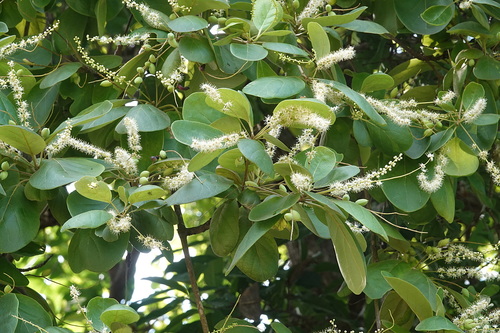
iNaturalist· cc-by-nc-sa
(c) Günter Baumann, some rights reserved (CC BY-NC-SA)
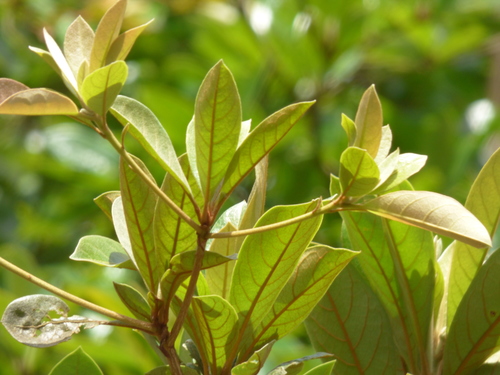
iNaturalist· cc-by-nc
(c) Sergio Chozas, some rights reserved (CC BY-NC), uploaded by Sergio Chozas
iNaturalist· cc-by-nc
(c) Bart Wursten, some rights reserved (CC BY-NC), uploaded by Bart Wursten
Description
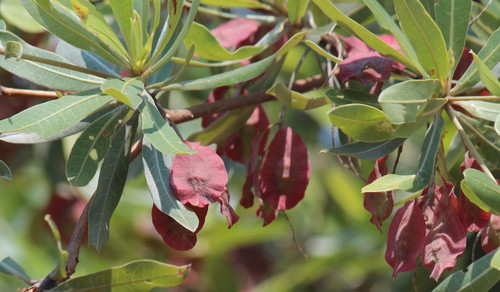
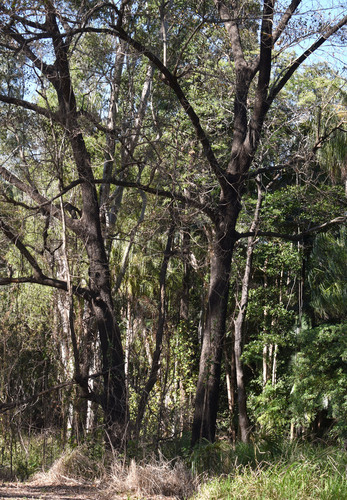
A small to medium sized tree. The leaves are usually in rings or 3-4. They can be opposite. The leaves are oval and dark green. They are velvety when young but lose theirs hairs when mature. There are 7-10 pairs of sides veins that can easily be seen underneath the leaf. The edges of the leaves can be wavy. The flowers are yellow to green. They are in dense spikes. They appear before the new leaves. The fruit is oval and 25 mm long by 35 mm wide. They have 4 wings. They are green with reddish patches.
Edible Uses
The bark exudes a soluble, red-coloured gum which is more or less edible. The root is used to prepare a beverage called djendjeng, Mende, a beverage.
Medicinal Uses
The leaves are used in a medicine for fevers. The branches, free of fruit, are used to prepare an infusion in Liberia for washing the body to relieve pain. An infusion of the bark is taken with natron to relieve lekki beernde (pains in chest). The bark, together with a mistletoe which commonly parasitizes the tree, is made into an infusion for washing the body. The bark and roots provide a decoction used in treating abdominal pains and low backache. The fresh roots, ground up and dried, are put on sores or prepared as a decoction for treating primary sores of syphilis.
Distribution
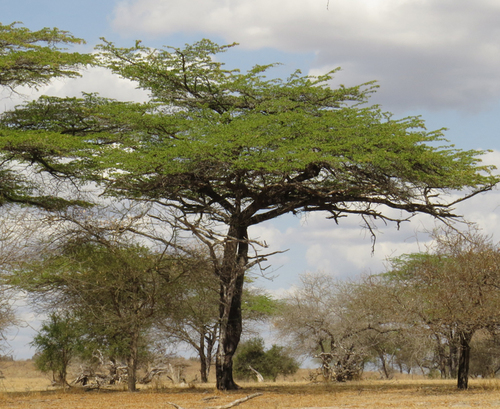
It is a tropical plant. It grows in dry savannah woodland and often on termite mounds.
Where It Grows
Africa, Botswana, Burkina Faso, East Africa, Ethiopia, Guinea, Guinée, Guinea-Bissau, Kenya, Malawi, Mozambique, Southern Africa, Uganda, West Africa, Zambia, Zimbabwe,
Cultivation
Grows at low to moderate elevations in moist tropical areas with a distinct dry season. Succeeds in a wide range of soils in the wild, including those that are seasonally inundated.
Propagation
Seed - The seed of most, if not all, species can be stored inside the fruit for several years without losing viability.
Other Uses
The wood is used as an incense. Smoke from the wood is used as a perfume. The bark exudes a soluble, red-coloured gum which is more or less edible. The tree is said to be the source of much of the gum collected in the Niger basin south of 14° N. The leaves yield a yellow dye on boiling. The leaves and leafy twigs are sometimes mixed with thatching grass. The wood is said to be unbreakable by the elephant: it just bends. It is used for hut-poles and for firewood generally.
Synonyms
Also Known As
Bane, Chinana, Djambacata, Djambacatam-o, Djambacatam-queo, Djambacatum, Fiti, Jambacata, Mboza, Mufiti, Mugwabwa, Muparurapweza, Mupweza, Nacuena, Nama, Umbhondo omkhulu, Upo
References (6)
- Dalziel, J. M., 1937, The Useful plants of west tropical Africa. Crown Agents for the Colonies London.
- Fowler, D. G., 2007, Zambian Plants: Their Vernacular Names and Uses. Kew. p 18
- Grubben, G. J. H. and Denton, O. A. (eds), 2004, Plant Resources of Tropical Africa 2. Vegetables. PROTA, Wageningen, Netherlands. p 560
- Peters, C. R., O'Brien, E. M., and Drummond, R.B., 1992, Edible Wild plants of Sub-saharan Africa. Kew. p 85
- World Checklist of Useful Plant Species 2020. Royal Botanic Gardens, Kew
Show all 6 references Hide references
- www.zimbabweflora.co.zw 2011