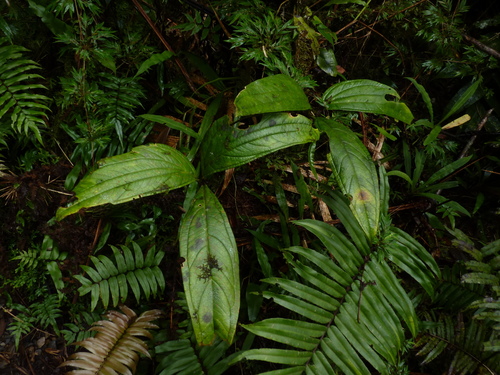
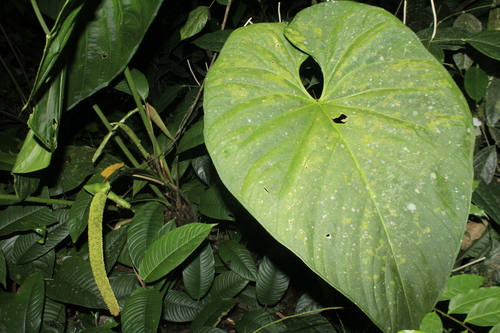
Colocasia gigantea
(Blume ex Hassk.) Hook.f.
Talas Padang
iNaturalist· cc-by-nc
(c) Yingyod Lapwong, some rights reserved (CC BY-NC)
iNaturalist· cc0
no rights reserved
iNaturalist· cc-by-nc
(c) guanhong, some rights reserved (CC BY-NC)
Description
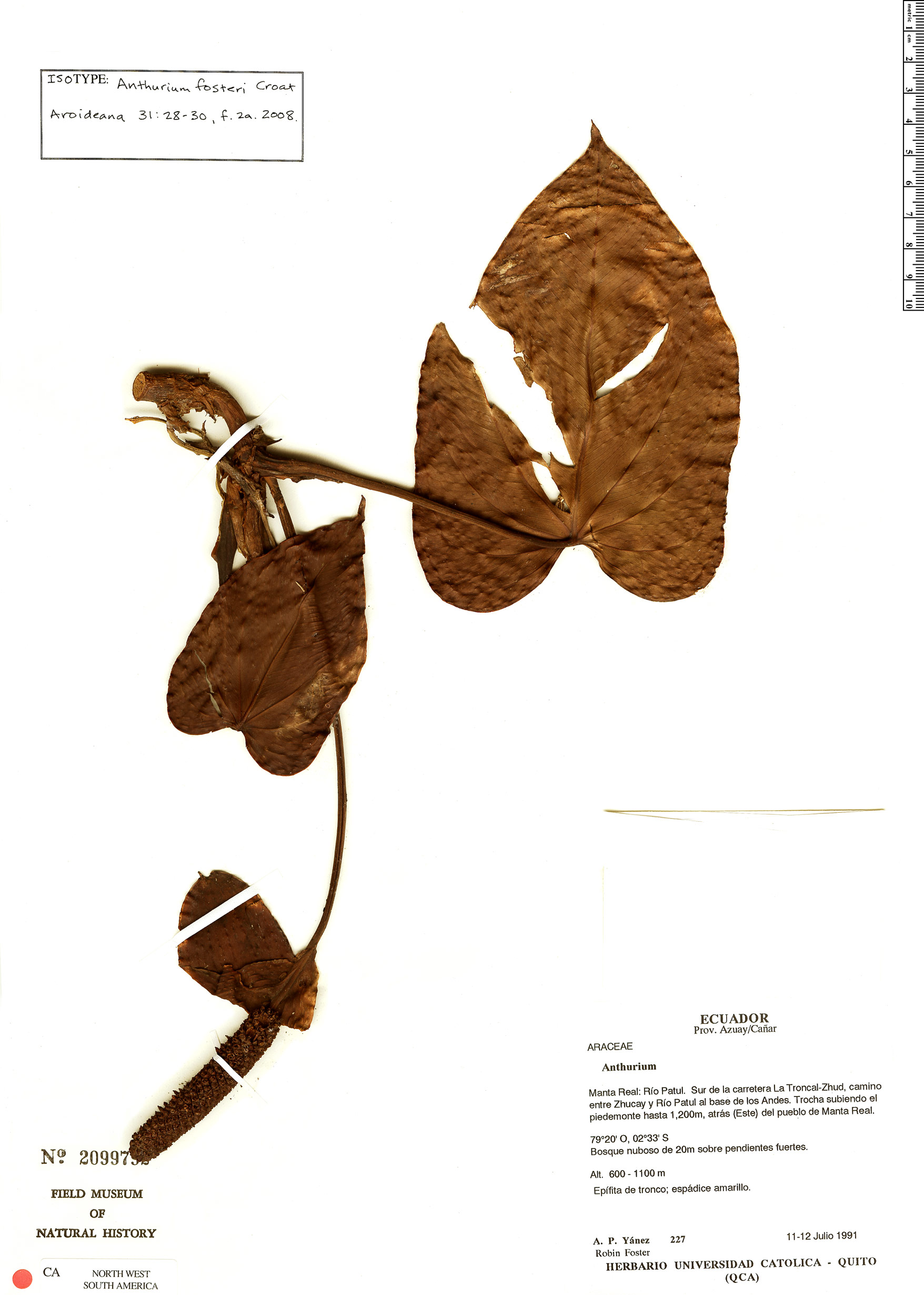
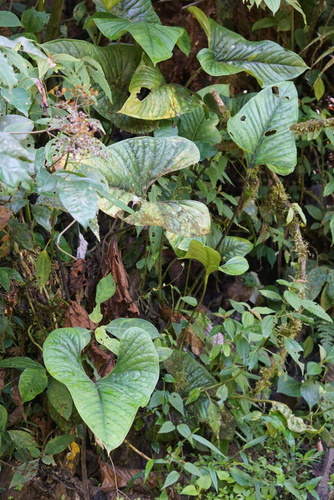
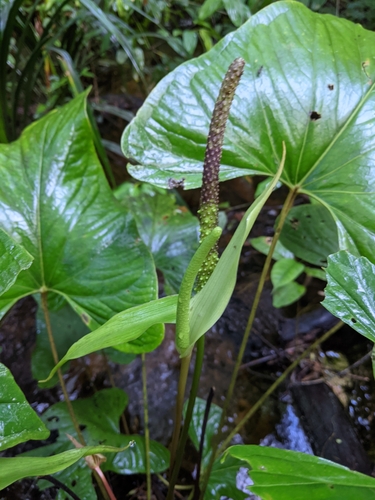
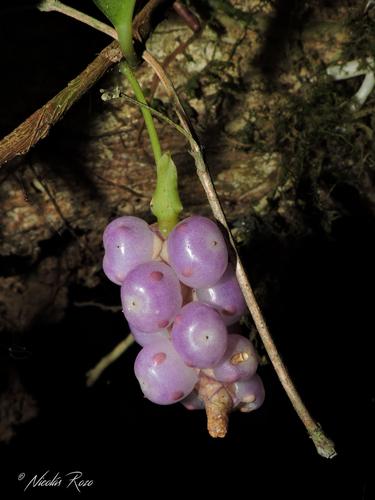
An erect herb. It is fleshy and produces latex. It grows 2 m tall. It has a tuberous underground stem. The leaves are flattened with the leaf stalk attached to the middle of the lower surface. The leaves have 2 lobes at the base. The leaf stalk is 1.5 m long. It is light green. The leaf blade is oval in outline and 25-120 cm long by 17-35 cm wide. The lobes at the base point downwards and are joined for half their length. The flower is a lily like flower with a fleshy stem and enclosed in a spathe. The tubular part is 3-8 cm long. The fruit is an oblong berry. It is about 1 cm long.
Edible Uses
In addition to its value as a starchy root vegetable—known by many names, such as taro, or arbi (in Hindi)—the plant’s leaf stalk (petiole) is also used as a vegetable in some areas of Southeastern Asia and Japan. It is sometimes used as an ingredient in miso soup, chanpurū and sushi.
Traditional Uses
The fruit are used as a flavouring. They are also eaten as a snack. The leaf stalks are eaten as a vegetable. They are well cooked. The leaves are also cooked and eaten.
Known Hazards
The plant contains calcium oxalate crystals. These cause an extremely unpleasant sensation similar to needles being stuck into the mouth and tongue if they are eaten, but they are easily neutralized by thoroughly drying or cooking the plant or by steeping it in water. The plant produces hydrocyanic acid. In small quantities, hydrogen cyanide has been shown to stimulate respiration and improve digestion, it is also claimed to be of benefit in the treatment of cancer. In excess, however, it can cause respiratory failure and even death.
Distribution
A tropical plant. It grows in valley forests, swamps, also cultivated between 100-700 m in China. It suits shady sites. It is often on limestone hills. Adelaide Botanical Gardens. Melbourne Botanical gardens. In XTBG Yunnan. In Sichuan.
Where It Grows
Asia, Australia, Bangladesh, Cambodia, China, East Timor, India, Indochina, Indonesia, Laos, Malaysia, Myanmar, Northeastern India, SE Asia, Singapore, Thailand, Timor-Leste, Vietnam,
Cultivation
Plants can be grown from sections of the rhizome.
Other Uses
The plant contains a latex. No uses are mentioned.
Other Information
It is sold in local markets.
Notes
There are 8 Colocasia species.
Synonyms
Also Known As
Bac ha, Batang, Bo ju, Bon, Bo rui, D(oj)e m(uf)ng, Hou bu, Kamumu, Khun, Kun, Lumpoi, Lumpuy, M(oon) to, Ok dip, Padun, Rombang, Talas raksasa, Taleh kemumu, Thamanai, Thoun, Yendem, You ti
References (23)
- Ambasta, S.P. (Ed.), 2000, The Useful Plants of India. CSIR India. p 137
- Burkill, I.H., 1966, A Dictionary of the Economic Products of the Malay Peninsula. Ministry of Agriculture and Cooperatives, Kuala Lumpur, Malaysia. Vol 1 (A-H) p 650
- Cao, Y., et al, 2020, Ethnobotanical study on wild edible plants used by three trans-boundary ethnic groups in Jiangcheng County, Pu’er, Southwest China. Journal of Ethnobiology and Ethnomedicine (2020) 16:66
- Cowie, I, 2006, A Survey of Flora and vegetation of the proposed Jaco-Tutuala-Lore National Park. Timor-Lests (East Timor) www.territorystories.nt/gov.au p 43
- Devi, O. S., et al, 2021, Wild edible plants associated with the people of Thoubal Khunou village and its migrated villagers. Int. J. Adv. Res. Biol. Sci. 8(9): 72-90
Show all 23 references Hide references
- Fl. Brit. India 6:524. 1893
- Hossain, U. & Rahman, A., 2018, Study and quantitative analysis of wild vegetable floral diversity available in Barisal district, Bangladesh. Asian J. Med. Biol. Res. 2018, 4 (4), 362-371
- Japanese International Research Centre for Agricultural Science www.jircas.affrc.go.jp/project/value_addition/Vegetables
- Lembaga Biologi Nasional, 1977, Ubi-Ubian, Balai Pustaka, Jakarta. p 72
- Li Heng, Araceae, Flora of China.
- Liu, Yi-tao, & Long, Chun-Lin, 2002, Studies on Edible Flowers Consumed by Ethnic Groups in Yunnan. Acta Botanica Yunnanica. 24(1):41-56
- Luczaj, L., et al, 2021, Wild food plants and fungi sold in the markets of Luang Prabang, Lao PDR. Journal of Ethnobiology and Ethnomedicine (2021) 17:6
- Luo, B., et al, 2019, Wild edible plants collected by Hani from terraced rice paddy agroecosystem in Honghe Prefecture, Yunnan, China. Journal of Ethnobiology and Ethnomedicine 15:56
- Martin, F.W. & Ruberte, R.M., 1979, Edible Leaves of the Tropics. Antillian College Press, Mayaguez, Puerto Rico. p 176
- Nakahara, K. et al, 2002, Antimutagenicity of Some Edible Thai Plants, and a Biocative Carbazole Alkaloid, Mahanine, Isolated from Micromelum minutum. Journal of Agricultural and Food Chemistry. 50: 4796-4892
- Pawera, L., et al, 2020, Wild Food Plants and Trends in Their Use: From Knowledge and Perceptions to Drivers of Change in West Sumatra, Indonesia, Foods. 2020, 9, 1240
- PROSEA handbook Volume 13 Spices. p 250
- Sang, D. T., & Mizoue, K. O. N., 2012, Use of Edible Forest Plants among Indigenous Ethnic Minorities in Cat Tien Biosphere Reserve, Vietnam. Asian Journal of Biodiversity Vol. 3 (1), p 23-49
- Seidemann J., 2005, World Spice Plants. Economic Usage, Botany, Taxonomy. Springer. p 114
- Teron, R. & Borthakur, S. K., 2016, Edible Medicines: An Exploration of Medicinal Plants in Dietary Practices of Karbi Tribal Population of Assam, Northeast India. In Mondal, N. & Sen, J.(Ed.) Nutrition and Health among tribal populations of India. p 149
- Terra, G.J.A., 1973, Tropical Vegetables. Communication 54e Royal Tropical Institute, Amsterdam, p 21, 22
- World Checklist of Useful Plant Species 2020. Royal Botanic Gardens, Kew (As Leucocasia gigantea)
- Xu, You-Kai, et al, 2004, Wild Vegetable Resources and Market Survey in Xishuangbanna, Southwest China. Economic Botany. 58(4): 647-667.