Stylochaeton hypogaeum
Lepr.
Barter's round arum
iNaturalist· cc-by-nc-sa
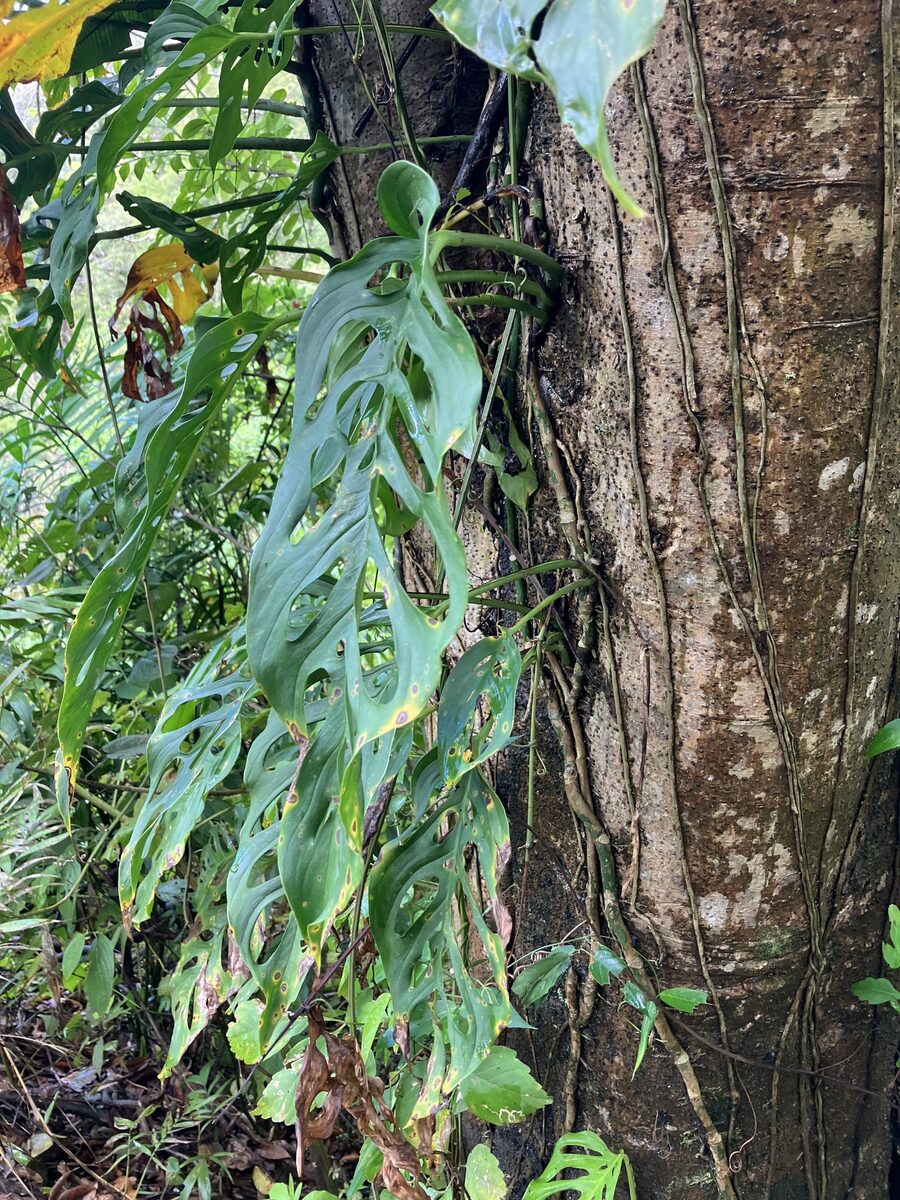
(c) Marco Schmidt, some rights reserved (CC BY-NC-SA)
iNaturalist· cc-by-nc-sa
(c) Marco Schmidt, some rights reserved (CC BY-NC-SA)
iNaturalist· cc-by-nc
(c) ONG OeBenin, some rights reserved (CC BY-NC)
Description
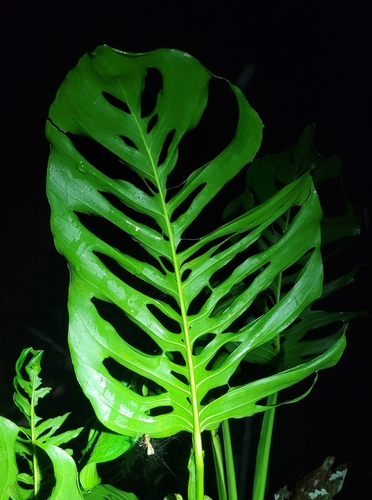
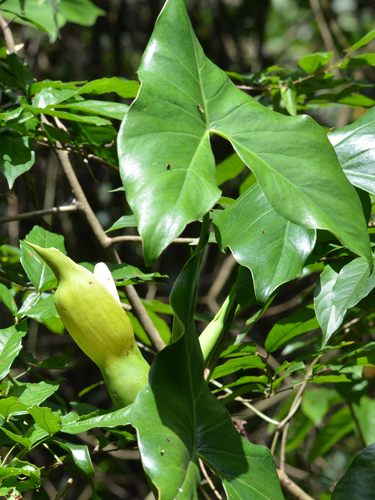
A small herb. It has a thick rootstock. It keeps growing from year to year. The leaves occur in tufts. They are simple. The leaf stalk is 8-15 cm long. The leaf sheath has horizontal purple bands. The leaves are arrowhead shape. They are 10-20 cm long by 5-10 cm wide. The lobes near the base are a narrow triangle shape. The flower spadix is 3-8 cm long. It has a spathe around it. The flowers are of one sex. Male flowers are at the top of the stalk and female flowers lower down. The fruit are round berries. They only have a few seeds. The seeds are oval and black.
Edible Uses
The flowers and flower stalks are cooked and eaten, and are also used as an additive to beer. The leaves, roots, spathe, and other vegetable parts are consumed as a minor vegetable.
Traditional Uses
The flowers and flower stalks are cooked and eaten. They are also used as an additive to beer.
This uses section is brief — help expand it
Distribution
They are tropical and subtropical plants. It grows in open forest and savannah.
Where It Grows
Africa, Benin, Burkina Faso, Central Africa, Côte d'Ivoire, Gabon, Gambia, Ghana, Guinea, Guinée, Guinea-Bissau, Ivory Coast, Liberia, Nigeria, Senegal, South Sudan, Sudan, West Africa,
Production
Flowers appear in the dry season.
Other Information
It is a minor vegetable.
Notes
There are 17 Stylochaeton species.
Synonyms
Also Known As
Bargo, Gwadaba, Ndukul mbop, Tabal, Worola, Wuula, Yafoton
References (9)
- Achigan-Dako, E, et al (Eds), 2009, Catalogue of Traditional Vegetables in Benin. International Foundation for Science.
- Burkill, H. M., 1985, The useful plants of west tropical Africa, Vol. 1. Kew.
- Gallagher, D. E., 2010, Farming beyond the escarpment: Society, Environment, and Mobility in Precolonial Southeastern Burkina Faso. PhD University of Michigan.
- Grubben, G. J. H. and Denton, O. A. (eds), 2004, Plant Resources of Tropical Africa 2. Vegetables. PROTA, Wageningen, Netherlands. p 516
- Jardin, C., 1970, List of Foods Used In Africa, FAO Nutrition Information Document Series No 2.p 20, 105
Show all 9 references Hide references
- Martin, F.W. & Ruberte, R.M., 1979, Edible Leaves of the Tropics. Antillian College Press, Mayaguez, Puerto Rico. p 176
- Mertz, O., Lykke, A. M., and Reenberg, A., 2001, Importance and Seasonality of Vegetable Consumption and Marketing in Burkina Faso. Economic Botany, 55(2):276-289 (As Stylochaeton)
- Morton, J.K., 1961, West African Lilies and Orchids. Longmans. p 47 (As Stylochaeton barteri)
- World Checklist of Useful Plant Species 2020. Royal Botanic Gardens, Kew