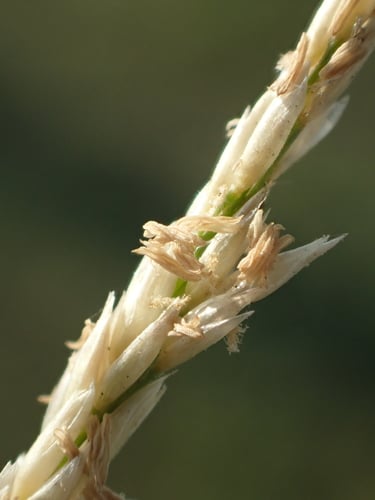
Coix lacryma-jobi
Linnaeus
Job’s tears
iNaturalist· cc0
no rights reserved, uploaded by 葉子
iNaturalist· cc-by-nc
(c) biobank-lantauhk, some rights reserved (CC BY-NC), uploaded by biobank-lantauhk
iNaturalist· cc-by-nc
(c) Gareth Preiss, some rights reserved (CC BY-NC), uploaded by Gareth Preiss
Summary
Source: WikipediaPerennial growing to 1 m (3ft 3in) tall by 0.2 m (8in) spread. Hardy to UK zone 9 and USDA zones listed above. In leaf May to October, flowers July to October, seeds ripen September to November. Monoecious with wind-pollinated flowers. Grows in light sandy, medium loamy, or heavy clay soils with mildly acid to basic pH; tolerates very acid soils. Requires full sun and prefers moist conditions.
Description
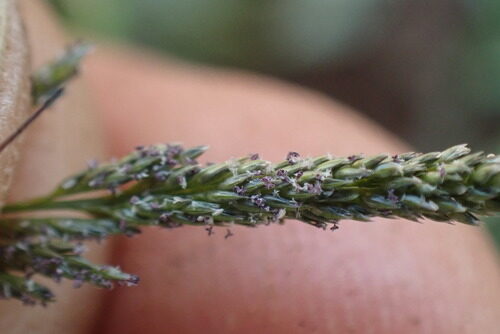
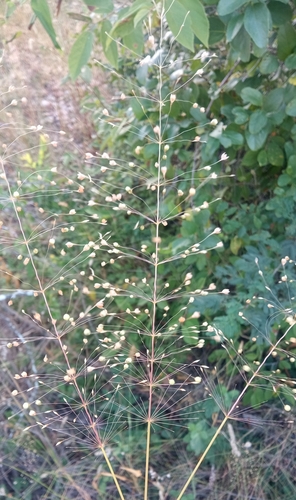
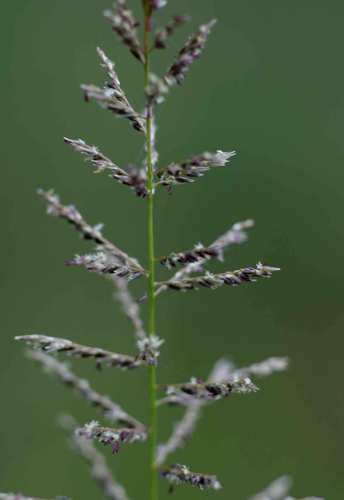
A millet grass. It is a loosely tufted, tall, annual grass. It grows up to 1-2 m high with long slender leaves. The stems have a soft, white, centre inside. The leaves can be 60 cm long and 3-5 cm wide. The sheath of the leaf around the stem, is short. The flower stalk is long and arching. Male and female flowers are in separate spikes on the flowering stalk. The female flowers have a hard covering which changes from green to black to white, as it ripens. Male flowers are small and on top. The seed is like a bead and used for necklaces. They are 1.5 cm long. The seeds are green when young, and turn to pearly grey or purple when mature.
Edible Uses
The seed (referring to the ssp. ma-yuen) is cooked and has a pleasant mild flavour. It can be used in soups and broths, ground into flour for bread-making, or used in the same ways as rice. Pounded flour is sometimes mixed with water like barley water, or fried and coated with sugar to make a sweet dish. The seed can also be husked and eaten out of hand like a peanut. Nutritionally, the seed contains approximately 52% starch, 18% protein and 7% fat — higher in protein and fat than rice but low in minerals. It has a higher protein-to-carbohydrate ratio than any other cereal, though the hard seedcoat makes flour extraction difficult. A tea can be made from parched seeds, and beers and wines are produced from the fermented grain. A coffee substitute is made from the roasted seed. Per 100g fresh weight the seed provides 380 calories, with 11.2% water, 15.4g protein, 6.2g fat, 65.3g carbohydrate, 0.8g fibre, 1.9g ash, 25mg calcium, 435mg phosphorus, 5mg iron, 0.28mg thiamine (B1), 0.19mg riboflavin (B2) and 4.3mg niacin.
Traditional Uses
The seeds are eaten raw. They can be cooked like rice. The seeds can be crushed to produce a cereal flour. This is best mixed with wheat flour to make a lighter but tasty flour. The seeds are used in soups, porridges, drinks or pastries. It is used for brewing beer. The parched seeds are used for a tea-like drink.
Medicinal Uses
The fruits are anodyne, anti-inflammatory, antipyretic, antiseptic, antispasmodic, hypoglycaemic, hypotensive, sedative and vermifuge. They are used in folk remedies for abdominal tumours, oesophageal, gastrointestinal and lung cancers, various tumours, and also for excrescences, warts and whitlows. This folk reputation is supported by research showing that coixenolide, one of the plant's active constituents, has antitumour activity. The seed with the husk removed is antirheumatic, diuretic, pectoral, refrigerant and tonic. A tea made from boiled seeds is drunk as part of a treatment for warts, and is also used for lung abscess, lobar pneumonia, appendicitis, rheumatoid arthritis, beriberi, diarrhoea, oedema and difficult urination. The plant has been used in treating cancer. The roots have been used for menstrual disorders, and a decoction of the root is used as an anthelmintic. Fruit is harvested when ripe in autumn; husks are removed before use fresh, roasted or fermented.
Distribution
A tropical and subtropical plant. It grows wild and semi-cultivated in many areas of Papua New Guinea. It is well suited to grow in swampy places. It grows in wetlands. It grows up to 2000 m altitude in the tropics. It needs a temperature above 13-16°C. It suits hardiness zones 9-11. In Yunnan.
Where It Grows
Africa, American Samoa, Argentina, Asia, Australia, Bhutan, Brazil, Cambodia, Cameroon, Central Africa, Central America, China, Colombia, Congo DR, Côte d'Ivoire, Cuba, Dominican Republic, East Africa, East Timor, Easter Island, Ecuador, Fiji, Ghana, Guam, Guiana, Guianas, Guinea, Guinée, Guinea-Bissau, Guyana, Haiti, Himalayas, India, Indochina, Indonesia, Ivory Coast, Japan, Korea, Laos, Liberia, Madagascar, Malaysia, Maldives, Mariana Islands, Marquesas, Mozambique, Myanmar, Nepal, Nigeria, Niue, Northeastern India, Pacific, Pakistan, Papua New Guinea, PNG, Paraguay, Peru, Philippines, Samoa, Sao Tome and Principe, SE Asia, Senegal, Sierra Leone, Singapore, Slovenia, South Africa, Southern Africa, South America*, Sri Lanka, St. Kitts and Nevis, Suriname, Taiwan, Thailand, Timor-Leste, Tonga, Trinidad, Vanuatu, Venezuela, Vietnam, West Africa, West Indies,
Cultivation
Succeeds in ordinary garden soil. Best grown in an open sunny border. Prefers a little shelter from the wind. Job's Tears is reported to tolerate an annual precipitation in the range of 61 to 429cm, an average annual temperature of 9.6 to 27.8°C and a pH in the range of 4.5 to 8.4. Weed to some, necklace to others, staff-of-life to others, job's tear is a very useful and productive grass increasingly viewed as a potential energy source. Before corn (Zea mays) became popular in Southern Asia, Job's tears was rather widely cultivated as a cereal in India. It is a potentially very useful grain having a higher protein to carbohydrate ratio than any other cereal. The seed has a very tough shell however making it rather difficult to extract the grain. The ssp. ma-yuen. (Roman.)Stapf. is grown for its edible seed and medicinal virtues in China, the seedcoat is said to be soft and easily removed. This form is widely used in macrobiotic diets and cuisine. The ssp. stenocarpa is used for beads. Whilst usually grown as an annual, the plant is perennial in essentially frost-free areas. Plants have survived temperatures down to about -35°c. (This report needs verifying, it seems rather dubious.) Plants have often overwintered when growing in a polyhouse with us, they have then gone on to produce another crop of seed in their second year. We have not as yet (1995) tried growing them on for a third year in a polyhouse.
Propagation
Pre-soak seed for 2 hours in warm water and sow in February or March in a greenhouse. Germination usually occurs in 3–4 weeks at 25°C. Prick seedlings out into individual pots when large enough to handle, grow on in cool conditions and plant out in late spring after the last expected frosts. Seed can also be sown in situ in May, though it is unlikely to ripen in an average British summer. In a suitable climate it takes about 4–5 months from seed to produce new seed. Root offshoots can also be divided, which is best done in spring as plants come into fresh growth.
Other Uses
The seeds are used as decorative beads. The stems are used to make matting.
Production
Seeds are ready to harvest about 5 months after sowing. On poor soils in dry conditions, hollow fruits may be produced. The tough seed shell has to be broken.
Other Information
Common in most areas of Papua New Guinea but rarely eaten. It is eaten often in some places e.g. Mendi Valley. Similarly in many tropical countries, the thin shelled form is used as food. It is a cultivated food plant.
Notes
Chemical composition (grams /100g): Protein = 18.81g. Fat = 6.2g. Carbohydrate (soluble) = 59.55g. Fibre = 1.28g. Ash = 3.4g. Water = 10.74g. Calories = 378.
Nutrition
| Part | Moisture | kJ | kcal | Protein | Vit A | Vit C | Iron | Zinc |
|---|---|---|---|---|---|---|---|---|
| Seed | 15 | 1279 | 306 | 12 | 0 | 0 | 0.7 | — |
Synonyms
Also Known As
Adlay millet, Adlay, Anjalai, Bbirkaulo, Bilen, Bonco, Butsu wasil, Canelos muyu, Chuan gu, Cura huea, Deuy, Duei, Gurgur, Holo, Hongo, Isangu, Jali, Jali-jali, Jangali zuvaai, Jargadi, Jelai pulut, Jelai, Joli, Juzudama, Ka-leik, Kalein, Kapi tape, Kasaiya, Kattu kundumani, Kola, Kolgowa, Kyeik, Miimtang, Mwahile hile, Netpavalam, Nongo, Oshiito, Pikopiko, Pooshakkal, Ranmakkai, Sanasana, Sankru, Senjelai, Shankru, Sku'ey, Sohriu, Tear-grass, Tiaku, Trigo tropical, Tumdak, Wasil, Yi yi, Yusari
References (81)
- References for Job's tears Coix lacryma-jobi.
- Altschul, S.V.R., 1973, Drugs and Foods from Little-known Plants. Notes in Harvard University Herbaria. Harvard Univ. Press. Massachusetts. no. 10
- Ambasta, S.P. (Ed.), 2000, The Useful Plants of India. CSIR India. p 135
- Anderson, E. F., 1993, Plants and people of the Golden Triangle. Dioscorides Press. p 207
- Arora, R. K., 2014, Diversity in Underutilized Plant Species - An Asia-Pacific Perspective. Bioversity International. p 102
Show all 81 references Hide references
- Bennett, B. C., 1990, Useful Plants of Amazonian Ecuador. US Agency for International Development. Fifth Progress Report. New York Botanical Gardens. p 39
- Borrell, O.W., 1989, An Annotated Checklist of the Flora of Kairiru Island, New Guinea. Marcellin College, Victoria Australia. p 22
- Bremness, L., 1994, Herbs. Collins Eyewitness Handbooks. Harper Collins. p 242
- Brickell, C. (Ed.), 1999, The Royal Horticultural Society A-Z Encyclopedia of Garden Plants. Convent Garden Books. p 286
- Brown, D., 2002, The Royal Horticultural Society encyclopedia of Herbs and their uses. DK Books. p 175
- Brown, W.H., 1920, Wild Food Plants of the Philippines. Bureau of Forestry Bulletin No. 21 Manila. p 26
- Burkill, H. M., 1985, The useful plants of west tropical Africa, Vol. 2. Kew.
- Burkill, I.H., 1966, A Dictionary of the Economic Products of the Malay Peninsula. Ministry of Agriculture and Cooperatives, Kuala Lumpur, Malaysia. Vol 1 (A-H) p 637
- Cabalion, P. and Morat, P., 1983, Introduction le vegetation, la flore et aux noms vernaculaires de l'ile de Pentcoste (Vanuatu), In: Journal d'agriculture traditionnelle et de botanique appliquee JATBA Vol. 30, 3-4
- Cheng, Z., et al, 2022, Ethnobotanical study on wild edible plants used by Dulong people in northwestern Yunnan, China. Journal of Ethnobiology and Ethnomedicine (2022) 18:3
- Cribb, A.B. & J.W., 1976, Wild Food in Australia, Fontana. p 101
- Dobriyal, M. J. R. & Dobriyal, R., 2014, Non Wood Forest Produce an Option for Ethnic Food and Nutritional Security in India. Int. J. of Usuf. Mngt. 15(1):17-37
- Ekman Herbarium records Haiti
- Ethnobotany of Karbis. Chapter 4 in p 82
- Facciola, S., 1998, Cornucopia 2: a Source Book of Edible Plants. Kampong Publications, p 174
- Flora of Pakistan. www.eFloras.org
- Fox, F. W. & Young, M. E. N., 1982, Food from the Veld. Delta Books. p 298
- Franklin, J., Keppel, G., & Whistler, W., 2008, The vegetation and flora of Lakeba, Nayau and Aiwa Islands, Central Lau Group, Fiji. Micronesica 40(1/2): 169–225, 2008
- French, B.R., 1986, Food Plants of Papua New Guinea, A Compendium. Asia Pacific Science Foundation p 137
- Gangwar, A. K. & Ramakrishnan, P. S., 1990, Ethnobotanical Notes on Some Tribes of Arunachal Pradesh, Northeastern India. Economic Botany, Vol. 44, No. 1 pp. 94-105
- Guite, C., 2016, A study of wild edible plants associated with the Paite tribe of Manipur, India, International Journal of Current Research. Vol. 8, Issue, 11, pp. 40927-40932
- Hani Medicine of Xishuangbanna, 1999, p 459
- Hedrick, U.P., 1919, (Ed.), Sturtevant's edible plants of the world. p 210
- Hibbert, M., 2002, The Aussie Plant Finder 2002, Florilegium. p 71
- Hu, Shiu-ying, 2005, Food Plants of China. The Chinese University Press. p 287
- Hwang, HS, et al, 2014, Distribution characteristics of plant in the Ungseokbong Mountain, Gyeongsangnam-do, Korea. Journal of Asia-Pacific Biodiversity. 7(2014) e164-e178
- Jacquat, C., 1990, Plants from the Markets of Thailand. D.K. Book House p 120
- Jansen, P.C.M., 2006. Coix lacryma-jobi L. [Internet] Record from Protabase. Brink, M. & Belay, G. (Editors). PROTA (Plant Resources of Tropical Africa), Wageningen, Netherlands. < http://database.prota.org/search.htm>. Accessed 15 October 2009.
- Jardin, C., 1970, List of Foods Used In Africa, FAO Nutrition Information Document Series No 2. p 2
- Joyal, E., 1987, Ethnobotanical Field Notes from Ecuador: Camp, Prieto, Jorgensen, and Giler. Economic Botany 41(2): 163-189
- Kiple, K.F. & Ornelas, K.C., (eds), 2000, The Cambridge World History of Food. CUP p 117, 1793
- Kuo, W. H. J., (Ed.) Taiwan's Ethnobotanical Database (1900-2000), http://tk.agron.ntu.edu.tw/ethnobot/DB1.htm
- Lazarides, M. & Hince, B., 1993, Handbook of Economic Plants of Australia, CSIRO. p 63
- Lokho, K. & Narasimhan, D., 2013, Ethnobotany of Mao-Naga Tribe of Manipur, India. Pleione 7(2): 314-324
- Macmillan, H.F. (Revised Barlow, H.S., et al), 1991, Tropical Planting and Gardening. Sixth edition. Malayan Nature Society. Kuala Lumpur. p 351
- Manandhar, N.P., 2002, Plants and People of Nepal. Timber Press. Portland, Oregon. p 164
- McMakin, P.D., 2000, Flowering Plants of Thailand. A Field Guide. White Lotus. p 93
- Miguel, E., et al, 1989, A checklist of the cultivated plants of Cuba. Kulturpflanze 37. 1989, 211-357
- Omawale, 1973, Guyana's edible plants. Guyana University, Georgetown p 96
- Paczkowska, G. & Chapman, A.R., 2000, The Western Australian Flora. A Descriptive Catalogue. Western Australian Herbarium. p 100
- Parham, B. E. V., 1972, Plants of Samoa. New Zealand Department of Scientific and Industrial Research. Information Series. No. 85 p 108
- PATON & DUNLOP,
- Peekel, P.G., 1984, (Translation E.E.Henty), Flora of the Bismarck Archipelago for Naturalists, Division of Botany, Lae, PNG. p 44, 45
- Phon, P., 2000, Plants used in Cambodia. © Pauline Dy Phon, Phnom Penh, Cambodia. p 167
- Plants for a Future database, The Field, Penpol, Lostwithiel, Cornwall, PL22 0NG, UK. http://www.scs.leeds.ac.uk/pfaf/
- Plants of Haiti Smithsonian Institute http://botany.si.edu/antilles/West Indies
- Powell, J.M., Ethnobotany. In Paijmans, K., 1976, New Guinea Vegetation. Australian National University Press. p 109
- PROSEA (Plant Resources of South East Asia) handbook, Volume
- Purseglove, J.W., 1972, Tropical Crops. Monocotyledons. Longmans p 134
- Ramachandran,V. S., & Udhayavani, C., 2013, Knowledge and uses of wild edible plants by Paniyas and Kurumbas of Western Nilgiris, Tamil Nadu. Indian Journal of Natural Products and Resources. 4(4) December 2013, pp 412-418
- Recher, P, 2001, Fruit Spirit Botanical Gardens Plant Index. www.nrg.com.au/~recher/ seedlist.html p 1
- Reid, L. A. & Madulid, D., 1972, Some comments on Bontoc Ethnobotany. Philippine Journal of Linguistics
- Reis, S. V. and Lipp, F. L., 1982, New Plant Sources for Drugs and Foods from the New York Botanical Garden herbarium. Harvard. p 10
- Roa, J. A. G. & Boada, D. S. G., 2018, Fundación para el Fortalecimiento de la Fruticultura y Plantas Alimenticias no Convencionales en Colombia.
- Romanowski, N., 2007, Edible Water Gardens. Hyland House. p 85
- Ruiters-Welcome, A. K., 2019, Food plants of southern Africa. Ph.D. thesis. Univ. of Johannesburg p 87
- Singh, V. and Singh, P., 1981, Edible Wild Plants of Eastern Rajasthan. J. Econ. Tax. Bot. Vol 2 pp 197-207
- Smith, P.M., 1979, Adlay, Job’s tears, in Simmonds, N.W., (ed), Crop Plant Evolution. Longmans. London. p 307
- Sp. pl. 2:972. 1753
- Sujanapal, P., & Sankaran, K. V., 2016, Common Plants of Maldives. FAO & Kerala FRI, p 93
- Sukarya, D. G., (Ed.) 2013, 3,500 Plant Species of the Botanic Gardens of Indonesia. LIPI p 1090
- Swapna, M. M. et al, 2011, A review on the medicinal and edible aspects of aquatic and wetland plants of India. J. Med. Plants Res. 5 (33) pp. 7163-7176
- Terashima, H., et al, 1992, Ethnobotany of the Lega in the Tropical Rainforest of Eastern Zaire (Congo): Part Two, Zone de Walikale, African Study Monographs, Suppl. 19:1-60
- Teron, R. & Borthakur, S. K., 2016, Edible Medicines: An Exploration of Medicinal Plants in Dietary Practices of Karbi Tribal Population of Assam, Northeast India. In Mondal, N. & Sen, J.(Ed.) Nutrition and Health among tribal populations of India. p 154
- Torre, de la, L., et al, 2008, Enciclopedia de las Plantas Útiles del Ecuador. Herbario QCA. Pontificia Universidad Católica del Ecuador. p 510
- Ulian, T., et al, 2020, Unlocking plant resources to support food security and promote sustainable agriculture. Plants, People, Planet. 2020;2:421–445.
- van Wyk, B., 2005, Food Plants of the World. An illustrated guide. Timber press. p 148
- van Wyk, Be, & Gericke, N., 2007, People's plants. A Guide to Useful Plants of Southern Africa. Briza. p 9
- Welcome, A. K. & Van Wyk, B.-E., 2019, An inventory and analysis of the food plants of southern Africa. South African Journal of Botany 122 (2019) 136–179
- Wiersema, J. H. & Leon, B., 2013, World Economic Plants. A Standard Reference CRC Press. 2nd Ed. p 190
- Wiriadinata, H., 1995, Ethnobotany of Economic Plants in the Baliem Valley, Jayawijaya, Irian Jaya, Indonesian Institute of Science, Bogor, Indonesia
- World Checklist of Useful Plant Species 2020. Royal Botanic Gardens, Kew
- www.ethnobiomed.com
- Zeven, A. C. & de West, J. M. J., 1982, Dictionary of cultivated plants and their regions of diversity. Wageningen. p 53
- Zhang, Y., et al, 2014, Diversity of wetland plants used traditionally in China: a literature review. Journal of Ethnobiology and Ethnomedicine. 10:72
- Zizka, G., 1991, Flowering Plants of Easter Island. Palmarum Hortus Francofurtensis