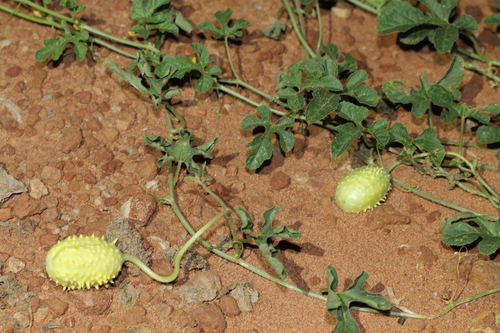
Coccinia rehmannii
Cogn.
Wild cucumber
iNaturalist· cc-by-nc
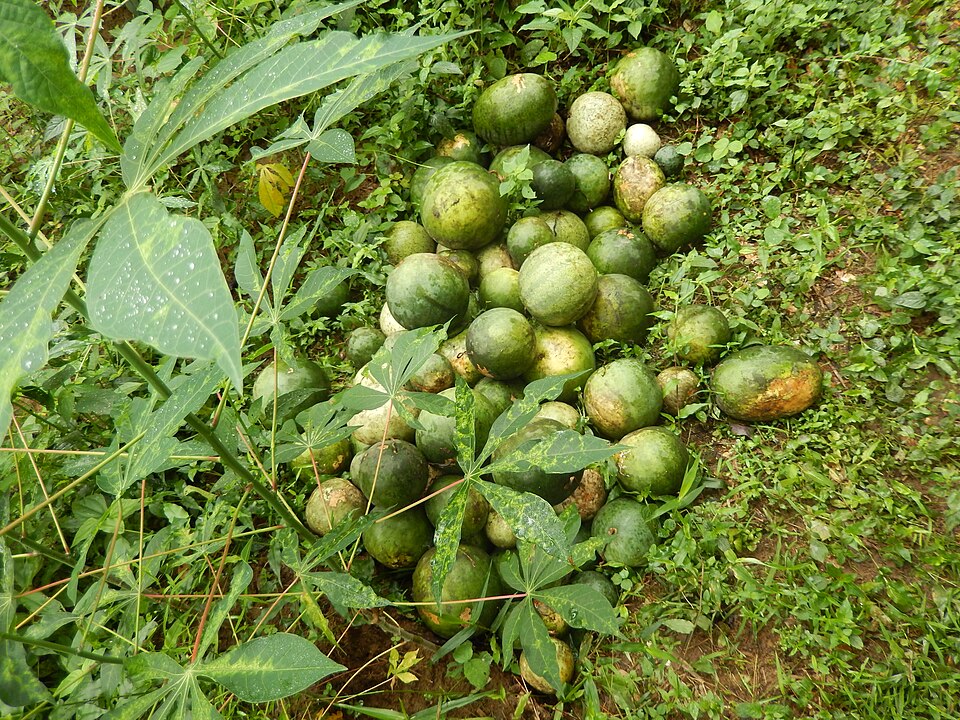
(c) Troos van der Merwe, some rights reserved (CC BY-NC), uploaded by Troos van der Merwe
iNaturalist· cc-by-nc
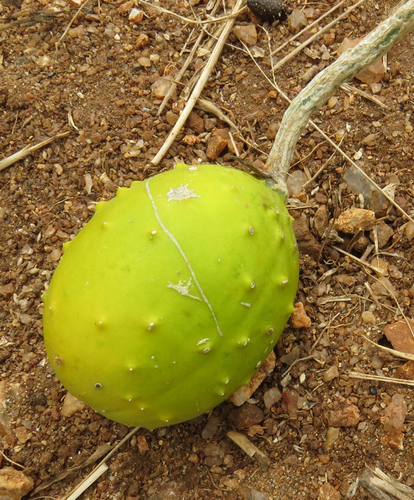
(c) Marion Maclean, some rights reserved (CC BY-NC), uploaded by Marion Maclean
iNaturalist· cc-by-nc
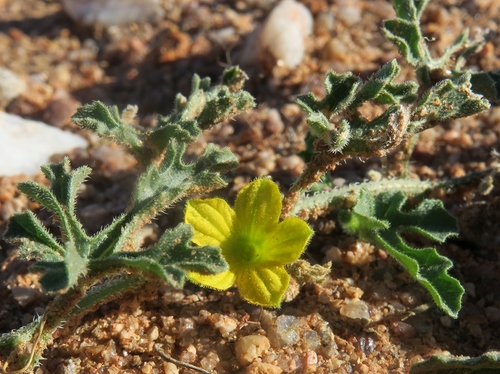
(c) Tony Benn, some rights reserved (CC BY-NC), uploaded by Tony Benn
Description
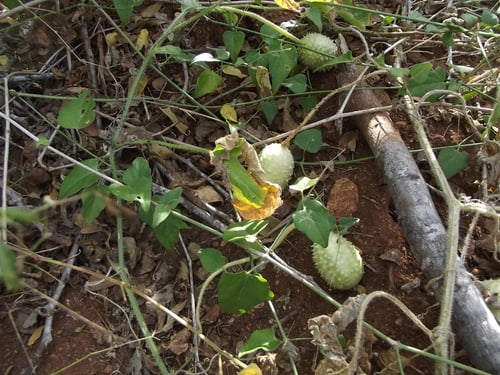
A pumpkin family plant. It is a perennial creeping herb. It has a tuber 40 cm long. The stems are angled. They are grey green with white specks. The leaves are rigid and rough. They are dark green on top and paler below. When they are young they have bristles but they are smooth later. The leaves are deeply divided. The edges of the leaves are thickened and with fine teeth. The flowers are separately male and female. The male flowers are in clusters and the female flowers occur singly. The flowers are funnel shaped and yellow. The fruit is oval and becomes bright red when ripe.
Edible Uses
Coccinia abyssinica tubers are an important staple crop in the Ethiopian highlands. The tubers are rich in starch and are cooked. Also the young shoots and the leaves are cooked and eaten around Dembi Dolo, Oromia State. There are also beliefs about medical use, but none is scientifically verified so far. The relatively high content of calcium might be the reason for the local belief that eating C. abyssinica helps against fractured bones. The edibility of the fruits is disputed, eventually, there are different races.
Traditional Uses
The tubers are eaten. They must be roasted or boiled and are normally then peeled. The thick juicy stems are eaten after roasting. The leaves are cooked and eaten. The fruit can be eaten. Caution: The fruit are claimed to cause sore eyes.
Known Hazards
The fruits are said to cause sore eyes.
Distribution
A tropical plant. Plants can tolerate occasional frosts. Plants grow up to 1000 m altitude or higher. They occur on dry sandy soils. They have some salt tolerance. It can grow in arid places.
Where It Grows
Africa, Angola, Asia, Botswana, Central Africa, East Africa, Eswatini, Mozambique, Namibia, South Africa, Southern Africa, Swaziland, Zimbabwe,
Cultivation
Tubers extend 70 cm into the ground which takes extensive digging to harvest them.
Propagation
Seed - Cuttings.
Other Information
The tubers are a major food of the Kade Bushmen of the Kalahari. The fruit are occasionally eaten by children.
Nutrition
| Part | Moisture | kJ | kcal | Protein | Vit A | Vit C | Iron | Zinc |
|---|---|---|---|---|---|---|---|---|
| Fruit | 89.1 | 150 | 36 | 2 | — | 3.5 | 0.5 | 0.5 |
| Roots | 89.1 | 142 | 34 | 1.5 | — | 4.1 | 0.5 | 0.9 |
Synonyms
Also Known As
Fuculumnue, Inyang-wazi, Itjimaka, Kaukau, Kgaba, Kujana, Magapa, Oro, Otjimaga, Pfungulune, Tshifhafhe, Uselwa-iwenyoka, Tjwalabetinyoni
References (28)
- Arnold, T.H., Wells, M.J. & Wehmeyer, A.S., Khoisan food plants: taxa with potential for future economic exploitation, in Wickens, G.E., Goodin, J.R., and Field, D.V.,(Eds.) 1985, Plants for Arid Lands. Unwin Hyman, London, p 73
- Bull. Herb. Boissier 3:418. 1895
- Cunningham, 1985,
- Fox, F. W. & Young, M. E. N., 1982, Food from the Veld. Delta Books. p 169
- Grivetti, L. E., 1980, Agricultural development: present and potential role of edible wild plants. Part 2: Sub-Saharan Africa, Report to the Department of State Agency for International Development. p 75, 79
Show all 28 references Hide references
- Grubben, G. J. H. and Denton, O. A. (eds), 2004, Plant Resources of Tropical Africa 2. Vegetables. PROTA, Wageningen, Netherlands. p 204
- Grivetti, 1976,
- Holstein, N., 2015, Monograph of Coccinia (Cucurbitaceae). PhytoKeys 54: 1–166
- http://aflora.africa.kyoto-u.ac.jp
- Jardin, C., 1970, List of Foods Used In Africa, FAO Nutrition Information Document Series No 2.p 68
- Leger, S., 1997, A Description of Today's Use of Plants in West Bushmanland (Namibia). German Development Service. PO Box 220035, 14061 Berlin, Germany. http://www.sigridleger.de/book/
- Long, C., 2005, Swaziland's Flora - siSwati names and Uses http://www.sntc.org.sz/flora/
- Maguire, 1978,
- Magwede, K., van Wyk, B.-E., & van Wyk, A. E., 2019, An inventory of Vhavenḓa useful plants. South African Journal of Botany 122 (2019) 57–89
- Marshall, 1976,
- Martin, F.W. & Ruberte, R.M., 1979, Edible Leaves of the Tropics. Antillian College Press, Mayaguez, Puerto Rico. p 189
- Matlhare, T., et al, Vegetables in Botswana. p 21 Bioversity website.
- Peters, C. R., O'Brien, E. M., and Drummond, R.B., 1992, Edible Wild plants of Sub-saharan Africa. Kew. p 99
- Plowes, N. J. & Taylor, F. W., 1997, The Processing of Indigenous Fruits and other Wildfoods of Southern Africa. in Smartt, L. & Haq. (Eds) Domestication, Production and Utilization of New Crops. ICUC p 188
- Royal Botanic Gardens, Kew (1999). Survey of Economic Plants for Arid and Semi-Arid Lands (SEPASAL) database. Published on the Internet; http://www.rbgkew.org.uk/ceb/sepasal/internet [Accessed 15th April 2011]
- Ruiters-Welcome, A. K., 2019, Food plants of southern Africa. Ph.D. thesis. Univ. of Johannesburg p 48
- Silberbauer, 1965, 1981,
- Story, 1958,
- Swaziland's Flora Database http://www.sntc.org.sz/flora
- van Wyk, Be., & Gericke, N., 2007, People's plants. A Guide to Useful Plants of Southern Africa. Briza. p 82
- Wehmeyer, A. S, 1986, Edible Wild Plants of Southern Africa. Data on the Nutrient Contents of over 300 species
- Welcome, A. K. & Van Wyk, B.-E., 2019, An inventory and analysis of the food plants of southern Africa. South African Journal of Botany 122 (2019) 136–179
- World Checklist of Useful Plant Species 2020. Royal Botanic Gardens, Kew