Coccinia sessilifolia
(Sond.) Cogn.
Sessile-leafed cucumber
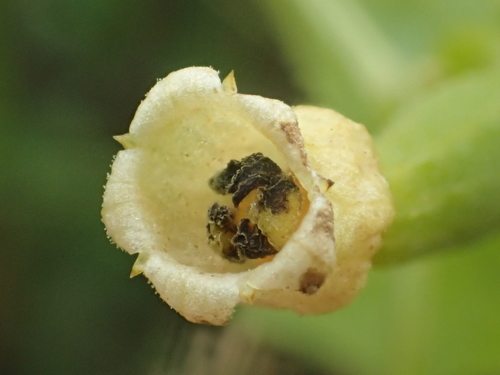
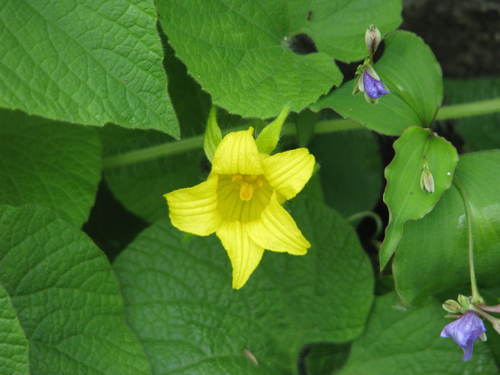
iNaturalist· cc-by
(c) Wynand Uys, some rights reserved (CC BY), uploaded by Wynand Uys
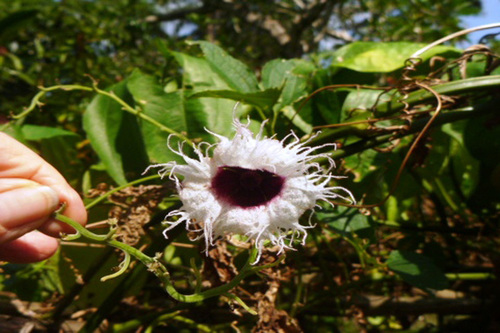
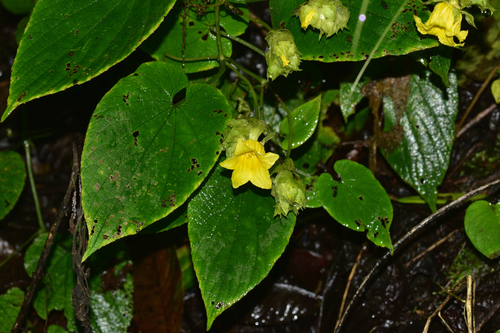
iNaturalist· cc-by
(c) Wynand Uys, some rights reserved (CC BY), uploaded by Wynand Uys
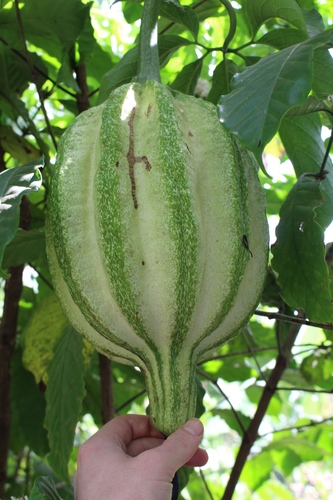
iNaturalist· cc-by-nc
(c) Peter Erb, some rights reserved (CC BY-NC), uploaded by Peter Erb
Summary
Source: WikipediaCoccinia sessilifolia is a species of Coccinia from southern Africa.
Description
A pumpkin family herb. It is a slender perennial climber. It has thick tuberous roots. It grows to 5 m long. The stems are branched and have grooves along them. The leaves are 5 lobed. They do no have a stalk. The edges of the leaves have teeth. The flowers are separately male and female. The male flowers occur in clusters while the female flowers occur singly. The fruit is oblong amd red amd 12 cm long. The seeds are oval and flattened.
Edible Uses
The tubers are eaten raw or cooked, boiled or roasted, though they may require processing to remove toxins. Unripe fruits are cooked as a vegetable, while ripe fruits are eaten raw. The leaves are used as a green vegetable. The roots are eaten in the Kalahari desert.
Traditional Uses
CAUTION: The tubers may be poisonous unless processed. The tubers are eaten raw or cooked. They can be boiled or roasted. The unripe fruit are eaten cooked, as a vegetable. Ripe fruit are eaten raw. The leaves are used as a green vegetable.
Known Hazards
The tubers may be poisonous unless processed.
Distribution
A tropical plant. It occurs on dry soils. It can grow between 315-1,800 m above sea level. It can grow in arid places.
Where It Grows
Africa, Botswana, Namibia, South Africa, Southern Africa,
Cultivation
Prefers a position in full sun or light shade in a well-drained soil. A dioecious species, both male and female forms need to be grown if fruit and seed are required.
Propagation
Seed - Cuttings
Production
The root tuber can weigh 25 kg.
Other Information
The roots are eaten in the Kalahari desert.
Nutrition
| Part | Moisture | kJ | kcal | Protein | Vit A | Vit C | Iron | Zinc |
|---|---|---|---|---|---|---|---|---|
| Fruit | 82.3 | 256 | 61 | 2.1 | — | 25 | 0.2 | — |
| Roots | 84 | 197 | 47 | 1 | — | 6.7 | 2.2 | — |
Synonyms
Also Known As
Bobbejaan ko kommer, Borobahlolo, Ekungu, Esita, Mogabala, Muyimbo, Wild karkoer
References (21)
- Arnold, T.H., Wells, M.J. & Wehmeyer, A.S., Khoisan food plants: taxa with potential for future economic exploitation, in Wickens, G.E., Goodin, J.R., and Field, D.V.,(Eds.) 1985, Plants for Arid Lands. Unwin Hyman, London, p 73
- A. L. P. P. de Candolle & A. C. de Candolle, Monogr. phan. 3:534. 1881
- Fox, F. W. & Young, M. E. N., 1982, Food from the Veld. Delta Books. p 169
- Grubben, G. J. H. and Denton, O. A. (eds), 2004, Plant Resources of Tropical Africa 2. Vegetables. PROTA, Wageningen, Netherlands. p 205
- Holstein, N., 2015, Monograph of Coccinia (Cucurbitaceae). PhytoKeys 54: 1–166
Show all 21 references Hide references
- INFOODS:FAO/INFOODS Databases
- Jardin, C., 1970, List of Foods Used In Africa, FAO Nutrition Information Document Series No 2.p 68
- Keith, M. E. & Renew, A., 1975, Notes on some edible wild plants found in the Kalahari. Koedoe 18:1-12
- Lee, 1979,
- Marshall, 1976,
- Martin, F.W. & Ruberte, R.M., 1979, Edible Leaves of the Tropics. Antillian College Press, Mayaguez, Puerto Rico. p 189
- Peters, C. R., O'Brien, E. M., and Drummond, R.B., 1992, Edible Wild plants of Sub-saharan Africa. Kew. p 99
- Plowes, N. J. & Taylor, F. W., 1997, The Processing of Indigenous Fruits and other Wildfoods of Southern Africa. in Smartt, L. & Haq. (Eds) Domestication, Production and Utilization of New Crops. ICUC p 188
- Royal Botanic Gardens, Kew (1999). Survey of Economic Plants for Arid and Semi-Arid Lands (SEPASAL) database. Published on the Internet; http://www.rbgkew.org.uk/ceb/sepasal/internet [Accessed 15th April 2011]
- Ruiters-Welcome, A. K., 2019, Food plants of southern Africa. Ph.D. thesis. Univ. of Johannesburg p 48
- Silberbauer, 1965, 1981,
- van Wyk, B., 2000, A Photographic Guide to Wild Flowers of South Africa. Struik Nature. p 39
- van Wyk, Be., & Gericke, N., 2007, People's plants. A Guide to Useful Plants of Southern Africa. Briza. p 82
- Wehmeyer, A. S, 1986, Edible Wild Plants of Southern Africa. Data on the Nutrient Contents of over 300 species
- Welcome, A. K. & Van Wyk, B.-E., 2019, An inventory and analysis of the food plants of southern Africa. South African Journal of Botany 122 (2019) 136–179
- World Checklist of Useful Plant Species 2020. Royal Botanic Gardens, Kew