Chimaphila umbellata
(L.) W. P. C. Barton
Spotted wintergreen, Prince's pine
iNaturalist· cc-by-nc
(c) Joanne Siderius, some rights reserved (CC BY-NC)
iNaturalist· cc-by-nc
(c) Eric Carignan, some rights reserved (CC BY-NC), uploaded by Eric Carignan
iNaturalist· cc-by-nc
(c) Veronique Tessier, some rights reserved (CC BY-NC)
Summary
Source: WikipediaChimaphila umbellata, the umbellate wintergreen, pipsissewa, or prince's pine, is a small perennial flowering plant found in dry woodlands, or sandy soils. It is native throughout the cool temperate Northern Hemisphere.
Description
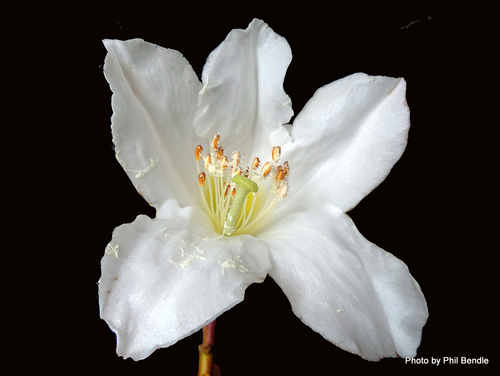
A shrub. It is evergreen. It often forms a mat. The underground stems or rhizomes are 1-2 mm across. They are long and creeping and branched. The aerial stems are erect or curve upwards. They are 5-15 cm long and 1-2.2 mm wide. They are angled. The leaves on the stem are in 2-6 groups of 4-9 leaves. The leaf stalk is 3-6 mm long. The leaf blade is pale green underneath. It is sword shaped and 1-5 cm long by 6-8 mm wide. It is thickly leathery. There are 2-7 flowers in a group 3-6 mm long. Often the flowers are nodding. The flowers are white. The fruit is a capsule 4-7 mm across. It splits open by 5 valves.
Edible Uses
The leaves of pipsissewa can be nibbled raw, brewed into a tea, or used as a flavouring in root beer. They have a notably delicious scent and flavour. An extract of the leaves is also used to flavour candy and soft drinks. In Mexico, the herb is used to prepare 'navaitai', an alcoholic beverage made from sprouted maize. A tea can additionally be made from an infusion of the stems and roots.
Traditional Uses
The leaves are used to make tea. They are also chewed. The leaves are used for root beer. An extract of the leaves is used to flavour candy and soft drinks.
Medicinal Uses
Pipsissewa was widely used by many Native North American tribes to induce sweating and treat fevers, including typhus. The plant contains hydroquinones with a pronounced disinfectant effect on the urinary tract, and modern herbalism primarily employs it to treat urinary problems such as cystitis and urethritis. The whole plant is alterative, antibacterial, astringent, diaphoretic, diuretic, rubefacient, stimulant, and tonic. Infusions treat various urinary conditions and more serious complaints such as kidney stones and gonorrhoea, while a decoction is considered very effective for skin diseases. Used externally, the fresh leaves are rubefacient; taken internally, they are valued for cardiac and kidney diseases, chronic rheumatism, and scrofula. Only the leaves are officially medicinal, though the whole plant is often used in practice. The plant contains the biologically active compounds arbutin, sitosterol, and ursolic acid. Arbutin hydrolyzes to hydroquinone, a toxic urinary antiseptic. Glycosides and an essential oil in the plant contribute to its astringent and tonic properties. The plant is harvested when in flower, though the leaves alone can be collected during the growing season and dried for later use. A homeopathic remedy made from the leaves is used to treat inflammations of the urinary system.
Known Hazards
Arbutin hydrolyzes to hydroquinone, a toxic urinary antiseptic.
Distribution
It is a temperate plant. It grows in dry pine and deciduous broad leafed forest at low altitudes in N China. It is best in light, well-drained soil. It needs a protected, shaded position. It is frost hardy. It suits hardiness zones 5-9.
Where It Grows
Asia, Australia, Canada, Central America, China, Dominican Republic, Denmark, Europe, France, Germany, Haiti, Japan, Manchuria, Mexico, North America, Russia, Siberia, USA, West Indies,
Cultivation
Plants can be grown by seed or by division.
Propagation
Seed is very difficult to germinate. It is best sown in a shady area of the greenhouse on moist sphagnum peat as soon as it is ripe. Prick seedlings out into individual pots when large enough to handle and grow on in a shady greenhouse position for at least their first winter. Plant out into permanent positions in late spring or early summer, after the last expected frosts. Division is rather difficult because the plant is very sensitive to root disturbance; it is best attempted in spring as growth begins. Softwood cuttings can be taken in June in a frame, using some soil taken from around an established plant.
Other Uses
The plant's stoloniferous root system and dwarf spreading habit make it a good ground cover, though it can be difficult to establish and grow well. It is also used in perfumery for its delicate scent.
Notes
There are 4 Chimaphila species. They are in Europe and North America. Also put in the family Pyrolaceae.
Synonyms
Also Known As
Encinilla, Pipsissewa
References (19)
- Beckstrom-Sternberg, Stephen M., and James A. Duke. "The Foodplant Database." http://probe.nalusda.gov:8300/cgi-bin/browse/foodplantdb.(ACEDB version 4.0 - data version July 1994)
- Bodkin, F., 1991, Encyclopedia Botanica. Cornstalk publishing, p 250
- Brown, D., 2002, The Royal Horticultural Society encyclopedia of Herbs and their uses. DK Books. p 166
- Cormack, R. G. H., 1967, Wild Flowers of Alberta. Commercial Printers Edmonton, Canada. p 231
- Cundall, P., (ed.), 2004, Gardening Australia: flora: the gardener's bible. ABC Books. p 371
Show all 19 references Hide references
- Facciola, S., 1998, Cornucopia 2: a Source Book of Edible Plants. Kampong Publications, p 189
- Flora of China Pyrolaceae
- Jackes, D. A., Edible Forest Gardens
- Kermath, B. M., et al, 2014, Food Plants in the Americas: A survey of the domesticated, cultivated and wild plants used for Human food in North, Central and South America and the Caribbean. On line draft. p 219
- Kiple, K.F. & Ornelas, K.C., (eds), 2000, The Cambridge World History of Food. CUP p 1835
- MacKinnon, A., et al, 2009, Edible & Medicinal Plants of Canada. Lone Pine. p 133
- Plants for a Future database, The Field, Penpol, Lostwithiel, Cornwall, PL22 0NG, UK. http://www.scs.leeds.ac.uk/pfaf/
- Plants of Haiti Smithsonian Institute http://botany.si.edu/antilles/West Indies (ssp. domingensis)
- Porsild, A.E., 1974, Rocky Mountain Wild Flowers. Natural History Series No. 2 National Museums of Canada. p 296
- Scotter, G. W., & Flygare, H., 1993, Wildflowers of the Canadian Rockies. Hurtig. p 112
- Seidemann J., 2005, World Spice Plants. Economic Usage, Botany, Taxonomy. Springer. p 97
- Veg. mater. med. U.S. 1:17. 1817
- Wiersema, J. H. & Leon, B., 2013, World Economic Plants. A Standard Reference CRC Press. 2nd Ed. p 169
- World Checklist of Useful Plant Species 2020. Royal Botanic Gardens, Kew