Vaccinium membranaceum
Douglas ex Torr.
Blue huckleberry
iNaturalist· cc-by-nc
(c) Roanan DeMeyer, some rights reserved (CC BY-NC), uploaded by Roanan DeMeyer
iNaturalist· cc-by-nc
(c) Lindy Lin, some rights reserved (CC BY-NC), uploaded by Lindy Lin
iNaturalist· cc-by-nc
(c) Emily Scherer, some rights reserved (CC BY-NC), uploaded by Emily Scherer
Summary
Source: WikipediaVaccinium membranaceum is a species of flowering plant in the heath family Ericaceae, known by the common names thinleaf huckleberry, tall huckleberry, big huckleberry, mountain huckleberry, square-twig blueberry, and ambiguously as "black huckleberry".
Description
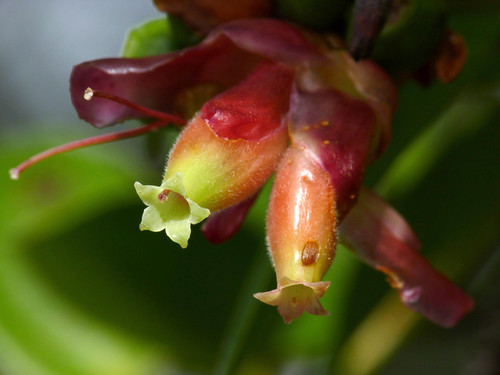
An erect shrub. It grows 1 m or more high. The leaves are alternate and simple. They are thin and sword shaped. They are 5 cm long. There are fine teeth along the edge. The leaves turn red in the autumn. The flowers are pinkish white or yellowish-green. They are small and occur singly on short stalks. The flowers are bell shaped. The fruit are large blue berries. They are juicy and sweet. They are 5 mm across. They are edible.
Edible Uses
The fruit can be eaten raw or cooked and is described as sweet but rather acid, or sour but delicious depending on the source. It is a reasonable source of vitamin C and is considered among the largest and best-flavoured of all wild blueberries. Native North Americans commonly dried the fruit for winter use.
Traditional Uses
The fruit are eaten raw. They are also used for pies, dried or in preserves. The fruit can be dried and stored.
This uses section is brief — help expand it
Medicinal Uses
The plant is antiseptic, astringent, carminative, and hypoglycaemic. An infusion made from the roots and stems has been used to treat heart troubles, arthritis, and rheumatism.
Distribution
It is a cold temperate plant. It grows near the timberline in the Rocky Mountains. It suits cold, upland places. It can tolerate temperatures down to -40°C. It normally needs moist conditions. It can tolerate drought. It benefits from an acidic organic mulch. It is not tolerant to wind. It does best with a pH of 4.5-6.
Where It Grows
Alaska, Canada, North America*, USA,
Cultivation
Requires a moist but freely-draining lime free soil, preferring one that is rich in peat or a light loamy soil with added leaf-mould. Prefers a very acid soil with a pH in the range of 4.5 to 6, plants soon become chlorotic when lime is present. Succeeds in full sun or light shade though it fruits better in a sunny position. Requires shelter from strong winds. Established plants are extremely drought resistant. Plants are very hardy, tolerating temperatures down to about -40°c in N. America. Dislikes root disturbance, plants are best grown in pots until being planted out in their permanent positions. Plants in this genus are notably resistant to honey fungus.
Propagation
Sow seed in late winter in a greenhouse using a lime-free potting mix, barely covering the seed. Stored seed may need up to 3 months of cold stratification. Alternatively, sow fresh seed in a greenhouse as soon as it is ripe. Prick seedlings out into individual pots once they reach about 5cm tall and grow on in a lightly shaded position in the greenhouse for at least their first winter. Plant out in late spring or early summer after the last expected frosts. Half-ripe cuttings, 5–8cm with a heel, can be taken in August and rooted in a frame, though this is slow and difficult. Layering can be done in late summer or early autumn, or in spring according to some sources, and takes 18 months. Suckers can be divided in spring or early autumn.
Other Uses
None known
Other Information
The fruit are popular.
Dangerous Lookalikes
This plant can be confused with the following toxic species. Always verify identification carefully before consuming any wild plant.
Deadly Nightshade
Atropa belladonna
Joan Simon from Barcelona, España
Blue huckleberry
Vaccinium membranaceum
(c) Roanan DeMeyer, some rights reserved (CC BY-NC), uploaded by Roanan DeMeyer
Deadly Nightshade: Tall herbaceous plant (1-2m), single shiny black cherry-sized berries, star-shaped calyx, large oval leaves, sweet but dangerous taste.
Blue huckleberry: Low woody shrub, berries in clusters with crown/remnant calyx ring, sweet taste.
Nutrition
| Part | Moisture | kJ | kcal | Protein | Vit A | Vit C | Iron | Zinc |
|---|---|---|---|---|---|---|---|---|
| Fruit | 86 | 247 | 59 | 0.6 | — | 6.6 | 0.2 | 0.1 |
Synonyms
Also Known As
Big whortleberry, Black mountain huckleberry, Globe huckleberry, Mountain bilberry, Mountain huckleberry, Tall huckleberry, Thin leafed blueberry, Tokabonoma, Tokaponoma, Twin-leafed huckleberry, Velvet-leaf huckleberry
References (23)
- Beckstrom-Sternberg, Stephen M., and James A. Duke. "The Foodplant Database." http://probe.nalusda.gov:8300/cgi-bin/browse/foodplantdb.(ACEDB version 4.0 - data version July 1994)
- Cormack, R. G. H., 1967, Wild Flowers of Alberta. Commercial Printers Edmonton, Canada. p 251
- Couture, M. D., 1978, Recent and Contemporary Foraging Practices of the Harney Valley Paiute. Thesis, Portland State University
- Coutre, M. D., et al, 1986, Foraging Behaviour of a Contemporary Northern Great Basin Population. Journal of California and Great Basin Anthropology Vol. 8(2) pp 150-160
- Facciola, S., 1998, Cornucopia 2: a Source Book of Edible Plants. Kampong Publications, p 97 (Also as Vaccinium globulare)
Show all 23 references Hide references
- Glowinski, L., 1999, The Complete Book of Fruit Growing in Australia. Lothian. p 158
- Heller, C. A., 1962, Wild Edible and Poisonous Plants of Alaska. Univ. of Alaska Extension Service. p 51
- http://en.hortipedia.com
- Kermath, B. M., et al, 2014, Food Plants in the Americas: A survey of the domesticated, cultivated and wild plants used for Human food in North, Central and South America and the Caribbean. On line draft. p 894
- Kuhnlein, H. V. & Turner, N. J., 1991, Traditional Plant Foods of Canadian Indigebous Peoples. Nutrition, Botany and Use. Gordon and Breach Publishers.
- Kuhnlein, H. V., et al, 2009, Indigenous Peoples' food systems. FAO Rome p 33, 53
- Lyle, S., 2006, Discovering fruit and nuts. Land Links. p 223
- MacKinnon, A., et al, 2009, Edible & Medicinal Plants of Canada. Lone Pine. p 113
- Moerman, D. F., 2010, Native American Ethnobotany. Timber Press. p 583
- Plants for a Future database, The Field, Penpol, Lostwithiel, Cornwall, PL22 0NG, UK. http://www.scs.leeds.ac.uk/pfaf/
- Porsild, A.E., 1974, Rocky Mountain Wild Flowers. Natural History Series No. 2 National Museums of Canada. p 320
- Reis, S. V. and Lipp, F. L., 1982, New Plant Sources for Drugs and Foods from the New York Botanical Garden herbarium. Harvard. p 229 (As Vaccinium globulare)
- Stubbs, R. D., 1966, An investigation of the Edible and Medicinal Plants used by the Flathead Indians. MA thesis University of Montana. p 41
- Trehane, J., 2004, Blueberries, Cranberries and Other Vacciniums. Timber Press. p 183, 231
- Turner, N., 1995, Food Plants of Coastal First Peoples. Royal BC Museum Handbook p 82
- Turner, N., 1997, Food Plants of Interior First Peoples. Royal BC Museum Handbook p 117
- Turner, N., et al, 2011, "Up on the Mountain": Ethnobotanical Important of Montane Sites in Pacific Coastal North America. Journal of Ethnobiology 31(1): 4-43
- C. Wilkes, U.S. Expl. Exped. 17:377. 1874 (W. J. Hooker, Fl. bor.-amer. 2:32. 1834, pro syn.)