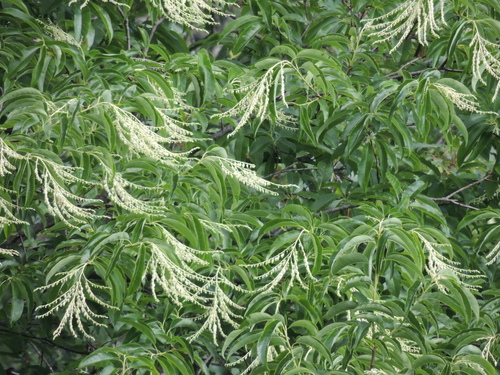
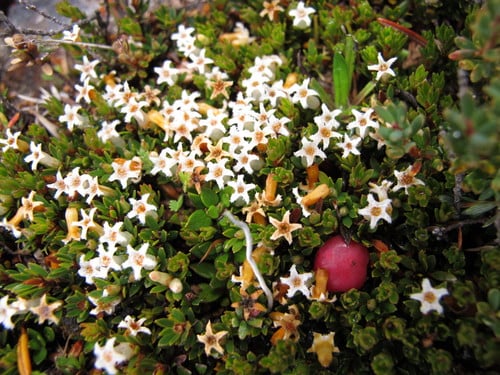
Vaccinium microcarpum
(Turcz. ex Rupr.) Schmalh.
Small cranberry, Dwarf cranberry
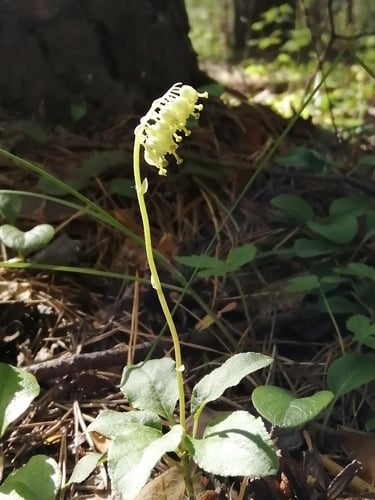
iNaturalist· cc-by-nc
(c) François-Xavier Taxil, some rights reserved (CC BY-NC), uploaded by François-Xavier Taxil
iNaturalist· cc-by-nc
(c) abk_paleo, some rights reserved (CC BY-NC)
iNaturalist· cc-by-nc
(c) Matthieu Gauvain, some rights reserved (CC BY-NC), uploaded by Matthieu Gauvain
Summary
Source: WikipediaVaccinium microcarpum is a species of flowering plant belonging to the family Ericaceae. Its native range is subarctic to Temperate Northern Hemisphere.
Description
An evergreen shrub. It has thin creeping stems. It has slightly longer flower stalks than small cranberry (Vaccinium oxycoccus). The leaves are smaller and the fruit elongated. The leaves are very small and leathery. The edges roll under. The leaves are 3-7.5 mm long by 1-2.5 mm wide. They are dark green above and have a bluish bloom underneath. The flowers occur as 1-4 on the end of the stem. They are small and pink to red. The fruit are dark red berries. They are about 1 cm across. They are edible.
Edible Uses
The fruit are picked and eaten.
Traditional Uses
The fruit are picked and eaten.
This uses section is brief — help expand it
Distribution
It is a cold temperate plant. It grows in sphagnum bogs. It grows in alpine sphagnum bogs in the Rocky Mountains. Subarctic, alpine.
Where It Grows
Alaska, Asia, Britain, Canada, China, Europe, Iceland, Japan, Korea, Mongolia, North America, Russia, Scotland, Siberia,
Dangerous Lookalikes
This plant can be confused with the following toxic species. Always verify identification carefully before consuming any wild plant.
Deadly Nightshade
Atropa belladonna
Joan Simon from Barcelona, España
Small cranberry
Vaccinium microcarpum
(c) François-Xavier Taxil, some rights reserved (CC BY-NC), uploaded by François-Xavier Taxil
Deadly Nightshade: Tall herbaceous plant (1-2m), single shiny black cherry-sized berries, star-shaped calyx, large oval leaves, sweet but dangerous taste.
Small cranberry: Low woody shrub, berries in clusters with crown/remnant calyx ring, sweet taste.
Synonyms
Also Known As
Bog cranberry, Timagliq
References (11)
- Ager, T. A. & Ager, L. P., 1980, Ethnobotany of the eskimos of Nelson Island, Alaska. Arctic Anthropology Vol 17. No. 1 pp 26-48 (As Oxycoccus microcarpus)
- Dzhangaliev, A. D., et al, 2003, The Wild Fruit and Nut Plants of Kazakhstan, Horticultural Reviews, Vol. 29. pp 305-371
- Hist. stirp. fl. petrop. 56. 1845 (As Oxycoccus microcarpus)
- https://en.wikipedia.org/wiki/List of wild edible plants in Mongolian cuisine (As Oxycoccus microcarpus)
- Jones, A., 2010, Plants that we eat. University of Alaska Press. p 129 (As Oxycoccus microcarpus)
Show all 11 references Hide references
- John, L., & Stevenson, V., 1979, The Complete Book of Fruit. Angus & Robertson p 119
- Porsild, A.E., 1974, Rocky Mountain Wild Flowers. Natural History Series No. 2 National Museums of Canada. p 310 (As Oxycoccus microcarpus)
- Reis, S. V. and Lipp, F. L., 1982, New Plant Sources for Drugs and Foods from the New York Botanical Garden herbarium. Harvard. p 229
- Trudy S.-Peterburgsk. Obshch. Estestvoisp. 2:149. 1871
- Urgamal, M., Oyuntsetseg, B., Nyambayar, D. & Dulamsuren, Ch. 2014. Conspectus of the vascular plants of Mongolia. (Editors: Sanchir, Ch. & Jamsran, Ts.). Ulaanbaatar, Mongolia. “Admon“ Press. 334pp. (p. 79-90).
- Whitney, C. W., et al, 2012, A Survey of Wild Collection and Cultivation of Indigenous Species in Iceland. Human Ecology 40:781-787 (As Oxycoccus microcarpus)