Hevea rigidifolia
(Spruce ex Benth.) Mull.Arg.
gbif· cc-by-nc
D. M. Le : Field Museum of Natural History - Botany Department | GDI 2013-2015
gbif· cc-by-nc
Field Museum of Natural History - Botany Department | GDI 2013-2015
gbif· cc-by-nc
Rapid Reference Collection (RRC) | Field Museum of Natural History - Keller Science Action Center
Summary
Source: WikipediaHevea rigidifolia is a species of rubber tree in the genus Hevea, belonging to the family Euphorbiaceae. It is native to the rainforests of northern Brazil and Colombia, where it is endemic to localities near the upper Rio Negro, a north bank tributary of the Amazon River, and its tributary, the Vaupés River.
Description
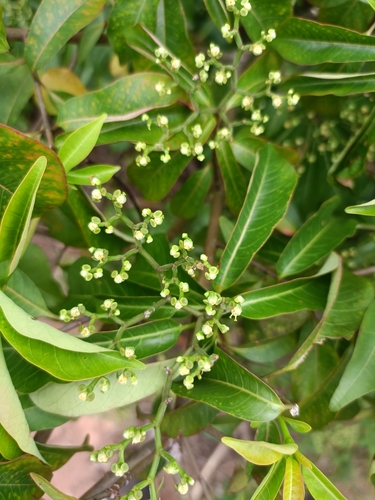
An evergreen tropical tree with a sparse crown that grows 18 m tall. It is native to areas with low rainfall (250-1,000 mm annually) and prefers well-drained sandy soils.
Edible Uses
The seeds are cooked and eaten, and in some places are an important food source, while in others they are only eaten during famines.
Traditional Uses
The seeds are cooked and eaten. Caution: The seeds contain cyanide and and are poisonous unless well cooked.
This uses section is brief — help expand it
Known Hazards
The seeds contain cyanide and are poisonous unless well cooked.
Distribution
It is a tropical plant. It is best in a well-drained sandy soil. It grows in areas that may not have rain for 6-11 months. The average rainfall is 250-1,000 mm and the average temperature is 24-26°C.
Where It Grows
Amazon, Brazil, Colombia, South America,
Cultivation
Plants are grown from seeds.
Other Uses
A latex is obtained from the tree. The latex, which usually has a slightly cream-yellow hue, is poor in rubber and high in resin.
Other Information
In some places the seeds are an important food and in others only a famine food.
Synonyms
References (4)
- Fern, K., 2012, Tropical Species Database http://theferns.info/tropical/
- Journal of the Arnold Arboretum Vol 37. 1956, http://www.bioversitylibrary.org
- Kew Plants of the World On line
- Roa, J. A. G. & Boada, D. S. G., 2018, Fundación para el Fortalecimiento de la Fruticultura y Plantas Alimenticias no Convencionales en Colombia.