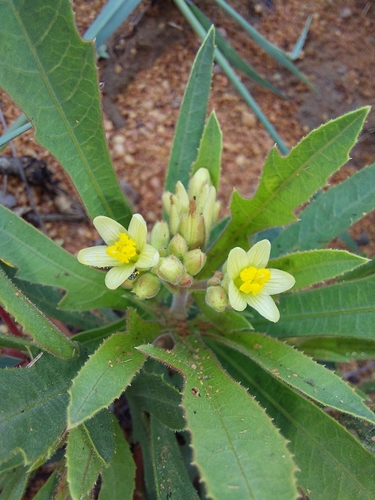
Euphorbia peplus
L.
Petty spurge
iNaturalist· cc-by-nc
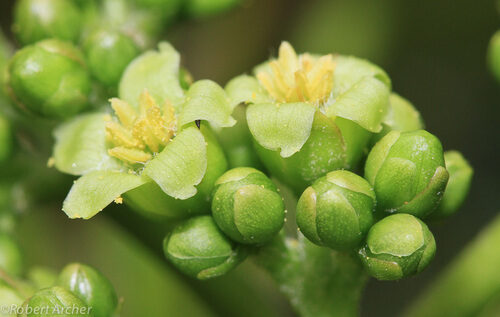
(c) Sergey Mayorov, some rights reserved (CC BY-NC), uploaded by Sergey Mayorov
iNaturalist· cc-by-nc
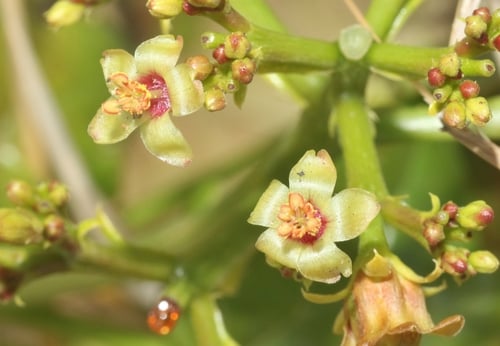
(c) Ron Vanderhoff, some rights reserved (CC BY-NC)
Summary
Source: WikipediaEuphorbia peplus (petty spurge, radium weed, cancer weed, or milkweed), is a species of Euphorbia, native to most of Europe, northern Africa and western Asia, where it typically grows in cultivated arable land, gardens and other disturbed land. Outside of its native range it is very widely naturalised and often invasive, including in Australia, New Zealand, North America and other countries in temperate and sub-tropical regions.
Description
A fleshy annual herb. It grows to 30 cm tall. It often has 2 branches from the base. It has milky sap. The leaves on the stem are alternate. The leaf blades are 1-2 cm long and up to 1 cm wide. It has a glabrous (hairless) stem. The leaves are oval-acute with an entire (smooth) margin.
Edible Uses
do not eat. Burning in mouth and on lips, can cause temporary or permanent blindness if sap comes in contact with eyes. Stomach reactions, vomiting, nausea, and faint feeling. (most of this is personal experience)
Medicinal Uses
The plant's sap is toxic to rapidly replicating human tissue, and has long been used as a traditional remedy for common skin lesions. The active ingredient in the sap is a diterpene ester called ingenol mebutate. A pharmaceutical-grade ingenol mebutate gel has approval from the US Food and Drug Administration for treatment of actinic keratosis. In Germany, recent studies have linked Euphorbia peplus with the virtual elimination of squamous cell skin cancer.
Known Hazards
The latex causes irritation of the skin, eyes and mucous membranes. Due to the toxicity of the latex, it is advised to use the plant topically only. Lactating goats, which fed on the aerial parts of this plant mixed with their usual green fodder, showed symptoms of general poisoning. The main toxic effects were seen in the heart, lung and liver. The milk of these goats, when consumed by their offspring, caused poisoning and even death, with signs similar to those observed in the adults. The toxicity is caused by ingenane type diterpenes.
Distribution
It is a temperate plant. In Pakistan it grows up to 2,600 m altitude. In Yunnan.
Where It Grows
Africa, Asia, Australia, China, Dominican Republic, East Africa, Easter Island, Europe, Falklands, Haiti, Hawaii, Iran, Luxembourg, Middle East, North Africa, North America, Pacific, Poland, Sao Tome and Principe, St Helena, Taiwan, Tasmania, West Indies, Zimbabwe, and New Zealand.
Cultivation
Prefers a position with some shade. In Australia Euphorbia peplus is grown in small plots for latex production. As the plants can be easily killed by herbicides, and because they do not spread beyond shade, the risk that they will become an invasive weed is small. The plant is classified as 'Invasive' in several countries however, including New Zealand and a number of Pacific Islands. If enough water is available throughout the year, Euphorbia peplus grows and produces seeds all year round and can be harvested for latex or seed whenever the need arises. The plant develops rapidly as it matures in 12 - 14 weeks. In Australia the fresh plant yield of Euphorbia peplus is 1 - 1.5 kg/m2, and latex yield is 100 - 300 mg/kg freshly harvested plant parts.
Propagation
Seed - very small (about 1,700 seeds per g) they have a germination rate of more than 70%.
Other Information
It is a famine food.
References (6)
- Łukasz Łuczaj and Wojciech M Szymański, 2007, Wild vascular plants gathered for consumption in the Polish countryside: a review. J Ethnobiol Ethnomedicine. 2007; 3: 17
- Plants of Haiti Smithsonian Institute http://botany.si.edu/antilles/West Indies
- Tasmanian Herbarium Vascular Plants list p 27
- Upson, R., & Lewis R., 2014, Updated Vascular Plant Checklist and Atlas for the Falkland Islands. Falklands Conservation and Kew.
- Zizka, G., 1991, Flowering Plants of Easter Island. Palmarum Hortus Francofurtensis
Show all 6 references Hide references
- en.wikipedia.org