Diospyros celebica
Bakh.
Makassar ebony
iNaturalist· cc-by-nc
(c) Almira Haris, some rights reserved (CC BY-NC)
iNaturalist· cc-by-nc
(c) Almira Haris, some rights reserved (CC BY-NC)
iNaturalist· cc-by-nc
(c) Alpian Maleso, some rights reserved (CC BY-NC)
Summary
Source: WikipediaDiospyros celebica (commonly known as black ebony or Makassar ebony) is a species of flowering tree in the family Ebenaceae that is endemic to the island of Sulawesi in Indonesia. The common name Makassar ebony originates from the main seaport on the island, Makassar.
Description
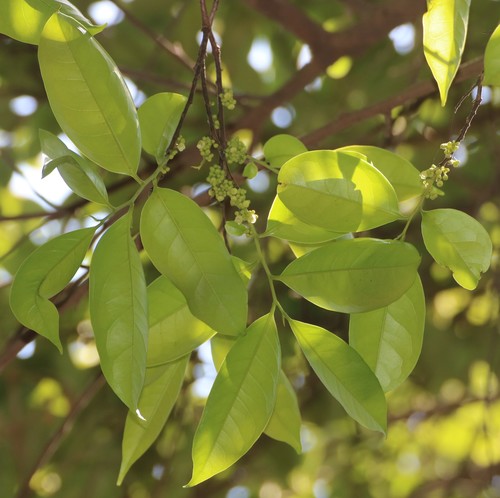
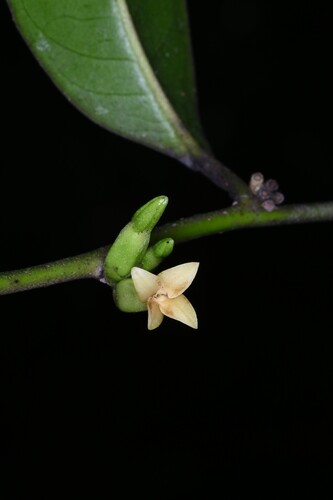
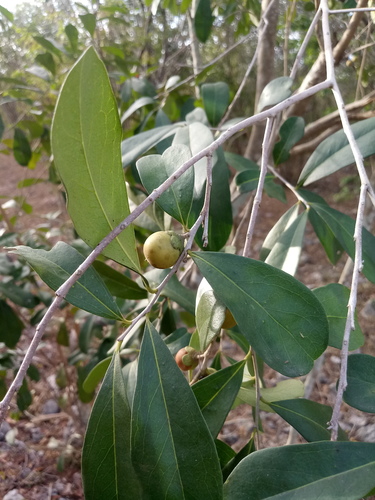
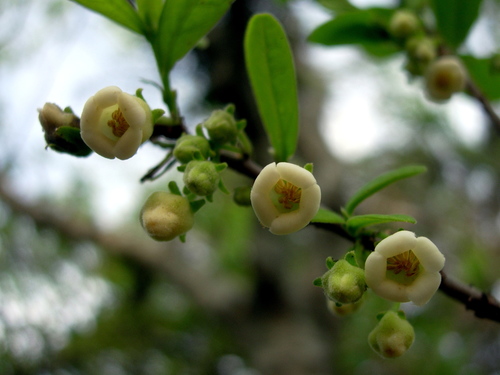
A tree. It grows 20-40 m tall. The trunk is straight and unbranched for 10-26 m. It is 1.5 m across. It can have buttresses 4 m tall. Old bark is scaly and black. The leaves are simple and alternate. They are narrowly oval. They are 12-35 cm long by 3-7 cm wide. The tips are pointed. The flowers are small and white. There are 5-19 flowers in a group. The fruit is oval and 4-5 cm long by 3 cm wide. The ripe fruit are and a dark yellowish green with brown spots. Each fruit contains 3-11 seeds. The seeds are narrowly oval and bark brown.
Edible Uses
The fruit is edible.
Medicinal Uses
None known
Distribution
It is a tropical plant. It grows in central and northern Sulawesi. It grows in rainforest and monsoon forest. It grows from sea level to 540 m above sea level. It grows in the humid lowlands. It grows in regions where the annual average temperature is 22°-28°C and the average annual rainfall is 2,000-2,500 mm. It is damaged by waterlogging.
Where It Grows
Asia, Indonesia, SE Asia,
Cultivation
A plant of the humid lowlands, where it is found at elevations up to 540 metres. It grows best in areas where the mean annual temperature is between 22 - 28°c and the mean annual rainfall is 2,000 - 2,500mm. Succeeds on various soil types - calcareous, clay and shallow stony soils. It prefers relatively nutrient rich soil and is sensitive to water-logging. The tree can commence flowering and fruiting when 5 - 7 years old from seed. We have seen no individual confirmation for this species, but in general Diospyros species are dioecious and require both male and female forms to be grown if fruit and seed are required.
Propagation
Seed has very short viability and should be sown as soon as possible after collection. Remove the flesh before sowing, as it contains germination inhibitors. Sow in a shady nursery seedbed using a mix of soil and fine sand at a 3:1 ratio. Plant seeds horizontally or vertically with the radicle end pointing down, at a depth of 1–1.5 times the seed's thickness, spacing them 3–5cm apart. Seeds are very sensitive to drying out during germination and early growth, so water regularly. Germination normally occurs within one week. In one trial, fresh seed sown one day after collection achieved an 85% germination rate within 17–65 days. Fresh seeds generally have high fertility rates. Seedlings develop long taproots early, often before any significant shoot elongation occurs. Overall growth is decidedly slow.
Other Uses
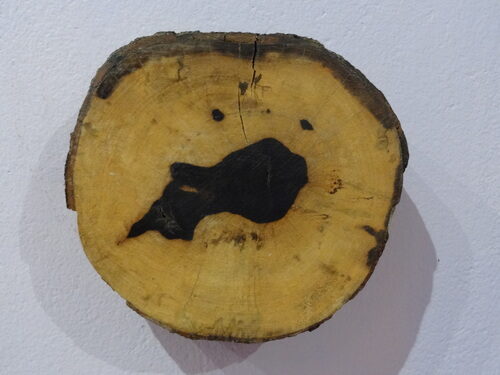
The wood of this ebony species is black with brown lines, naturally shiny, and very hard with a fine, smooth texture and generally straight grain. It is prized for its high decorative and commercial value and used for wood carving, furniture, house utensils, interior accessories, and building materials. No species-specific detail beyond this is available, though all Diospyros woods share essentially identical structural characteristics across the genus. Whether heartwood develops depends largely on tree size and other conditions, with wide variation in the ratio of sapwood to heartwood even within the same species. When present, the heartwood can be black with rosy, yellowish, brownish, or ashy streaks, sometimes nearly or totally black, and is generally sharply demarcated from the thin to very wide band of whitish, yellowish, or red sapwood. The texture is fine, smooth, and very dense, especially in the heartwood; the grain is generally very straight. The wood is hard to very hard and heavy to very heavy; the sapwood is tough and flexible while the heartwood is brittle. The heartwood is very durable and the sapwood moderately so. Seasoning is difficult — logs almost invariably check from the heart outward, and sawn lumber must be stacked carefully and weighted to prevent warping. Once thoroughly dried, however, it becomes very stable. Its density makes it hard to work, but it takes a beautiful finish under sharp tools. Small trees with little or no heartwood are used locally for posts, beams, joists, rafters, window sills, and parts of agricultural implements; small poles are also used as skids in lumbering for their hardness, toughness, and smooth wear. The heartwood is used for scabbards, canes, hilts, tool handles, gunstocks, saw frames, musical instruments (especially guitar fingerboards and keys), furniture, cabinetwork, inlaying, paperweights, inkstands, and similar desk items. The tough sapwood is excellent for T-squares and drawing instruments, shuttles, bobbins, spindles, golf-club heads and shafts, and axe, pick, and hammer handles.
Production
Trees can flower and fruit when 5-7 years old. In Sulawesi flowering is March to May and fruiting September to November. It takes about 6 months from flowering to fruit.
Other Information
The fruit is occasionally used.
Synonyms
Also Known As
Pohon eben kayu hitam, Pohon eben sulawesi
References (2)
- Fern, K., 2012, Tropical Species Database http://theferns.info/tropical/
- Sukarya, D. G., (Ed.) 2013, 3,500 Plant Species of the Botanic Gardens of Indonesia. LIPI p 236