Diospyros villosa
(L.) De Winter
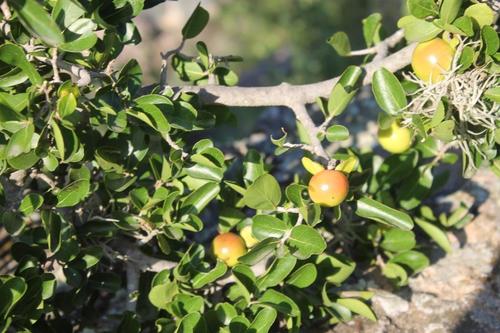
iNaturalist· cc-by-nc
(c) Gail Bowers-Winters, some rights reserved (CC BY-NC), uploaded by Gail Bowers-Winters
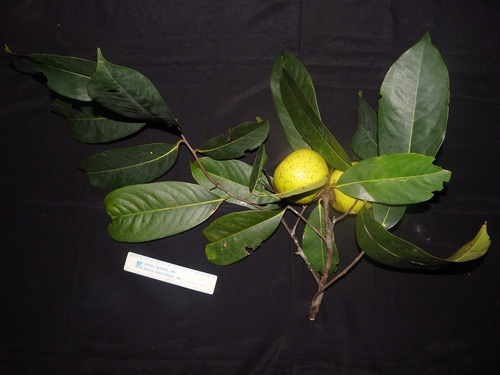
iNaturalist· cc-by-nc
(c) Craig Peter, some rights reserved (CC BY-NC), uploaded by Craig Peter
iNaturalist· cc-by-nc
(c) Adriaan Grobler, some rights reserved (CC BY-NC), uploaded by Adriaan Grobler
Description
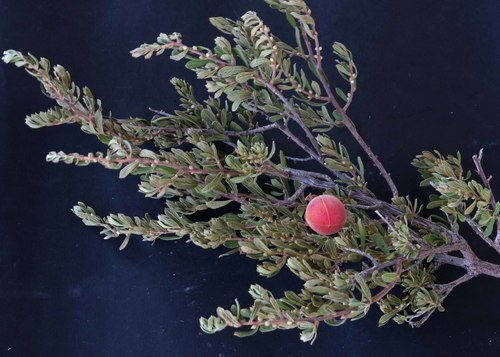
A shrub. It can be erect or lie along the ground. It grows 1-4 m high. It can be taller. The leaves are alternate. The leaves are papery and more pale underneath. The leaves are 7-13 cm long by 3-6 cm wide. The are rounded at both ends. There are about 5 pairs of side veins. The flowers are yellow. Male flowers can be in groups of 2-3. The female flowers are slightly smaller than the male flowers. The fruit are a flattened oval shape and 3 cm long by about 4 cm wide. They are hairy. There are 3-8 seeds that are 1.5 cm long and dull brown.
Edible Uses
The fruit is eaten, though it is not considered an attractive fruit.
Traditional Uses
It is eaten but is not an attractive fruit.
This uses section is brief — help expand it
Medicinal Uses
The root is used for medicine and as a chew stick.
Distribution
It is a subtropical plant. It grows in dry soils. It grows between sea level to 300 m above sea level. It can grow in arid places.
Where It Grows
Africa, East Africa, Mozambique, South Africa, Southern Africa,
Notes
The root is used for medicine and as a chew stick.
Synonyms
Also Known As
Nhachibabane, Nhaurratane
References (4)
- Royal Botanic Gardens, Kew (1999). Survey of Economic Plants for Arid and Semi-Arid Lands (SEPASAL) database. Published on the Internet; http://www.rbgkew.org.uk/ceb/sepasal/internet [Accessed 16th April 2011]
- Ruiters-Welcome, A. K., 2019, Food plants of southern Africa. Ph.D. thesis. Univ. of Johannesburg p 53
- Welcome, A. K. & Van Wyk, B.-E., 2019, An inventory and analysis of the food plants of southern Africa. South African Journal of Botany 122 (2019) 136–179
- World Checklist of Useful Plant Species 2020. Royal Botanic Gardens, Kew