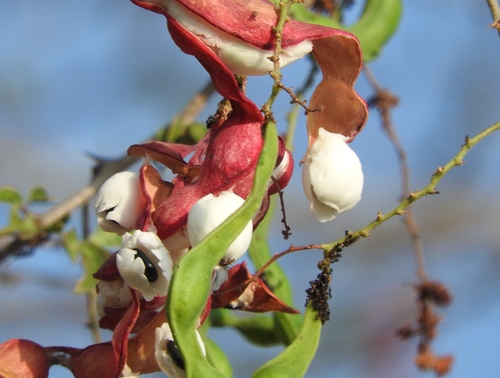
Chidlowia sanguinea
Hoyle
iNaturalist· cc-by-nc
(c) Carel Jongkind, some rights reserved (CC BY-NC), uploaded by Carel Jongkind
Description
A tree. It grows up to 25 m tall. The trunk is often twisted and crooked. It can be 80 cm across. It can have steep buttresses.
This description is brief — help expand it
Edible Uses
The seeds are eaten.
Medicinal Uses
The leaves contain the alkaloid chidlowine - this has been shown to have hypotensive and antienaemic properties.
Distribution
It is a tropical plant. It grows in evergreen and semi-deciduous forest.
Where It Grows
Africa, Côte d'Ivoire, Ivory Coast, Liberia, Sierra Leone, West Africa,
Cultivation
The boles of large trees are often hollow, which diminishes the commercial value and may cause danger during felling. This species has a symbiotic relationship with certain soil bacteria, these bacteria form nodules on the roots and fix atmospheric nitrogen. Some of this nitrogen is utilized by the growing plant but some can also be used by other plants growing nearby.
Other Uses
The heartwood is dark greenish grey with a bronze tinge to dark brown; it is distinctly demarcated from the narrow band of yellowish white to pale greyish brown sapwood. The grain is interlocked; texture moderately fine and even; radial surfaces show a ribbon figure. The wood is moderately heavy and hard. It is difficult to saw due to its hardness and the presence of interlocked grain; it is liable to splitting upon nailing. The wood is used locally for joinery, stakes and rifle butts. It is suitable for heavy construction and probably occasionally used in building local houses, and is also suitable for sliced veneer.
Notes
Also as Caesalpinaceae.
References (3)
- Fern, K., 2012, Tropical Species Database http://theferns.info/tropical/
- Hawthorne, W.& Marshall, C., 2013, Nimba Western Area Iron Ore Concentrator Mining Project Environmental and Social Impact Assessment. AcelorMittel Liberia. p 467
- World Checklist of Useful Plant Species 2020. Royal Botanic Gardens, Kew