Senegalia senegal
(L.) Britton
Sudan Gum Arabic
Wikipedia· cc-by-sa
Wikimedia Commons - Acacia_senegal_-_Köhler–s_Medizinal-Pflanzen-004.jpg
iNaturalist· cc-by-nc
(c) Radha Veach, some rights reserved (CC BY-NC)
iNaturalist· cc-by-nc
(c) Radha Veach, some rights reserved (CC BY-NC)
Summary
Source: WikipediaSenegalia senegal (also known as Acacia senegal) is a small thorny deciduous tree from the genus Senegalia, which is known by several common names, including gum acacia, gum arabic tree, Sudan gum and Sudan gum arabic. In parts of India, it is known as kher, khor, or kumatiya. It is native to semi-desert regions of Sub-Saharan Africa, as well as Oman, Pakistan, and west coastal India. It grows to a height of 5–12 metres (16-40'), with a trunk up to 30 cm (1') in diameter. Sudan is the source of the world's highest quality gum arabic, known locally as hashab gum in contrast to the related, but inferior, gum arabic from red acacia, known as talah gum.
Description
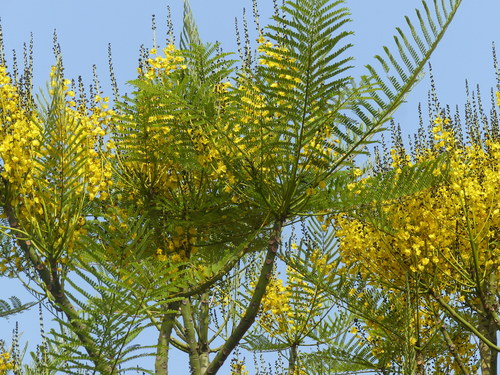
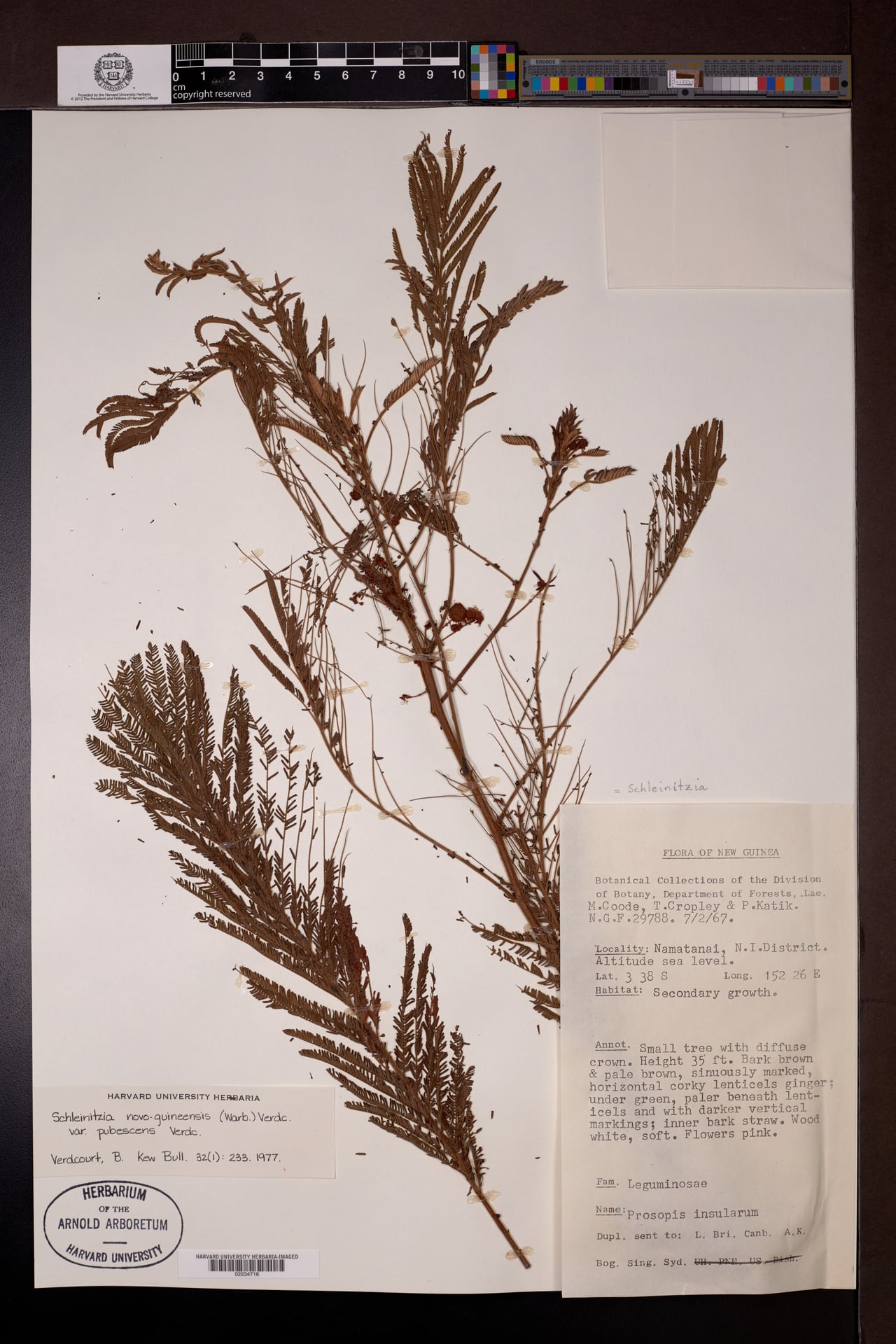
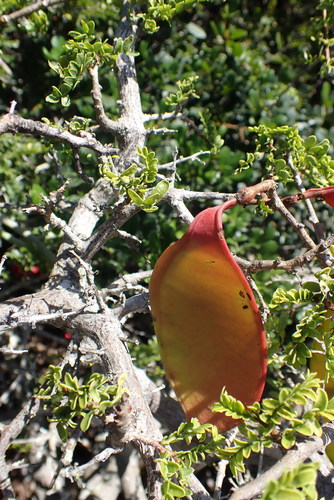
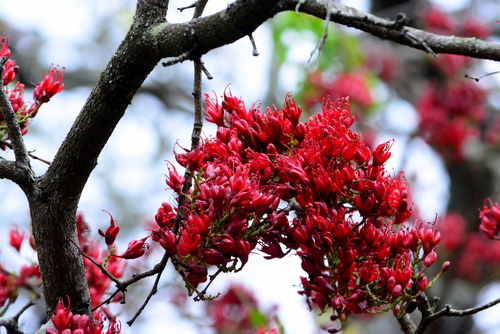
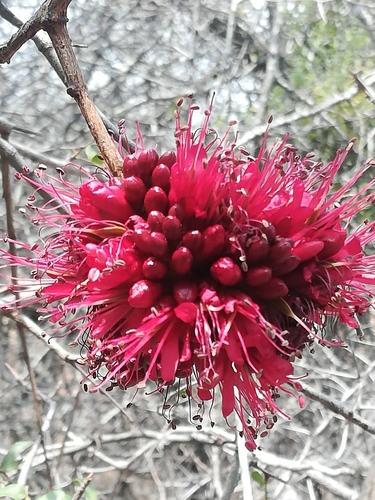
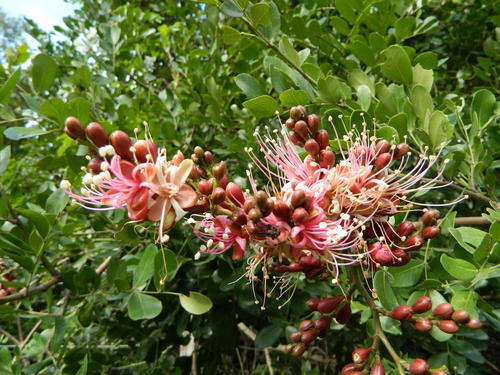
An evergreen shrub. It grows to 3-12 m high and 3 m across. The stem is erect. It is spiny and densely branched. The bark is waxy and smooth but then peels in yellow strips of a red base. The thorns are in threes. The central one is hooked and the two sides ones curve up and are brown to black. The leaves (phyllodes) occur one after the other along the branch and they are divided twice. The stalk is 7 cm long and it carries 3-6 pairs of side main leaflets. The flowers are yellow balls or spikes. They occur in stalked clusters in the angles where leaves join. The have a sweet smell. The pods are 10 cm long and 3 cm wide. They are thin and flat. They are yellow to light brown and papery. The veins are clear. They have few seeds.
Edible Uses
The gum obtained from the trunk is important in the food industry as an emulsifier, stabilizer, and flavour fixative. It is also used as an additive (E414) to retard sugar crystallization, and appears particularly in chewing gum and confectionery. The gum is harvested after the rainy season by scraping it from the trunk and branches where it naturally oozes; unhealthy trees tend to yield more, and incisions are sometimes made in the bark to increase production. The dried seed is also edible and cooked as a protein source. It is the main component of panchkut, a delicacy from Jodhpur, India, which also includes fruits of Capparis decidua, Cucumis sativa, and Prosopis cinerearia.
Traditional Uses
The gum is eaten. It is highly nutritious. People eating 200 g a day can survive for several days. Gum arabic has the important use in food products that it enables oil and water to mix. The gum has little taste. It is used in confectionary and chewing gum. The soft inner bark is also chewed. The seeds are eaten as a vegetable. They can be dried and stored.
Medicinal Uses
The trunk gum has soothing properties, forming a protective coating over inflamed tissue to reduce irritation and encourage healing. Taken internally — often as pastilles — it treats sore throats, coughs, and catarrh. It is frequently added to proprietary preparations for dysentery and diarrhoea. Externally, it treats sores, burns, and leprosy. The bark, leaves, and gum contain tannins and are used as an astringent for colds, ophthalmia, diarrhoea, and haemorrhages. The roots are used to treat dysentery, gonorrhoea, and nodular leprosy. The seeds contain a fat known as khakhan, which is used medicinally.
Known Hazards
Especially in times of drought, many Acacia species can concentrate high levels of the toxin Hydrogen cyanide in their foliage, making them dangerous for herbivores to eat.
Distribution
It is a tropical plant. It occurs naturally in tropical Africa. It grows in the Sahel. It prefers deep sandy soils. It requires an open sunny position. It is drought and frost resistant. It grows in semi arid zones. It is very drought tolerant and can survive long dry seasons. It can grow in arid places. Its extensive side roots help bind the soil. In equatorial regions it grows from 600-1700 m altitude. It grows in areas with a rainfall of 25 to 35 mm. It can grow in arid places. It suits hardiness zones 10-12.
Where It Grows
Africa, Angola, Asia, Australia, Botswana, Burkina Faso, Cameroon, Central Africa, Central African Republic, CAR, Chad, China, Congo, Côte d'Ivoire, East Africa, Egypt, Eswatini, Ethiopia, Gambia, Ghana, Haiti, India, Iran, Ivory Coast, Kenya, Mali, Mauritania, Mediterranean, Middle East, Morocco, Mozambique, Namibia, Niger, Nigeria, North Africa, Oman, Pakistan, Puerto Rico, Rwanda, Sahel, Saudi Arabia, Senegal, Somalia, South Africa, Southern Africa, South Sudan, Sudan, Swaziland, Taiwan, Tanzania, Uganda, West Africa, West Indies, Yemen, Zambia, Zimbabwe,
Cultivation
Tolerates a minimum temperature of about 15°c. Plants can tolerate high daily temperatures, but are sensitive to frost. Prefers areas where the mean annual rainfall is 300 - 400mm, but can survive with as little as 100mm and a dry period of 8 - 11 months. Grows best in a moist, well-drained, neutral to acid soil. Gum production is best when the plant grows in a poor soil. Prefers a pH in the range 5 - 8. Established plants are very drought tolerant. Plants can be coppiced and pollarded. Wood yields of 120 - 190 cubic metres per hectare, with annual increments of 0.5 - 1.0 cubic metres per hectare have been recorded. The gum exudes from ducts in the inner bark; it is tapped in the hot season when the trees are stressed. Tapping begins when trees are 4 - 5 years old, commencing after leaf fall and ceasing during the colder months of the dry season. Gum nodules form in 3 - 8 weeks, exuding from the former broken abscission scars. Care should be taken to keep the gum clean. Annual yields stand at 188 - 2,856g for young trees and 379 - 6,754g for older trees (7-15 years). Gum production is excellent on poor soils and higher in stressed trees. This species has a symbiotic relationship with certain soil bacteria, these bacteria form nodules on the roots and fix atmospheric nitrogen. Some of this nitrogen is utilized by the growing plant but some can also be used by other plants growing nearby.
Propagation
Unlike most acacias, the seed coat is not impermeable to water even after storage, so scarification is generally unnecessary. Germination is improved, however, by pre-soaking seed in warm water for 24 hours before sowing. Sow in individual pots — preferably deep pots to allow taproot development. Seed usually germinates quickly and freely at around 21°C. Plants form a deep taproot and resent root disturbance, so should be moved to their permanent positions as soon as possible. Can also be propagated by semi-ripe cuttings of lateral shoots.
Other Uses
The plant is used in soil improvement and dune stabilization schemes, and as a pioneer species to re-establish woodland in dry areas. It intercropping well with sorghum and millet and is well suited to agroforestry systems with watermelon, millet, and forage grasses. In Sudan it is grown in gum gardens for gum production and soil fertility restoration. The trunk gum has additional industrial uses including adding lustre to crape and silk, thickening colours, calico printing, manufacturing ink, and serving as a mucilage. Sustainable gum production requires careful wounding of the trunk — cuts should be only just deep enough for gum to exude. Cordage is made from the roots, directly or after beating to extract fibres, and is strong enough for well ropes and fishing nets. An oil from the seed is used in soap-making. A dye is obtained from the seeds. The nearly black heartwood takes a good polish and is used for posts, poles, tool handles, and sugar cane crushers. The dense wood is an excellent fuel and is also made into charcoal, with a calorific value estimated at 3,000 kcal/kg.
Production
It is slow growing. It can be pruned. Gum production is excellent when growing on poor soils. The gum can be collected by cutting the bark. It is collected about one month after cutting the bark. It produces the most gum in the dry season. Highest yields are obtained from trees over 6 years old.
Other Information
It is a significant food in some places. It is cultivated.
Notes
There are about 1,350 Acacia species. Over 1,000 occur in Australia. Also as Mimosaceae.
Synonyms
Also Known As
AdadCadaad, Addado, Cadaad-geri, Cape Gum, Dakwara, Danga, Ekonoit, Gombier blanc, Goradio-babul, Hidhaadhoo, Jaleefan, Kher, Khor, Kikwata, Kinyua, Kisewa, Kordofan gum, Kumata, Kumbat, Kumbatiyo, Kumta, Kumut, mu -Nyua, Muyumu, Mzasa, Olibilie, Pohitata, Qutad, Saphansa adi, Senegal gum, Sepensa dima, Sepesa, Sneta khadira, Three thorned acacia
References (84)
- Addis, G., Asfaw, Z & Woldu, Z., 2013, Ethnobotany of Wild and Semi-wild Edible Plants of Konso Ethnic Community, South Ethiopia. Ethnobotany Research and Applications. 11:121-141 (As Acacia senegal)
- Addis. G. et al, 2013, The Role of Wild and Semi-wild Edible Plants in Household Food Sovereignty in Hamer and Konso Communities, South Ethiopia. Ethnobotany Research & Applications. 11:251-271 (As Acacia senegal)
- Al-Fatimi, M., 2021, Wild edible plants traditionally collected and used in southern Yemen. J Ethnobiology Ethnomedicine (2021) 17:49 (As Acacia senegal)
- Asfaw, Z. and Tadesse, M., 2001, Prospects for Sustainable Use and Development of Wild Food Plants in Ethiopia. Economic Botany, Vol. 55, No. 1, pp. 47-62 (As Acacia senegal)
- Ambasta S.P. (Ed.), 2000, The Useful Plants of India. CSIR India. p 7 (As Acacia senegal)
Show all 84 references Hide references
- Bahru, T., et al, 2013, Wild Edible Plants: Sustainable Use and Management by Indigenous Communities in and the Buffer Area of Awah National Park, Ethiopia. Ethiop. J. Sci., 36(2): 93-108
- Ballal, M. E., et al, 2014, Ethno-botany of Natural Forests of Nuba Mountains, South Kordofan State, Sudan. Journal of Forest Poducts & Industries. 3(1):13-19 (As Acacia senegal)
- Beche D, Gebeyehu G, Feyisa K., 2016, Indigenous Utilization and Management of Useful Plants in and around Awash National Park, Ethiopia. J Plant Biol Soil Health. 3(1):12.
- Bekele-Tesemma A., Birnie, A., & Tengnas, B., 1993, Useful Trees and Shrubs for Ethiopia. Regional Soil Conservation Unit. Technical Handbook No 5. p 62 (As Acacia senegal)
- Bernholt, H. et al, 2009, Plant species richness and diversity in urban and peri-urban gardens of Niamey, Niger. Agroforestry Systems 77:159-179 (As Acacia senegal)
- Bircher, A. G. & Bircher, W. H., 2000, Encyclopedia of Fruit Trees and Edible Flowering Plants in Egypt and the Subtropics. AUC Press. p 5 (As Acacia senegal)
- Bodkin, F., 1991, Encyclopedia Botanica. Cornstalk publishing, p 33 (As Acacia senegal)
- BROKENSHA & RILEY, (As Acacia senegal)
- Brouk, B., 1975, Plants Consumed by Man. Academic Press, London. p 260 (As Acacia senegal)
- Brown, D., 2002, The Royal Horticultural Society encyclopedia of Herbs and their uses. DK Books. p 98 (As Acacia senegal)
- Burkill, H. M., 1985, The useful plants of west tropical Africa, Vol. 3. Kew. (As Acacia senegal)
- COSSALTER, (As Acacia senegal)
- Dale, I. R. and Greenway, P. J., 1961, Kenya Trees and Shrubs. Nairobi. p 293 (As Acacia senegal)
- Dalziel, J. M., 1937, The Useful plants of west tropical Africa. Crown Agents for the Colonies London. (As Acacia senegal)
- Dharani, N., 2002, Field Guide to common Trees & Shrubs of East Africa. Struik. p 193 (As Acacia senegal)
- Dobriyal, M. J. R. & Dobriyal, R., 2014, Non Wood Forest Produce an Option for Ethnic Food and Nutritional Security in India. Int. J. of Usuf. Mngt. 15(1):17-37 (As Acacia senegal)
- Etherington, K., & Imwold, D., (Eds), 2001, Botanica's Trees & Shrubs. The illustrated A-Z of over 8500 trees and shrubs. Random House, Australia. p 56 (As Acacia senegal)
- Facciola, S., 1998, Cornucopia 2: a Source Book of Edible Plants. Kampong Publications, p 151 (As Acacia senegal)
- Feyssa, D. H., et al, 2011, Seasonal availability an consumption of wild edible plants in semiarid Ethiopia; Implications to food security and climate change adaptation. Journal of Horticulture and Forestry 3(5): 138-149
- Fowler, D. G., 2007, Zambian Plants: Their Vernacular Names and Uses. Kew. p 33 (var. leiorachis)
- Fox, F. W. & Young, M. E. N., 1982, Food from the Veld. Delta Books. p 201 (As Acacia senegal)
- Gaisberger, H., et al, 2017, Spatially explicit multi-threat assessment of food tree species in Burkina Faso: A fine-scale approach. PLoS ONE 12 (9): e0184457
- Gemedo-Dalle, T., et al, 2005, Plant Biodiversity and Ethnobotany of Borana Pastoralists in Southern Oromia, Ethiopia. Economic Botany 59(1) pp. 43-65 (As Acacia senegal)
- Hall, N. et al, 1972, The Use of Trees and Shrubs in the Dry Country of Australia, AGPS, Canberra. p 342 (As Acacia senegal)
- Hedrick, U.P., 1919, (Ed.), Sturtevant's edible plants of the world. p 20 (As Acacia senegal)
- Ichikawa, M., 1980, The Utilization of Wild Food Plants by the Suiei Dorobo in Northern Kenya. J. Anthrop. Soc. Nippon. 88(1): 25-48 (As Acacia senegal)
- ILDIS Legumes of the World http:www;ildis.org/Legume/Web (As Acacia senegal)
- Katende, A.B., Birnie, A & Tengnas B., 1995, Useful Trees and Shrubs for Uganda. Identification, Propagation and Management for Agricultural and Pastoral Communities. Technical handbook No 10. Regional Soil Conservation Unit, Nairobi, Kenya. p 54 (As Acacia senegal)
- Kiple, K.F. & Ornelas, K.C., (eds), 2000, The Cambridge World History of Food. CUP p 1713 (As Acacia senegal)
- Kiran, K. C., et al, 2019, Diversity and Seasonal Availability of Potential Wild Edible Plants from Vidarbha Region of Maharashtra State, India. Int.J.Curr.Microbiol.App.Sci (2019) 8(2): 1434-1446 (As Acacia senegal)
- Krishen P., 2006, Trees of Delhi, A Field Guide. DK Books. p 273 (As Acacia senegal)
- Kuhnlein, H. V., et al, 2009, Indigenous Peoples' food systems. FAO Rome p 239 (As Acacia senegal)
- Le Houerou, H. N., (Ed.), 1980, Browse in Africa. The current state of knowledge. International Livestock Centre for Africa, Ethiopia. p 162 (As Acacia senegal)
- Long, C., 2005, Swaziland's Flora - siSwati names and Uses http://www.sntc.org.sz/flora/ (As Acacia senegal)
- Lulekal, E., et al, 2011, Wild edible plants in Ethiopia: a review on their potential to combat food insecurity. Afrika Focus - Vol. 24, No 2. pp 71-121 (As Acacia senegal)
- Mahony, D., 1991, Trees of Somalia. A Field Guide for Development Workers. Oxfam Research Paper 3. p 9 (As Acacia senegal)
- Mannheimer, C. A. & Curtis. B.A. (eds), 2009, Le Roux and Muller's Field Guide to the Trees and Shrubs of Namibia. Windhoek: Macmillan Education Namibia. p 118 (As Acacia senegal)
- Marwah, R. G., et al, 2006, Antioxidant capacity of some edible and wound healing plants in Oman. Journal of Food Chemistry. (As Acacia senegal)
- Maundu, P. et al, 1999, Traditional Food Plants of Kenya. National Museum of Kenya. p 45 (As Acacia senegal)
- Maydell, H. von, 1990 Trees and shrubs of the Sahel: their characteristics and uses. Margraf. p 133 (As Acacia senegal)
- Mbuya, L.P., Msanga, H.P., Ruffo, C.K., Birnie, A & Tengnas, B., 1994, Useful Trees and Shrubs for Tanzania. Regional Soil Conservation Unit. Technical Handbook No 6. p 66 (As Acacia senegal)
- Morgan, W. T. W., 1981, Ethnobotany of the Turkana: Use of plants by a Pastoral People and Their Livestock in Kenya. Economic Botany 35(1):96-130 (As Acacia senegal)
- Molla, A., Ethiopian Plant Names. http://www.ethiopic.com/aplants.htm (As Acacia senegal)
- Mutie, F. G., 2020, Conservation of Wild Food Plants and Their Potential for Combatting Food Insecurity in Kenya as Exemplified by the Drylands of Kitui County. Plants 2020, 9, 1017
- Mutie, F. M., et al, 2023, Important Medicinal and Food Taxa (Orders and Families) in Kenya, Based on Three Quantitative Approaches. Plants 2023, 12, 1145
- Nassif, F., & Tanji, A., 2013, Gathered food plants in Morocco: The long forgotten species in Ethnobotanical Research. Life Science Leaflets 3:17-54 (As Acacia senegal)
- Ojelel, S., et al, 2019, Wild edible plants used by communities in and around selected forest reserves of Teso-Karamoja region, Uganda. Journal of Ethnobiology and Ethnomedicine (2019) 15:3 (As Senegalia senegal)
- Omer, M., 2011, Diversity of Woody Species, Local Knowledge and Management Practices in Different Land Use Systems of Awbare Wereda, Jig-Jiga Zone of Somali Region, Ethiopia. M. Sc. these Addis Abba University p 47
- Palgrave, K.C., 1996, Trees of Southern Africa. Struik Publishers. p 250 (As Acacia senegal)
- Palmer, E and Pitman, N., 1972, Trees of Southern Africa. Vol. 2. A.A. Balkema, Cape Town p 745 (As Acacia senegal)
- Peters, C. R., O'Brien, E. M., and Drummond, R.B., 1992, Edible Wild plants of Sub-saharan Africa. Kew. p 128 (As Acacia senegal)
- Plants of Haiti Smithsonian Institute http://botany.si.edu/antilles/West Indies (As Acacia senegal)
- Plowes, N. J. & Taylor, F. W., 1997, The Processing of Indigenous Fruits and other Wildfoods of Southern Africa. in Smartt, L. & Haq. (Eds) Domestication, Production and Utilization of New Crops. ICUC p 184 (As Acacia senegal)
- Purseglove, J.W., 1968, Tropical Crops Dicotyledons, Longmans. p 209 (As Acacia senegal)
- RILEY & BROKENSHA (As Acacia senegal)
- Roodt, V., 1998, Trees & Shrubs of the Okavango Delta. Medicinal Uses and Nutritional value. The Shell Field Guide Series: Part 1. Shell Botswana. p 195 (As Acacia senegal)
- Royal Botanic Gardens, Kew (1999). Survey of Economic Plants for Arid and Semi-Arid Lands (SEPASAL) database. Published on the Internet; http://www.rbgkew.org.uk/ceb/sepasal/internet [Accessed 27th April 2011] (As Acacia senegal)
- Ruffo, C. K., Birnie, A. & Tengnas, B., 2002, Edible Wild Plants of Tanzania. RELMA p 88 (As Acacia senegal)
- Ruiters-Welcome, A. K., 2019, Food plants of southern Africa. Ph.D. thesis. Univ. of Johannesburg p 60
- SAXENA; (As Acacia senegal)
- Shah, G.L. et al, 1981, An account of the Ethnobotany of Saurashtra in Gujarat State (India). J. Econ. Tax. Bot. Vol 2 pp 173-182 (As Acacia senegal)
- SHANKARNARAYAN & SAXENA. (As Acacia senegal)
- Sharma, R. & Kaur, S., 2016, Antimicrobial and phytochemical screening of Trikuta- traditional food of western Rajasthan. Indian Journal of Traditional Knowledge Vol. 16(2), April 2017, pp. 270-276 (As Acacia senegal)
- Shumsky, S., et al, 2014, Institutional factors affecting wild edible plant (WEP) harvest and consumption in semi-arid Kenya. Land Use Policy 38(2014) 48-69
- Singh, D. et al, 2014, Local wild plants from the Thar Desert for improved health and food security. in Promotion of Underutilized Indigenous Food Resources for Food Security and Nutrition in Asia and Pacific. FAO. Bangkok p 147 (As Acacia senegal)
- Smith, P.M., 1979, Wattle, in Simmonds, N.W., (ed), Crop Plant Evolution. Longmans. London. p 311 (As Acacia senegal)
- Sp. pl. 4(2):1077. 1806 (As Acacia senegal)
- Sprent, J. I., et al, 2009, African legumes: a vital but under-utilized resource. Journal of Experimental Botany. Vol. 61 No. 5 pp. 1257-1265 (As Acacia senegal)
- Swaziland's Flora Database http://www.sntc.org.sz/flora (As Acacia senegal)
- Usher, G., 1974, A Dictionary of Plants Used by Man. Constable. p 14 (As Acacia senegal)
- van Wyk, B, van Wyk, P, and van Wyk B., 2000, Photographic guide to Trees of Southern Africa. Briza. p 42 (As Acacia senegal)
- van Wyk, B., 2005, Food Plants of the World. An illustrated guide. Timber press. p 39 (As Acacia senegal)
- Van Wyk, Br. and van Wyk P., 2009, Field Guide to Trees of Southern Africa. Struik Nature. p 488
- van Wyk, Ben-Erik, 2019, The diversity and multiple uses of southern African legumes. Australian Systematic Botany, 2019, 32, 519–546
- Vickery, M.L. and Vickery, B., 1979, Plant Products of Tropical Africa, Macmillan. p 97 (As Acacia senegal)
- Welcome, A. K. & Van Wyk, B.-E., 2019, An inventory and analysis of the food plants of southern Africa. South African Journal of Botany 122 (2019) 136–179
- Wiersema, J. H. & Leon, B., 2013, World Economic Plants. A Standard Reference CRC Press. 2nd Ed. p 629
- World Checklist of Useful Plant Species 2020. Royal Botanic Gardens, Kew
- www.worldagroforestrycentre.org/sea/products/afdbases/af (As Acacia senegal)