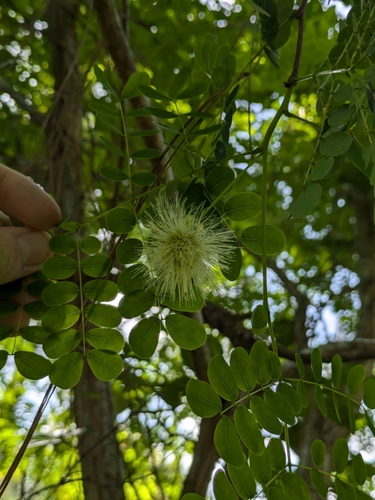
Senegalia pennata subsp. insuavis
(Lace) I. C. Nielsen
Cha-om
iNaturalist· cc-by-nc
(c) natthakanthurasuk, some rights reserved (CC BY-NC)
iNaturalist· cc-by-sa
(c) Vikas D Prasad, some rights reserved (CC BY-SA), uploaded by Vikas D Prasad
iNaturalist· cc-by-nc
(c) thaksaphornthongyim, some rights reserved (CC BY-NC)
Summary
Source: WikipediaSenegalia pennata (English: climbing wattle, Vietnamese: rau thối, Thai: ชะอม cha-om, Northeastern Thai: ผักขา phak kha, Northern Thai: ผักหละ phak la, Burmese: ဆူးပုပ်, pronounced [sʰúboʊʔ]; Khmer: ស្អំ; Meiteilon : khang, Thadou-Kuki: khang-khu, Paite Language: Khangkhuh, Mizo: Khanghu, Hmar: khanghmuk,Vaiphei: Khangkhu, Biate: khang-hu, Malay: petai duri or petai siam), is a species of plant which is native to South and Southeast Asia. It is a shrub or small tropical tree which grows up to 5 metres (16 ft) in height. Its leaves are bipinnate with linear-oblong and glabrous pinnules. Its yellowish flowers are terminal panicles with globose heads. The pods are thin, flat and long with thick sutures.
Description
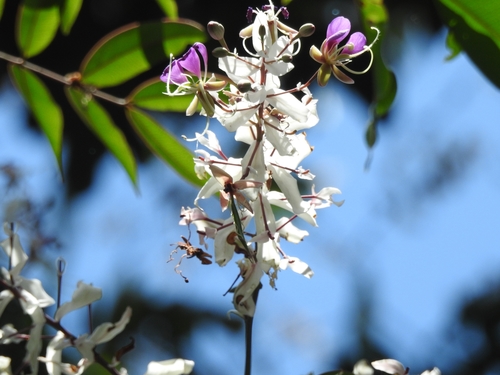
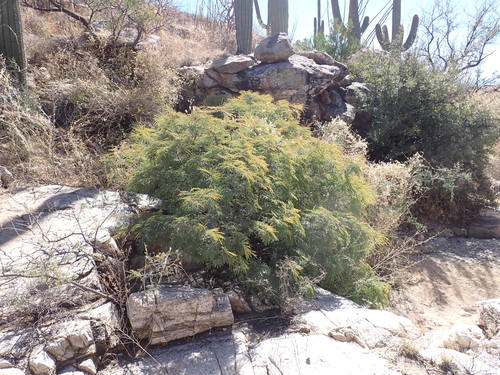
A shrub or small tree. It grows 5 m tall. There are prickles along the stem. The leaves are twice divided and there are 8-18 pairs of pinnae. There are up to 50 pairs of pinnules on each pinnae. The flowers are yellow. They are in large clusters at the ends of branches. The pods are flattened.
Edible Uses
In Northeast India, in the states of Mizoram and Manipur, climbing wattle is an ingredient in indigenous cuisine like kaang-hou (fried vegetables) and eromba. The plant is locally known as khanghmuk in Hmar, khang in Meiteilon and khanghu in Mizo. In Burma, Cambodia, Laos, and Thailand, the feathery shoots of Senegalia pennata are used in soups, curries, omelettes and stir-fries. The edible shoots are picked up before they become tough and thorny. In Northern Thai cuisine, cha-om is also eaten raw with Thai salads, such as tam mamuang (mango salad), and it is one of the ingredients of kaeng khae curry. In Central Thailand and Isan it is usually boiled or fried. Cha-om omelet pieces are one of the usual ingredients of nam phrik pla thu and commonly used in kaeng som, a sour Thai curry. In Vietnam, the plant is cultivated in the Northwest region such as Sơn La and Lai Châu provinces, by the Thái and Khơ Mú ethnic groups as a delicacy vegetable. The leaves have a distinctively stinky odor, and are used in salads (especially with mountain ebony flowers - Bauhinia variegata), as well as in stir-fries, grilled fish, pork or buffalo dishes.
Traditional Uses
The young tips are eaten. They can be eaten raw or fast boiled. They are eaten with a spicy sauce. They are also cooked in an omelette. They are used for soup.
Distribution
It is a tropical plant.
Where It Grows
Asia, Cambodia, Indochina, Laos, SE Asia, Thailand,
Other Information
It is grown for edible leaves in some places in Thailand. It is a commonly used leafy vegetable in Thailand.
Notes
There are about 1,350 Acacia species. Over 1,000 occur in Australia. Also as Mimosaceae. This one is a declared pest in Australia.
Nutrition
| Part | Moisture | kJ | kcal | Protein | Vit A | Vit C | Iron | Zinc |
|---|---|---|---|---|---|---|---|---|
| Leaves | — | 57 | — | 10066 | 58 | 4.1 | — | — |
Synonyms
Also Known As
Pak kha, Phu-zei-du, Vor em
References (7)
- Anderson, E. F., 1993, Plants and people of the Golden Triangle. Dioscorides Press. p
- Hassan, R. A. & Hamdy, R. S., 2021, Synoptic Overview of Exotic Acacia, Senegalia and Vachellia (Caesalpinioideae, Mimosoid Clade, Fabaceae) in Egypt. Plants 2021, 10, 1344.
- Kuhnlein, H. V., et al, 2009, Indigenous Peoples' food systems. FAO Rome p 169
- Martin, F.W. & Ruberte, R.M., 1979, Edible Leaves of the Tropics. Antillian College Press, Mayaguez, Puerto Rico. p 197 (As Acacia pennata)
- Srichaiwong, P., et al, 2014, A Study of the Biodiversity of Natural Food Production to Support Community Upstream of Chi Basin, Thailand. Asian Social Science 10 (2):
Show all 7 references Hide references
- Thitiprasert, W., et al, 2007, Country report on the State of Plant Genetic Resources for Food and Agriculture in Thailand (1997-2004). FAO
- Turreira Garcia, N., et al, 2017, Ethnobotanical knowledgeof the Kuy and Khmer people in Prey Lang, Cambodia. Cambodian Journal of Natural History 2017 (1): 76-101