Garcinia hanburyi
Hook. f.
Hanbury's garcinia
iNaturalist· cc-by-nc
(c) ytt, some rights reserved (CC BY-NC), uploaded by ytt
wikimedia· cc-by-sa
Wikimedia Commons - Raffi Kojian
wikimedia· cc-by-sa
Wikimedia Commons - Raffi Kojian
Summary
Source: WikipediaGarcinia hanburyi is a plant species in the genus Garcinia, native to Indochina; it is one of the gamboge producing trees. Cytotoxic xanthonoids (gambogin, morellin dimethyl acetal, isomoreollin B, moreollic acid, gambogenic acid, gambogenin, isogambogenin, desoxygambogenin, gambogenin dimethyl acetal, gambogellic acid, gambogic acid, isomorellin, morellic acid, desoxymorellin, hanburin) and isomorellinol can be isolated from the dry latex of G. hanburyi.
Description
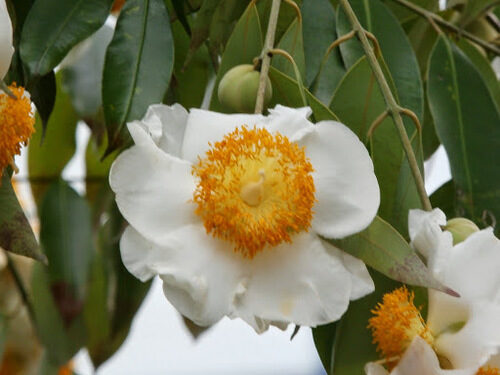
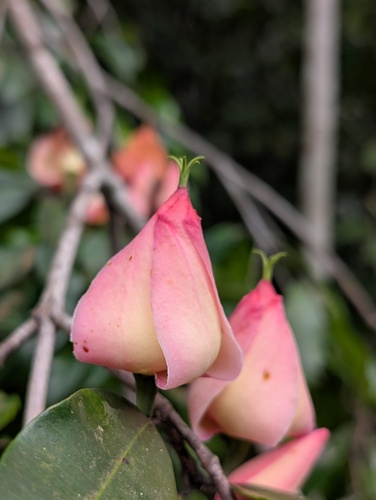
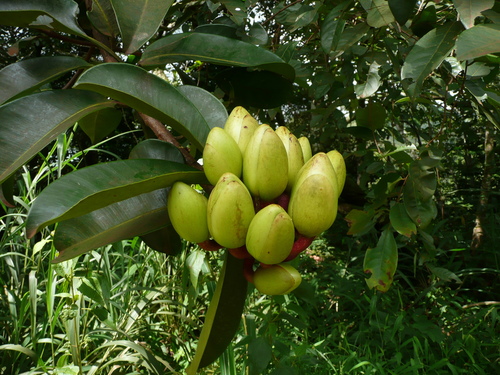
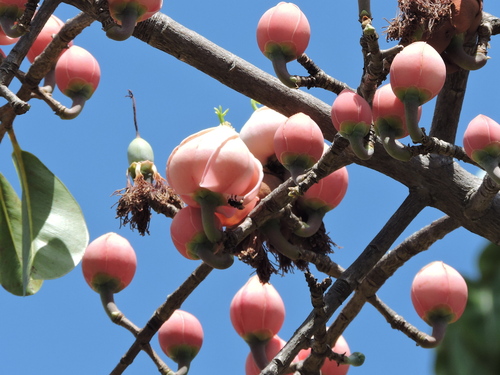
A low spreading tree. It grows 15 m tall. The trunk is short and straight and 20 cm across. It yields a yellow gum-resin. The leaves are opposite. They are oval and 10-25 cm long by 3-10 cm wide. They are wedge shaped at the base and taper to the tip. The flowers can be in clusters or occur singly in the axils of fallen leaves. They are pale yellow. The fruit is a round berry 2-3 cm across.
Edible Uses
None known.
Medicinal Uses
The gum resin obtained from the trunk acts as a drastic purgative, an emetic, and a vermifuge used in treating tapeworm. It is no longer used in human medicine. Gamboge is odourless and tasteless or slightly acid. Large doses administered medicinally can be fatal.
Known Hazards
The gum-resin obtained from the trunk has been used in the past as a medicine. However, large doses can be fatal, and so it is no longer recommended for human use.
Distribution
It is a tropical plant.
Where It Grows
Asia, Cambodia, Indochina, Indonesia, Laos, SE Asia, Thailand, Vietnam,
Cultivation
It is found in areas where the annual rainfall is up to 2,500 mm. Trees are not usually tapped before they are 20 years old, when the trunk has attained a diameter of about 15 cm. A spiral incision is made in the trunk just below the lowest branches, and the exudate is collected in a bamboo container. About every 3 days the content is poured into smaller bamboo stem parts (about 75 cm long), in which the gum-resin coagulates in about a month or longer. The bamboo containers are then cracked and the gamboge is removed in cylindrical sticks (pipe gamboge), which is the usual form in trade. Sometimes gamboge is moulded and pressed into cakes. The gum-resin obtained from this plant is often called Siamese gamboge to distinguish it from the similar product from the bark of G. Morella, which is called Indian gamboge. The species are closely related, and this species has been treated in the past as a variety of G. Morella
Propagation
No specific propagation information is available for this species. Seed of most members of the genus can be slow to germinate even when sown fresh, often taking 6 months or more.
Other Uses
The tree yields a resinous sap called gamboge, collected by making incisions in the bark. This reddish-yellow to brownish-orange sap contains 70–80% resin and 15–25% gum and is used as a golden-yellow colouring matter in varnishes, lacquer, paints, and ink, and as a pigment in watercolours. The main acidic component of the resin is cambogic acid (C38H44O8). The gum fraction is composed mainly of arabinose (approximately 50%) and galactose (approximately 40%), and is soluble in water, forming a yellow emulsion. The pale or brownish-yellow wood is straight-grained with a fine texture and weighs approximately 900 kg/m³. It is moderately hard, works easily, and takes a fine polish. It is sometimes used for interior work.
Notes
It has a range of medicinal uses.
Synonyms
Also Known As
Bua moi, Gambojia, Gummi-gutti, Indian gamboge tree, Rung, Tamala