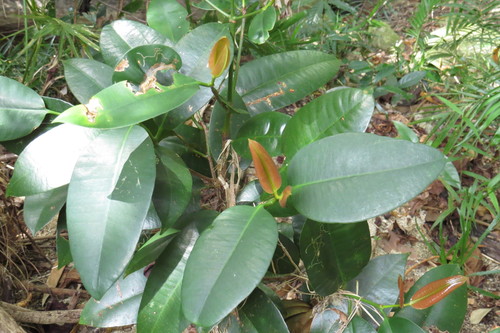
Garcinia humilis
(Vahl) Adams
Wild mammee, Achacha
iNaturalist· cc-by-nc
(c) Alan R. Franck, some rights reserved (CC BY-NC), uploaded by Alan R. Franck
iNaturalist· cc-by-nc
(c) Alan R. Franck, some rights reserved (CC BY-NC)
Summary
Source: WikipediaGarcinia humilis, known commonly as achachairú or achacha, is a small, prolifically fruiting tree related to the mangosteen. It grows in the southern part of the Amazon basin in the central area of Bolivia and is cultivated in northern Australia.
Description
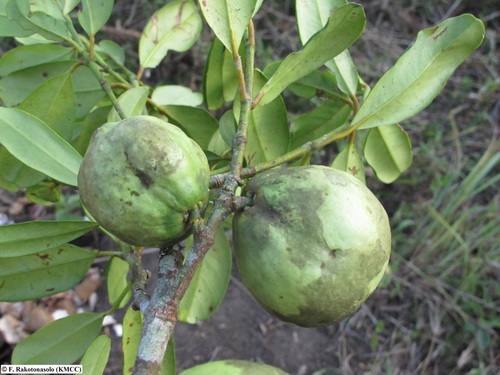
A shrub or tree. It grows 10 m tall. The branches are in flat rings. The leaves are opposite and evergreen. They are narrowly oval and 28 cm long and 16 cm wide. They are leathery. The flowers are cream-yellow to white. They are 2.5 cm across. They are in clusters in the axils of leaves. The fruit are yellow and oval. They are 8 cm long. There are 1-3 seeds 2.5 cm long.
Edible Uses
Fruit - raw. Eaten by children. The yellow, ellipsoid fruit is around 30 - 40mm long. The skin is thin, inside there are 2 - 3 large, fleshy seeds surrounded by a sweet and succulent edible pulp. It is used for making drinks and preserves. There is a report that the tree is cultivated on a commercial basis for its fruit in northern Australia, where the fruit skin is also used to make a refreshing drink. We are not sure if this report properly belongs to this species or is more correctly applied to another species - see notes above on taxonomy.
Medicinal Uses
The sap is applied to the skin for its healing properties.
Distribution
It is a tropical plant. It grows between 150-950 m above sea level. It grows in shady woodland.
Where It Grows
Australia, Bolivia, Brazil, Colombia, Grenada, Haiti, Jamaica, South America, Trinidad, West Indies,
Propagation
Seed - we have no specific information on this species, but the seed of most members of the genus can be slow to germinate, even if sown fresh, often taking 6 months or more.
Other Uses
The tree is a source of a hard wax. A kind of waxy resin exudes from nodes on the branches. It has a pleasant aroma and is used as the fuel in making torches. The dried and powdered gum-resin obtained from the fruit, peel and seed is used as an ingredient in commercial cosmetic preparations as a skin conditioner. An extract of the fruit peel is used as an ingredient in commercial cosmetic preparations as a hair and skin conditioner and a masking agent. The reddish wood is used for common joinery etc.
Synonyms
Also Known As
Bois mulatre, Garcinia abricot
References (2)
- Grandtner, M. M. & Chevrette, J., 2013, Dictionary of Trees, Volume 2: South America: Nomenclature, Taxonomy and Ecology. Academic Press p 260
- Roa, J. A. G. & Boada, D. S. G., 2018, Fundación para el Fortalecimiento de la Fruticultura y Plantas Alimenticias no Convencionales en Colombia.