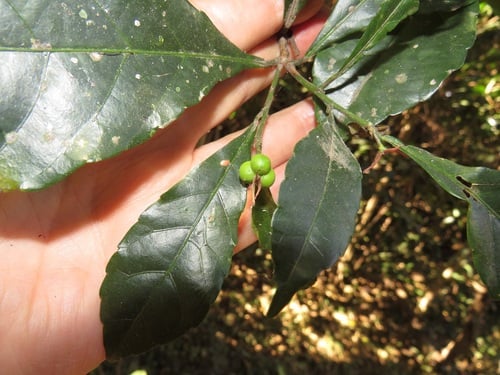
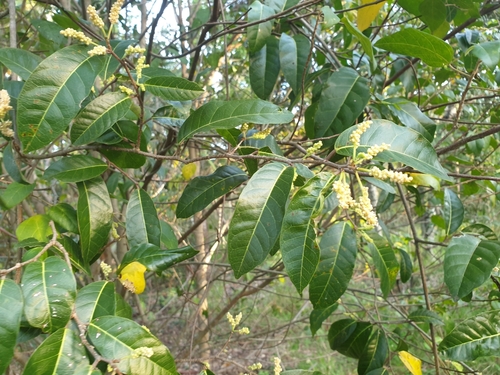
Manihot carthaginensis glaziovii - (Müll.Arg.) Allem
(Müll.Arg.) Allem
Ceara Rubber Tree, Tree cassava
Description
Manihot carthaginensis glaziovii is a deciduous Tree growing to 6 m (19ft) by 4 m (13ft) at a fast rate. See above for USDA hardiness. It is hardy to UK zone 10. Suitable for: light (sandy), medium (loamy) and heavy (clay) soils, prefers well-drained soil and can grow in heavy clay and nutritionally poor soils. Suitable pH: mildly acid, neutral and basic (mildly alkaline) soils and can grow in very acid soils. It cannot grow in the shade. It prefers dry moist or wet soil and can tolerate drought.
Edible Uses
Leaves - cooked. Eaten as a vegetable. The leaves contain hydrocyanic acid, which is toxic, but it is destroyed by heat and so the cooked leaves are safe to eat. Root - cooked. A famine food, it is eaten in times of food scarcity. The root is rich in starch but it is hard and woody. It also contains hydrocyanic acid (see note above re the leaves). Seed - oily.
Medicinal Uses
The stem and root are ingredients in a remedy for skin infections.
Distribution
S. America - northeast Brazil.
Where It Grows
Coming Soon
Cultivation
It grows in areas where the mean annual rainfall is within the range 600 - 700mm. Prefers a position in a sunny position. The tree tolerates a wide range of soils including very poor and acidic soils. It can succeed in sticky red soil, which may be water logged. Established plants are very drought tolerant. Plants have escaped from cultivation in many of the areas in which they have been grown. They are reported to be invasive in Hawaii. The growth of young plants is rapid. The plant can flower the whole year through, it probably also fruits the year round but no data is available. The tree can be tapped at the age of 3 years.
Propagation
Seed - usually sown in situ. Seed - best sown as soon as it is ripe in a partially shaded position in a nursery seedbed. A germination rate of around 50% can be expected, with the seed sprouting within 30 - 50 days. Cuttings.
Other Uses
The tree is used to provide temporary shade for cocoa plants. The leaves are applied as green leaf manure. In some areas, especially where the rainfall is low, the species is used as a hedge. Other Uses: The plant is used in breeding programmes for cassava (Manihot esculenta), being used to improve disease resistance. The tree is a source of latex that can be used to make rubber. The rubber is said to be of good appearance, but the resin content, at 3 - 12%, is too high, It is, therefore, considered to be uneconomical when there are other sources. The latex can be used as a glue for paper. The seeds contain 90 % unsaturated oil. (This seems a very high figure.) The oil might possibly be used as a fuel for pre-combustion diesel engines. The wood is coarse-textured, straight-grained, very light in weight, very susceptible to wood-eating organisms. Easy to cut but of quite low quality, it is used to make items such use boxes.
Synonyms
Also Known As
Ceara Rubber Tree, False Tapioca, Manicoba, Ubi. French - manioc de ceara, maniçoba, ceara, caouchouc de ceara. Portuguese - manicoba. Swahili - mpira. Yoruba - gbaguda