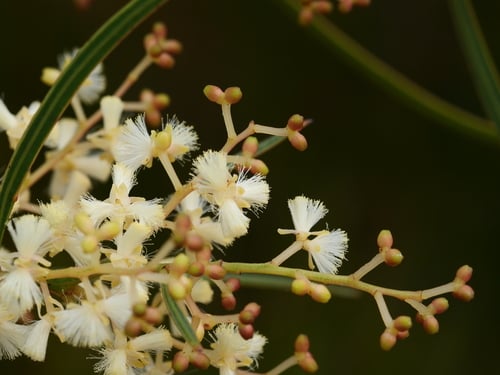
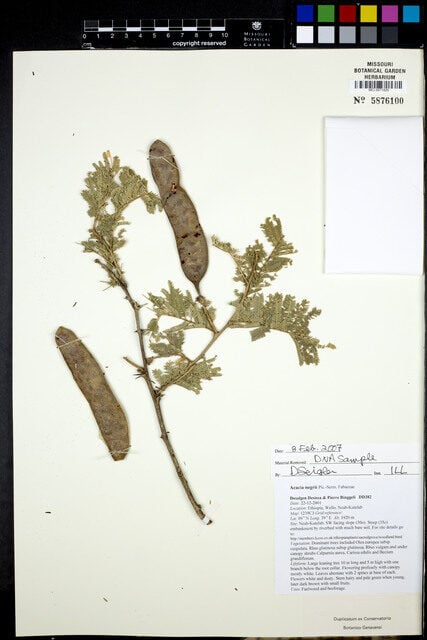
Dalbergia rimosa
Roxb.
wikimedia· cc0
Wikimedia Commons - Naturalis Biodiversity Center
Summary
Source: WikipediaDalbergia rimosa is a species of liana (or treelet), with the Vietnamese name trắc giây or trắc dây. The synonym Dalbergia discolor, with the Vietnamese name trắc biến màu, is no longer recognised. The genus Dalbergia is placed in the subfamily Faboideae and tribe Dalbergieae.
Description
A straggling or climbing shrub. The branches often have tendrils. It grows 4-6 m tall. The leaves are 10-20 cm long. There are 5-9 leaflets. The flowers are small and have a sweet scent. The fruit are strap shaped pods. There are one or two seeds. The seeds are kidney shaped and 12 mm long by 6 mm wide.
Edible Uses
Seeds. The reddish-brown, reniform seeds are around 16mm wide and 27mm long. There is one seed, occasionally two, in each seedpod.
Distribution
It is a subtropical plant. It grows in open forest and along rivers between 800-1,700 m above sea level in southern China. In Yunnan.
Where It Grows
Asia, China, India, Indochina, Indonesia, Laos, Malaysia, Myanmar, Northeastern India, SE Asia, Thailand, Vietnam,
Cultivation
Species in this genus are mainly found in the wild growing in sany soils and on limestone escarpments. In cultivation they are likely to do well in a fertile, loam soil and a position in full sun.
Propagation
Like many species within the family Fabaceae, once they have been dried for storage the seeds of this species may benefit from scarification before sowing in order to speed up germination. This can usually be done by pouring a small amount of nearly boiling water on the seeds (being careful not to cook them!) and then soaking them for 12 - 24 hours in warm water. By this time they should have imbibed moisture and swollen - if they have not, then carefully make a nick in the seedcoat (being careful not to damage the embryo) and soak for a further 12 hours before sowing. Softwood cuttings of many species, especially if taken from younger plants, will root in a well-drained, sandy medium in a closed case with bottom heat.
Other Uses
The stem is used for making axe handles. The timber is valued in Vietnam, where it is known as 'Go Hue'. This species has been suggested for use in forest restoration projects.
Also Known As
Dauk-ta-laung, Gajai lota, Jyrmi-bu-stem, Mermeri lata, Ndawng-karawng, Phukri lewa, Trac giay
References (4)
- Dobriyal, M. J. R. & Dobriyal, R., 2014, Non Wood Forest Produce an Option for Ethnic Food and Nutritional Security in India. Int. J. of Usuf. Mngt. 15(1):17-37
- Patiri, B. & Borah, A., 2007, Wild Edible Plants of Assam. Geethaki Publishers. p 37
- Sarma, H., et al, 2010, Updated Estimates of Wild Edible and Threatened Plants of Assam: A Meta-analysis. International Journal of Botany 6(4): 414-423
- Sawian, J. T., et al, 2007, Wild edible plants of Meghalaya, North-east India. Natural Product Radiance Vol. 6(5): p 415