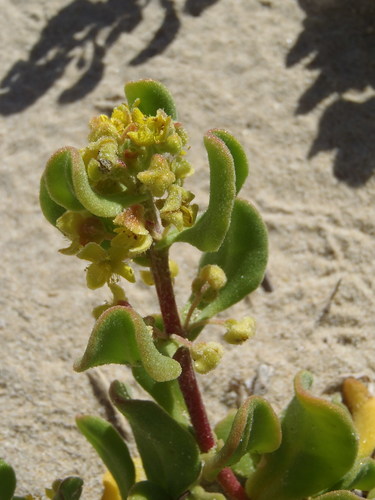
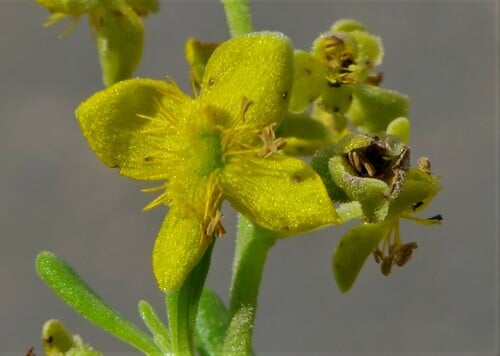
Carpobrotus deliciosus
(L. Bolus.) L. Bolus
Sweet hottentot fig, Ice-plant, Sour-fig
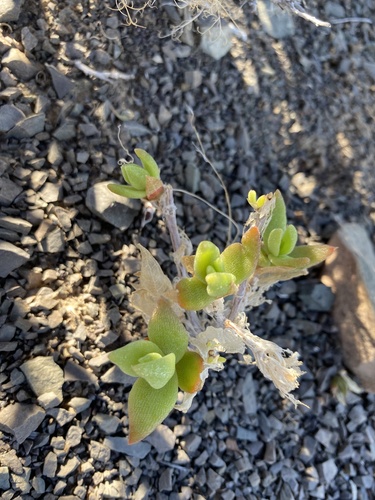
iNaturalist· cc-by-nc
(c) hennidebeer, some rights reserved (CC BY-NC), uploaded by hennidebeer
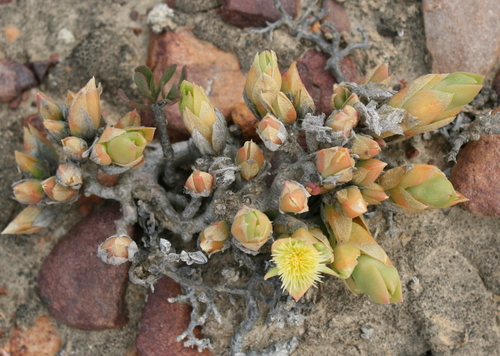
iNaturalist· cc-by
(c) Karen Eichholz, some rights reserved (CC BY)
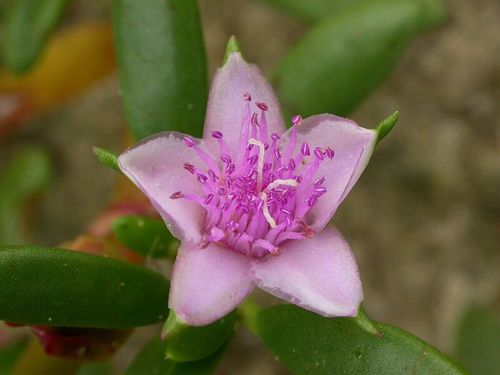
iNaturalist· cc-by-nc
(c) John M Zippay, some rights reserved (CC BY-NC)
Summary
Source: WikipediaCarpobrotus deliciosus (commonly known as sweet Hottentots fig, perdevy, ghaukum, ghounavy) is a succulent perennial of the family Aizoaceae, native to a strip along the south coast of South Africa.
Description
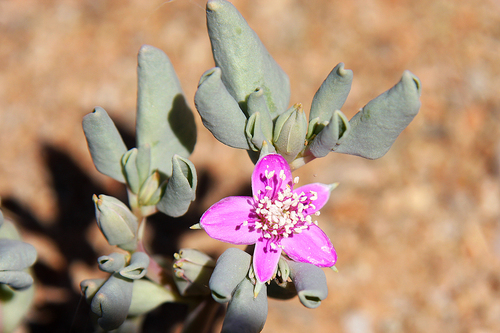
A succulent creeping herb. It forms mats over the ground. The leaves are cylinder shaped and fleshy. They are 3 angled. The leaves are 10 cm long and 1-2 cm thick. They are slightly curved. The flowers are bright red or golden. The flowers occur singly and are 5-7 cm across. The fruit are round and edible.
Edible Uses
The fruit can be eaten raw, used as a garnish for fruit salads, dried and eaten like candy, or made into jams and preserves. There is very little flesh in the fruit and it must be fully ripe, as unripe fruit is very astringent.
Traditional Uses
The fruit are eaten. They can be eaten fresh or used for fruit salad. They can be dried and eaten like candy or made into jams and preserves. They are also used to flavour milk.
Medicinal Uses
None known
Distribution
It is a Mediterranean climate plant. It is native to South Africa. It grows along the coast. It needs moderate moisture when hot and can be dry in cool weather. It suits gritty, well drained soil. It can grow on sand. It needs full sun. It can grow in arid places. It suits hardiness zones 8-11.
Where It Grows
Africa, Hawaii, Pacific, South Africa*, Southern Africa, USA,
Cultivation
Plants seed easily. They can be grown from seed.
Propagation
Surface sow seed from March to June in a greenhouse, with lower night-time temperatures being beneficial. Seed typically germinates in 7–10 days at 23°C. Prick seedlings out into individual pots once large enough to handle and grow on in a greenhouse for at least their first winter. Plant out into permanent positions in late spring or early summer, after the last expected frosts. Cuttings can be taken at any point during the growing season — allow the cutting to dry in the sun for a day or two, then pot up in a very sandy mix. Very easy to propagate this way.
Other Uses
The plant is moderately fire-retardant and can be planted as a barrier to the spread of forest fires in Mediterranean and similar climates. It is also planted on sunny banks and in sandy soils to prevent soil erosion.
Notes
There are about 25 Carpobrotus species. Also put in the family Mesembryanthemaceae.
Synonyms
Also Known As
Ghaukum, Higo marino
References (13)
- Barkhuizen, 1978,
- Courtenay-Latimer, M., et al, 1967, The Flowering Plants of the Tsitsikama Forest and Coastal National Park. National Parks Board. Republic of South Africa. Plate 31:2 (As Carpobrotus fourcadei)
- Facciola, S., 1998, Cornucopia 2: a Source Book of Edible Plants. Kampong Publications, p 150
- Jardin, C., 1970, List of Foods Used In Africa, FAO Nutrition Information Document Series No 2.p 125 (As Carpobrotus fourcadei)
- Joffe, P., 2007, Creative Gardening with Indigenous Plants. A South African Guide. Briza. p 269
Show all 13 references Hide references
- Llamas, K.A., 2003, Tropical Flowering Plants. Timber Press. p 49
- Peters, C. R., O'Brien, E. M., and Drummond, R.B., 1992, Edible Wild plants of Sub-saharan Africa. Kew. p 46
- Plants for a Future database, The Field, Penpol, Lostwithiel, Cornwall, PL22 0NG, UK. http://www.scs.leeds.ac.uk/pfaf/
- Royal Botanic Gardens, Kew (1999). Survey of Economic Plants for Arid and Semi-Arid Lands (SEPASAL) database. Published on the Internet; http://www.rbgkew.org.uk/ceb/sepasal/internet [Accessed 24th March 2011]
- Ruiters-Welcome, A. K., 2019, Food plants of southern Africa. Ph.D. thesis. Univ. of Johannesburg p 7
- Staples, G.W. and Herbst, D.R., 2005, A tropical Garden Flora. Bishop Museum Press, Honolulu, Hawaii. p 97
- Welcome, A. K. & Van Wyk, B.-E., 2019, An inventory and analysis of the food plants of southern Africa. South African Journal of Botany 122 (2019) 136–179
- World Checklist of Useful Plant Species 2020. Royal Botanic Gardens, Kew