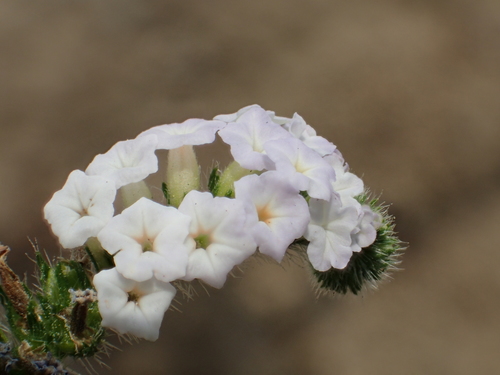
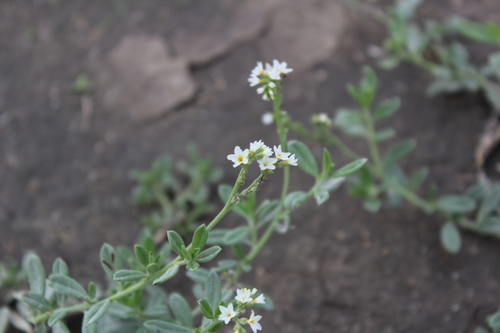
Heliotropium zeylanicum
(Burm. f.) Lam.
iNaturalist· cc-by
(c) Wynand Uys, some rights reserved (CC BY), uploaded by Wynand Uys
iNaturalist· cc-by
(c) Wynand Uys, some rights reserved (CC BY), uploaded by Wynand Uys
iNaturalist· cc-by
(c) Wynand Uys, some rights reserved (CC BY), uploaded by Wynand Uys
Description
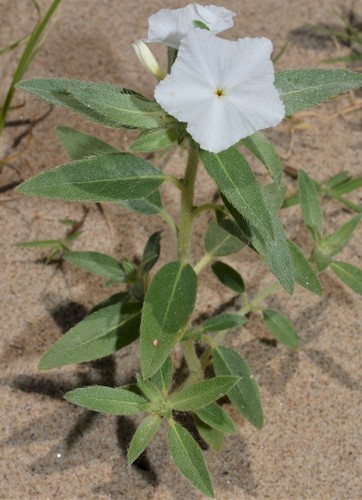
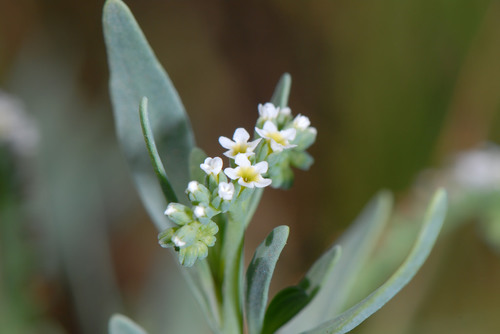
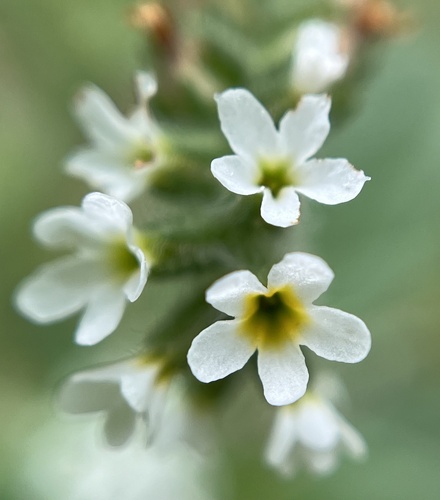
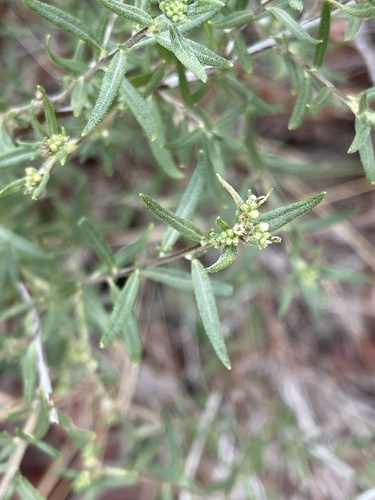
A erect herb. It keeps growing from year to year. It grows 80 cm tall. It has a long thick rootstock and can be a spreading plant. The stems are branched and woody at the base. They have hairs. The leaves are long and thin. They are 9 cm long and 1 cm wide. They have a sharp tip and narrow at the base. The flowers are small and greenish-yellow. They form along a spike like stalk. The fruit is rounded and 2 mm long. It breaks into 4 nutlets.
Edible Uses
Leaves - cooked. The tender leaves are chopped and cooked alone or with other vegetables such as Amaranthus, Bidens or Galinsoga. Coconut milk or pounded groundnuts are then added, and the dish is served with a staple such as rice.
Traditional Uses
The young leaves are chopped and cooked either alone or with other vegetables.
This uses section is brief — help expand it
Medicinal Uses
The plant is eaten as a bitter tonic and stimulant in the belief that it has some of the properties of the kola nut, making the lips or the saliva red. The plant is applied to scorpion-stings on the basis of the shape of the tail-tipped petals resembling a scorpion’s sting. Combined with Indigofera pulchra it is put on sore breasts. The leaves are prepared into poultices alone or with butter and without heating for treating boils, yaws etc. The stems are crushed and soaked, then dried and applied to parts affected by yaws. A cold root-infusion which has stood overnight is taken as a stomachic and laxative. The leaves and roots are pounded and boiled, the decoction being drunk as a treatment for postpartum diseases in women. The aerial parts of the plant contain the pyrrolizidine alkaloids subulacine-N-oxide, 7-angeloyl heliotrine, retronecine and heliotrine. The crude ethanol and hexane extracts have significant in-vitro activity against coxsackie, poliomyelitis and measles viruses. Seven-angeloyl heliotrine and heliotrine have shown in-vitro activity against poliomyelitis and vesicular stomatitis viruses. Antitumour activity of several extracts and isolated alkaloids has been confirmed in in-vitro tests on several cancer cell lines including Sarcoma 180, human carcinoma of the nasopharynx and lymphocytic leukaemia. Extracts, as well as isolated alkaloids, have shown antimicrobial activity in tests with the bacteria Escherichia coli, Streptococcus pneumoniae, Bacillus subtilis, Bacillus anthracis and Staphylococcus aureus, and the fungi Aspergillus fumigatus, Aspergillus niger, Rhizoctonia phaseoli and Pennicilium chrysogenum.
Known Hazards
No specific mention of toxicity has been seen for this species, but many members of this plant family (Boraginaceae) are known to contain pyrrolizidine alkaloids. These alkaloids have a cumulative effect upon the body and, unless concentrations in a plant are high, occasional use is generally completely safe. They are derived from amino acids including ornithine. Many pyrrolizidine alkaloids have pronounced hepatic toxicity, but the lungs and other organs may be affected as well. Mutagenic and carcinogenic activities of pyrrolizidine alkaloids have also been reported.
Distribution
It is a tropical plant. In grows in dry bushland and grassland from sea level to 1,700 m above sea level in Tanzania.
Where It Grows
Africa, Asia, Botswana, Burkina Faso, Central Africa, Comoros, East Africa, Ethiopia, India, Kenya, Mozambique, Socotra, Somalia, Southern Africa, Sudan, Tanzania, Uganda, West Africa,
Cultivation
Plants can be grown from seed.
Production
Leaves are collected during the rainy season.
Synonyms
References (4)
- Grubben, G. J. H. and Denton, O. A. (eds), 2004, Plant Resources of Tropical Africa 2. Vegetables. PROTA, Wageningen, Netherlands. p 562
- Mutie, F. M., et al, 2023, Important Medicinal and Food Taxa (Orders and Families) in Kenya, Based on Three Quantitative Approaches. Plants 2023, 12, 1145
- Ruffo, C. K., Birnie, A. & Tengnas, B., 2002, Edible Wild Plants of Tanzania. RELMA p 366
- World Checklist of Useful Plant Species 2020. Royal Botanic Gardens, Kew