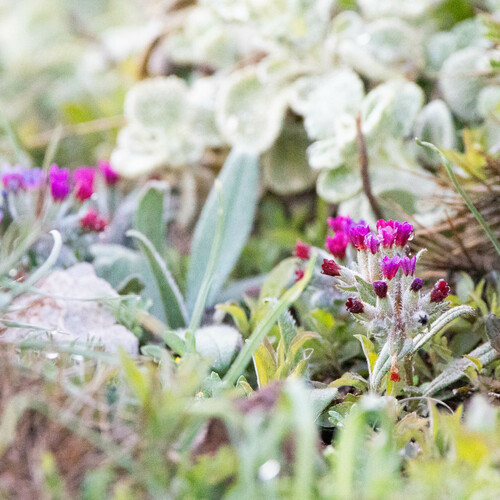
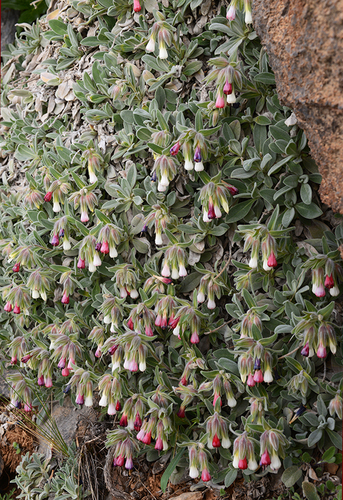
Amsinckia lycopsoides
Lindl. ex Lehm.
Yellow Burrweed, Tarweed fiddleneck, Bugloss fiddle-neck
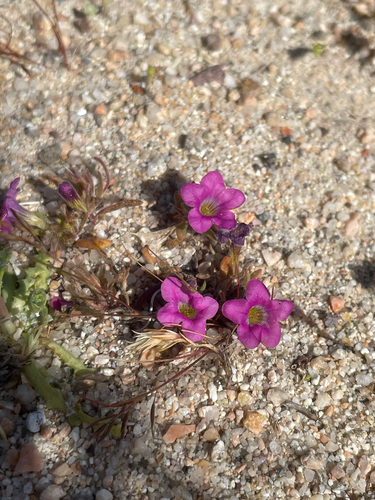
iNaturalist· cc-by-nc
(c) rie1130, some rights reserved (CC BY-NC)
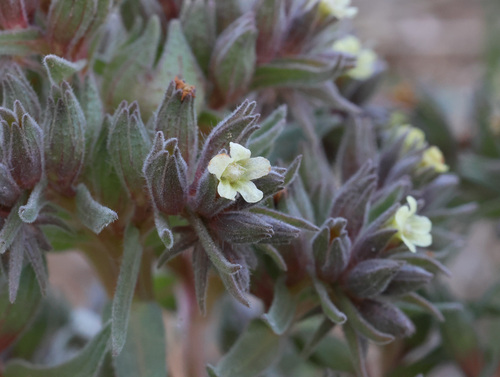
iNaturalist· cc-by-nc
(c) Mike Bogar, some rights reserved (CC BY-NC), uploaded by Mike Bogar
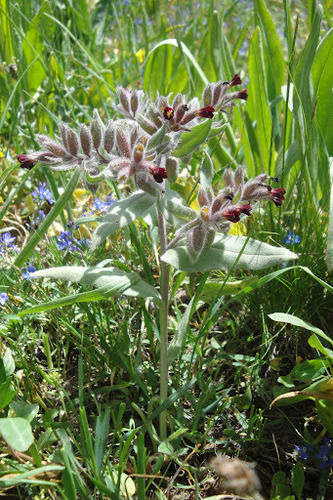
iNaturalist· cc-by-nc
(c) Cat Chang, some rights reserved (CC BY-NC), uploaded by Cat Chang
Summary
Source: WikipediaAmsinckia lycopsoides is a species of flowering plant, known by the common name tarweed fiddleneck or bugloss fiddleneck, in the family Boraginaceae. It is one of the more common species of fiddleneck. It is native to much of western North America from California to British Columbia. It can be found in a wide variety of areas.
Description
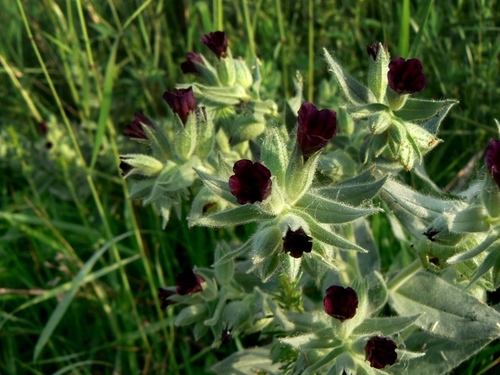
An annual plant. It is erect. It grows 50 cm high. They have both long and short hairs mixed. The leaves do not have stalks and are narrowly sword shaped. The flowers are yellow and without bracts. The flowers have a restricted corolla throat which is enclosed in a hairy pouch.
Edible Uses
The fresh young shoots are juicy and edible, though no further preparation details are recorded. The seed can be eaten raw or ground into a powder after parching, then formed into cakes and eaten without further cooking. As with most members of the Boraginaceae family, seeds likely ripen gradually and fall individually when mature, which would make harvesting any significant quantity very fiddly and time-consuming.
Traditional Uses
CAUTION: Substances toxic to the liver have been found in related plants. The sprouts are eaten as a potherb. The seeds are parched and pounded into flour and used for cakes.
Medicinal Uses
None known
Distribution
It is a temperate plant.
Where It Grows
Asia, Australia, Britain, Europe, Korea, North America, USA,
Cultivation
Succeeds in ordinary garden soil in full sun.
Propagation
Sow seed in situ in late spring.
Other Uses
None known
Synonyms
References (9)
- Anderson, M. K., 2012, Edible Seeds and Grains of California Tribes and the Klamath Tribe of Oregon in the Phoebe Apperson Hearst Museum of Anthropology Collections, University of California, Berkeley. USDA p 10
- Beckstrom-Sternberg, Stephen M., and James A. Duke. "The Foodplant Database." http://probe.nalusda.gov:8300/cgi-bin/browse/foodplantdb.(ACEDB version 4.0 - data version July 1994)
- Bircher, A. G. & Bircher, W. H., 2000, Encyclopedia of Fruit Trees and Edible Flowering Plants in Egypt and the Subtropics. AUC Press. p 25
- Lamp, C & Collet F., 1989, Field Guide to Weeds in Australia. Inkata Press. p 19
- Lazarides, M. & Hince, B., 1993, Handbook of Economic Plants of Australia, CSIRO. p 19
Show all 9 references Hide references
- Martin, F.W. & Ruberte, R.M., 1979, Edible Leaves of the Tropics. Antillian College Press, Mayaguez, Puerto Rico. p 179
- Paczkowska, G. & Chapman, A.R., 2000, The Western Australian Flora. A Descriptive Catalogue. Western Australian Herbarium. p 180
- Plants for a Future, The Field, Penpol, Lostwithiel, Cornwall, PL22 0NG, UK. http://www.scs.leeds.ac.uk/pfaf/
- Sem. hort. bot. hamburg. 1831:3,7. 1831