Aglaonema costatum
N. E. Br.
Spotted evergreen, Malay evergreen
iNaturalist· cc-by-sa
(c) BotBln, some rights reserved (CC BY-SA)
iNaturalist· cc-by-nc-sa
(c) Ahmad Fuad Morad, some rights reserved (CC BY-NC-SA)
wikimedia· cc-by-sa
Wikimedia Commons - H. Zell
Summary
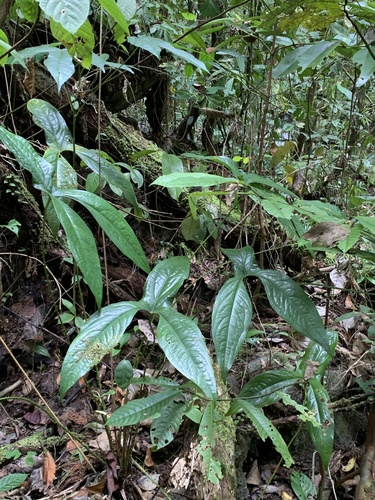
Source: WikipediaAglaonema costatum, called the spotted evergreen, is a species of flowering plant in the genus Aglaonema, native to Bangladesh, Thailand, Peninsular Malaysia, Laos, Cambodia and Vietnam. In these areas, the plant is typically found growing in the understory of tropical rain forests. Its putative form, Aglaonema costatum f. immaculatum, called the unspotted Chinese evergreen, has gained the Royal Horticultural Society's Award of Garden Merit. A. costatum typically reaches about 60 cm tall and 30-45 cm wide. Its leaves are typically about 20 centimeters long, ovately shaped, with entire margins. They are green, with a white stripe along the midrib and a number of irregularly shaped white spots. In the summer, it produces white spathe-and-spadix flowers, about 2–3.5 centimeters long. As a result of the calcium oxalate crystals found in all parts of the plant, it will irritate the mouth and esophagus of a human who ingests it, and it is toxic to cats and dogs.
Description
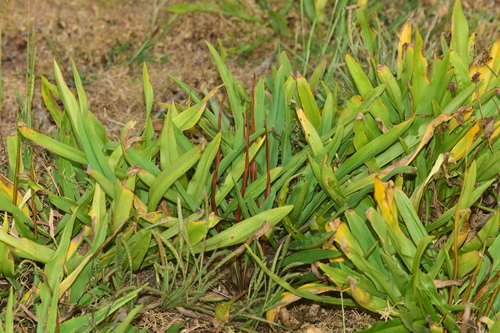
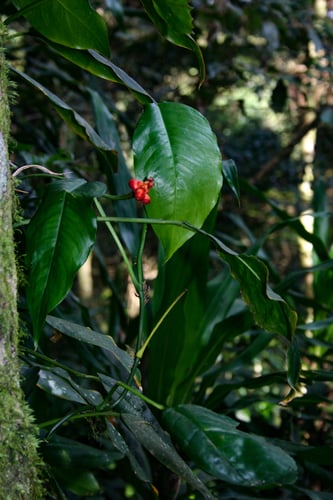
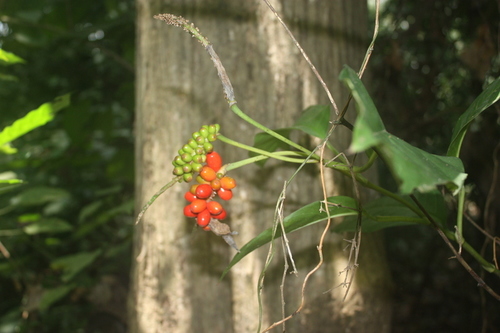
A taro family plant. It is a herb. It keeps growing from year to year. It grows about 50-100 cm tall. The leaf blade is 12-45 cm long by 4-16 cm wide. They are oval to heart shaped and dark green with white marks. The base is often unequal. There are 7-9 pairs of spreading and arched veins. The flowers are in clusters of 1-9. The spathe is boat-shaped and oval. It can be 2.5 cm long. The fruit is a fleshy green berry.
Traditional Uses
Caution: It contains oxalates that burn the throat.
This uses section is brief — help expand it
Known Hazards
Contains oxalates that burn the throat.
Distribution
It is a tropical plant. It grows in tropical swamps and rainforests up to 400 m above sea level. It is best in part shade.
Where It Grows
Asia, Australia, Bangladesh, Cambodia, China, Hawaii, Indochina, Indonesia Laos, Malaysia, Marshall Islands, Micronesia, Myanmar, Nauru, Pacific, SE Asia, Thailand, Vietnam,
Cultivation
Plants can be grown from seeds, stem cuttings of sections of the rhizome.
Also Known As
Aglonema beras tumpuh, Si-pwa-gamon
References (5)
- Anderson, E. F., 1993, Plants and people of the Golden Triangle. Dioscorides Press. p
- Kew Plants of the World Online
- Sukarya, D. G., (Ed.) 2013, 3,500 Plant Species of the Botanic Gardens of Indonesia. LIPI p 1053
- Thaman, R. R., et al, 1994, The Flora of Nauru. Atoll Research Bulletin No. 392. Smithsonian Institute p 38
- Vander Velde, N, 2003, The Vascular Plants of Majuro Atoll, Republic of the Marshall Islands. Atoll research Bulletin. No. 503. Smithsonian Institute. p 21