Euphorbia heterophylla
L.
Mexican Fire plant, Mole plant
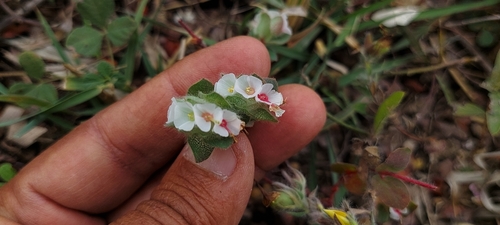
iNaturalist· cc-by-nc
(c) Steve Jones, some rights reserved (CC BY-NC), uploaded by Steve Jones
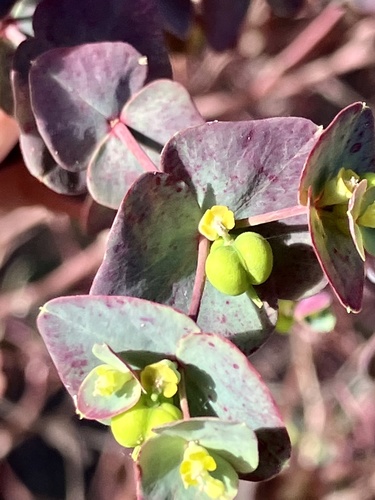
iNaturalist· cc-by-nc
(c) yulla, some rights reserved (CC BY-NC)
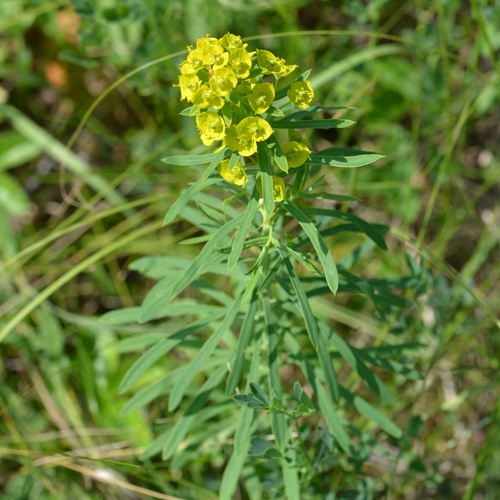
iNaturalist· cc-by-nc
(c) Franco Colnago, some rights reserved (CC BY-NC), uploaded by Franco Colnago
Summary
Source: WikipediaEuphorbia heterophylla, also known under the common names of Mexican fireplant, painted euphorbia, Japanese poinsettia, paintedleaf, painted spurge and milkweed, is a plant belonging to the Euphorbiaceae or spurge family.
Description
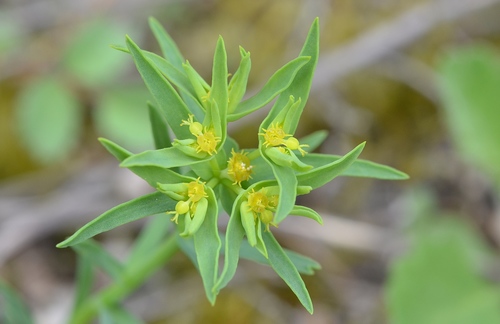
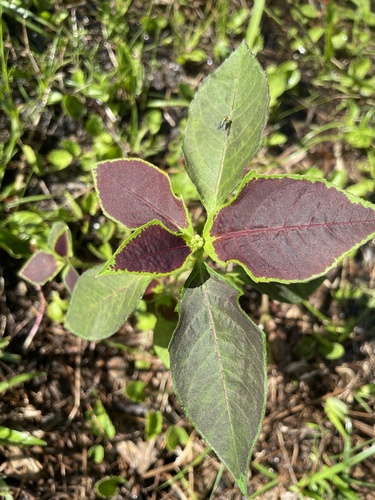
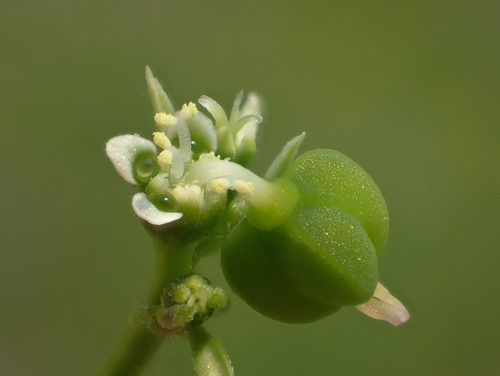
A woody herb. It grows up to 2 m high. The young shoots are hairy with long purple hairs. The stems are green. The leaf stalks have a reddish tinge. The leaf is dark green on the upper surface and dull green underneath. The flowers are cream of light green. They occur closely together at the ends of branches. The fruit are green. The seeds are grey. They are almost round and are rough.
Edible Uses
The leaves are used as a famine food and in curries.
Traditional Uses
Caution: All Euphorbias or spurges have irritating sap and many have chemicals that can cause cancer. The leaves are used as a famine food. They are also used in curries.
Medicinal Uses
Although it contains a latex with a caustic effect upon the skin and mucous membranes, this plant is widely used in traditional African medicine and also elsewhere in tropical countries. All parts of the plant contain latex: leaves 0.42%, stems 0.11%, roots 0.06% and whole plant up to 0.77%. The plant also contains lectins and carbohydrates. A dimeric N-acetylgalactosamine-specific lectin was isolated from the seeds. The red colouring matter of the coloured leaves and bracts is porcetin. The purgative action of the plant was found to be a joint action of both the phorbols and the bulk-forming laxative sugars. A water extract from the leaves exhibited strong purgative effects when given orally. In-vitro experiments suggest that the effect is caused by an increase in intestinal motility. The butanol extract of the dried leaves exhibited marked inhibitory action on the growth of Escherichia coli, Staphylococcus aureus, Pseudomonas aeruginosa, Klebsiella pneumoniae and Bacillus subtilis at 100 mg/ml. A methanol extract of the aerial parts showed moderate antiplasmodial activity. A leaf extract showed significant nematicidal activity against Meloidogyne graminicola. An extract of the aerial parts given orally to goats showed moderate activity against several intestinal nematodes, such as Haemonchus, Trichostrongylus, Bunostomum and Oesophagostomum. Extracts from the fresh shoots produced inhibitory effects on the early seed germination of tomato, pepper and cowpea. A decoction or infusion of the stems and fresh or dried leaves is taken as a purgative and laxative to treat stomach-ache and constipation, and to expel intestinal worms. A leaf infusion is used as a wash to treat skin problems, including fungal diseases, and abscesses. The leaf extract is taken to treat body pain. The latex and preparations of the leaves and root are applied to treat skin tumours. The roots are cathartic, emetic and galactogogue. They are used in small doses in the treatment of gonorrhoea and to increase milk production in breast-feeding women. The latex is irritant to the skin and eyes and may be employed as a rubefacient and to remove warts and corns. However, the latex is also used as an antidote against the irritation caused by the latex of other Euphorbia species. The flowers are pectoral.
Known Hazards
Toxicity is documented in most members of the genus Euphorbia. Individuals sensitive to latex are known to have strong reactions, including dermatitis and anaphylaxis, to the latex exuded by this plant.
Distribution
A tropical and subtropical plant. It can grow in arid places. In Zimbabwe it grows up to 1,500 m above sea level. In Argentina it grows from sea level to 1,000 m above sea level.
Where It Grows
Africa, Angola, Argentina, Australia, Bahamas, Barbados, Belize, Benin, Bermuda, Bolivia, Botswana, Brazil, Britain, Burkina Faso, Burundi, Cameroon, Caroline Islands, Central Africa, Central African Republic, CAR, Central America, China, Christmas Island, Chuuk, Colombia, Congo, Cook Islands, Costa Rica, Côte d'Ivoire, Cuba, Cyprus, Dominican Republic, East Africa, East Timor, Ecuador, Egypt, El Salvador, Ethiopia, Europe, Fiji, French Guiana, FSM, Ghana, Guam, Guiana, Guianas, Guatemala, Guyana, Haiti, Hawaii, Honduras, India, Indochina, Indonesia, Ivory Coast, Jamaica, Jordan, Kenya, Liberia, Malawi, Malaysia, Maldives, Mali, Mediterranean, Mexico, Middle East, Mozambique, Myanmar, Namibia, New Caledonia, Nicaragua, Nigeria, North Africa, North America, Oman, Pacific, Pakistan, Panama, Papua New Guinea, PNG, Paraguay, Peru, Philippines, Puerto Rico, Reunion, Rwanda, Samoa, Sao Tome and Principe, Saudi Arabia, SE Asia, Sierra Leone, Solomon Islands, Somalia, South Africa, Southern Africa, South America*, Sri Lanka, Sudan, Suriname, Taiwan, Tanzania, Thailand, Timor-Leste, Togo, Trinidad-Tobago, Tuvalu, Uganda, Uruguay, USA, Vanuatu, Venezuela, West Africa, West Indies, Zambia, Zimbabwe,
Cultivation
Prefers a position in full sun, but is shade-tolerant. This species is a common and troublesome, nitrophilic weed in arable land in tropical Africa, and should be controlled. Hand weeding is commonly used. It grows from sea level to nearly 1,800 metres and, although it has adapted to subtropical conditions, it is only a weed in warm climates. It inhabits cultivated crops, vegetables, pastures, and wastelands. Reproduction is by seeds which are shed with an explosive mechanism. The plant is an annual with a life cycle of 45 - 50 days, and is thus capable of several life cycles per rainy season. It can be found flowering and fruiting throughout the year if enough water is available.
Propagation
Seed - if sown fresh it germinates readily under tropical conditions, but remains dormant under temperate circumstances. Both light and temperature influence the breaking of dormancy. The turning of soil favours germination and seeds germinate even when at a depth of 10cm in the soil.
Other Uses
All parts of the plant contain latex: leaves 0.42%, stems 0.11%, roots 0.06% and whole plant up to 0.77%. In Sudan it is reported to have been exploited during World War II as a substitute for rubber, but this has never been followed up. A dye is obtained from the red-coloured leaves. A red dye, known as porcetin, is obtained from the leaves.
Production
In Australia, plants flower and fruit in May.
Notes
There are about 2000 Euphorbia species. Most Euphorbias have sap which irritates the skin.
Synonyms
Also Known As
Annual poinsettia, Cruel plant, Kankaka, Kuriraiyvaa, Kywe-kyaung-myin-si, Mpendo, Mpira, Painted leaf, Pekapar, Saarni koora
References (25)
- Achigan-Dako, E, et al (Eds), 2009, Catalogue of Traditional Vegetables in Benin. International Foundation for Science.
- Burkill, I.H., 1966, A Dictionary of the Economic Products of the Malay Peninsula. Ministry of Agriculture and Cooperatives, Kuala Lumpur, Malaysia. Vol 1 (A-H) p 994
- Codjia, J. T. C., et al, 2003, Diversity and local valorisation of vegetal edible products in Benin. Cahiers Agricultures 12:1-12
- Cowie, I, 2006, A Survey of Flora and vegetation of the proposed Jaco-Tutuala-Lore National Park. Timor-Lests (East Timor) www.territorystories.nt/gov.au p 47
- Flora of Solomon Islands
Show all 25 references Hide references
- Fowler, D. G., 2007, Zambian Plants: Their Vernacular Names and Uses. Kew. p 26
- Franklin, J., Keppel, G., & Whistler, W., 2008, The vegetation and flora of Lakeba, Nayau and Aiwa Islands, Central Lau Group, Fiji. Micronesica 40(1/2): 169–225, 2008
- Henty, E.E., & Pritchard, G.S., 1973, Weeds of New Guinea and their control. Botany Bulletin No 7, Division of Botany, Lae, PNG. p 102
- Hussey, B.M.J., Keighery, G.J., Cousens, R.D., Dodd, J., Lloyd, S.G., 1997, Western Weeds. A guide to the weeds of Western Australia. Plant Protection Society of Western Australia. p 144
- Jackes, B.R., 2001, Plants of the Tropics. Rainforest to Heath. An Identification Guide. James Cook University. p 52
- Kenneally, K.E., Edinger, D. C., and Willing T., 1996, Broome and Beyond, Plants and People of the Dampier Peninsula, Kimberley, Western Australia. Department of Conservation and Land Management. p 102
- Lazarides, M. & Hince, B., 1993, Handbook of Economic Plants of Australia, CSIRO. p 111
- Lord, E.E., & Willis, J.H., 1999, Shrubs and Trees for Australian gardens. Lothian. p 228
- Martin, F.W. & Ruberte, R.M., 1979, Edible Leaves of the Tropics. Antillian College Press, Mayaguez, Puerto Rico. p 192
- Paczkowska, G. & Chapman, A.R., 2000, The Western Australian Flora. A Descriptive Catalogue. Western Australian Herbarium. p 246
- Peekel, P.G., 1984, (Translation E.E.Henty), Flora of the Bismarck Archipelago for Naturalists, Division of Botany, Lae, PNG. p 317, 318
- Pickering, H., & Roe, E., 2009, Wild Flowers of the Victoria Falls Area. Helen Pickering, London. p 62
- Plants of Haiti Smithsonian Institute http://botany.si.edu/antilles/West Indies
- Reddy, K. N. et al, 2007, Traditional knowledge on wild food plants in Andhra Pradesh. Indian Journal of Traditional Knowledge. Vol. 6(1): 223-229
- Royal Botanic Gardens, Kew (1999). Survey of Economic Plants for Arid and Semi-Arid Lands (SEPASAL) database. Published on the Internet; http://www.rbgkew.org.uk/ceb/sepasal/internet [Accessed 16th April 2011]
- Sujanapal, P., & Sankaran, K. V., 2016, Common Plants of Maldives. FAO & Kerala FRI, p 123
- Terra, G.J.A., 1973, Tropical Vegetables. Communication 54e Royal Tropical Institute, Amsterdam, p 46
- Vernon, R., 1983, Field Guide to Important Arable Weeds of Zambia. Dept of Agriculture, Chilanga, Zambia. p 44
- Wheeler, J.R.(ed.), 1992, Flora of the Kimberley Region. CALM, Western Australian Herbarium, p 605
- World Checklist of Useful Plant Species 2020. Royal Botanic Gardens, Kew