Fevillea cordifolia
L.
Sequa, Antidote vine
iNaturalist· cc-by-nc
(c) Kurt Miller, some rights reserved (CC BY-NC)
iNaturalist· cc-by-nc
(c) Kurt Miller, some rights reserved (CC BY-NC)
iNaturalist· cc-by-nc
(c) Kurt Miller, some rights reserved (CC BY-NC)
Summary
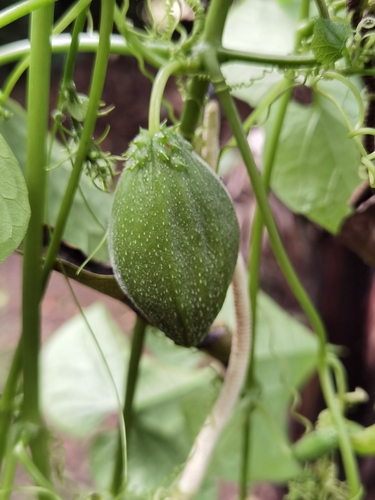
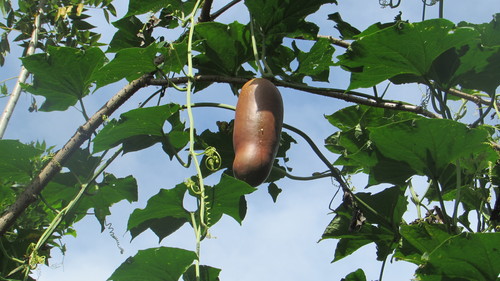
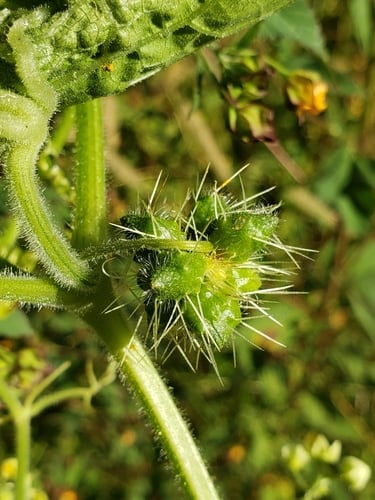
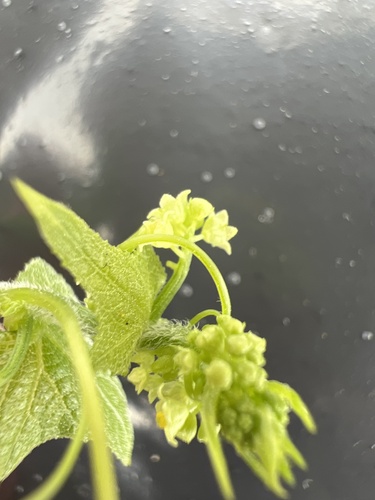
Source: WikipediaFevillea cordifolia, also known as javillo and antidote caccoon, is a climbing vine of up to 20 m of the family Cucurbitaceae and occurring in South and Central America in Bolivia, Brazil, Colombia, Costa Rica, Ecuador, Nicaragua, Panama, Peru and Venezuela. This dioecious species produces a globose, green fruit some 12 cm in diameter, dehiscing along a line about 2 cm from its base. Its leaves are 8-16 by 5.5–12 cm, entire, ovate-triangular or with 3-5 lobes, with axillary tendrils. Lax panicles are 10–15 cm long. Flowers with campanulate calyx, 5-lobed. Corolla with 5 lobes, yellow, orange or pink. The flowers with 5 stamens which are free, and with recurved filaments. The pistillate flowers produce a globose ovary with 3 carpels, and 3 styles more or less united. Seeds are numerous, orbicular or elliptical, and compressed. Seeds, which contain the glucoside fevicordin, produce a fat with buttery texture, investigated in the 1980s as an internal combustion engine fuel by ethnobotanist James A. Duke. In Costa Rica and Honduras the indigenous people use the seeds as a laxative and for treating ailments such as parasites, fever and stomach cramps, septicemia in farmyard animals, and diarrhea.
Description
A pumpkin family plant. It keeps growing from year to year. It climbs by tendrils in the axils of leaves. It grows 10 m long. The stems are green and a flat cylinder shape. They have lines along them when young. The branches hang down. The tendrils can be divided and 16 cm long. The leaves are alternate and 8-16 cm long by 4-12 cm wide. They are oval or can be 8 sided. The base is heart shaped. The edges curl up. The upper surfaces are dark green and shiny and the lower surfaces are dull pale green. The flowers are yellow to pink. The fruit are a flattened round shape. They are green and 8-12 cm across. The seeds are flattened and 3-6 cm across.
Edible Uses
Oil from the seeds is edible, and the seeds themselves are eaten.
Traditional Uses
The oil from the seeds is edible.
This uses section is brief — help expand it
Medicinal Uses
Traditionally used in native medicine as a purgative and antidote to various poisons. The seeds are antirheumatic. They are used as an antidote to manchineel poisoning and manioc poisoning. The seeds have been used with success, in the form of an emulsion, for treating intermittent fever, and as a counterpoison.
Known Hazards
The seeds are used in a hunting poison.
Distribution
It is a tropical plant. It grows along riverbanks and at the edges of forests. It grows from sea level to 500 m above sea level.
Where It Grows
Amazon, Argentina, Bolivia, Brazil, Caribbean, Central America, Colombia, Costa Rica, Cuba, Dominican Republic, Ecuador, French Guiana, Guatemala, Haiti, Hispaniola, Jamaica, Mexico, North America, Panama, Peru, Puerto Rico, South America, Trinidad-Tobago, Venezuela, West Indies, Winward Is.,
Cultivation
The seed content, on a weight per fruit basis, is higher than for any other dicotyledon and is one of the highest recorded for any plant.
Other Uses
The seeds are a rich source of oil, which has been used to make candles. The oil can be used for painting the face to make it shiny before painting it over with annatto (Bixa orellana). A good torch can be made by stringing the dried seeds together on a thin stick then setting light to it.
Synonyms
Also Known As
Abiria, Sta'cho, Ata muyu, Babilla, Fevillea, Janpatu panka, Jucu, Nhandiroba, Pepita amarga, Pusanka, Secua, Segra seed, Tsapatar, Uyama
References (9)
- Facciola, S., 1998, Cornucopia 2: a Source Book of Edible Plants. Kampong Publications, p 87
- Gentry, A. H., & Wettach, R. H., 1986, Fevillea - a New Oil Seed from Amazonian Peru. Economic Botany 40(2) pp 177-185
- Kermath, B. M., et al, 2014, Food Plants in the Americas: A survey of the domesticated, cultivated and wild plants used for Human food in North, Central and South America and the Caribbean. On line draft. p 368
- Kew Plants of the World Online
- Plants of Haiti Smithsonian Institute http://botany.si.edu/antilles/West Indies
Show all 9 references Hide references
- Roa, J. A. G. & Boada, D. S. G., 2018, Fundación para el Fortalecimiento de la Fruticultura y Plantas Alimenticias no Convencionales en Colombia.
- Sp. pl. 2:1013. 1753
- Torre, de la, L., et al, 2008, Enciclopedia de las Plantas Útiles del Ecuador. Herbario QCA. Pontificia Universidad Católica del Ecuador. p 299
- Vasquez, R. and Gentry, A. H., 1989, Use and Misuse of Forest-harvested Fruits in the Iquitos Area. Conservation Biology 3(4): 350f