Searsia undulata
(Jacq.) Moffett
Kuni bush
iNaturalist· cc-by-nc
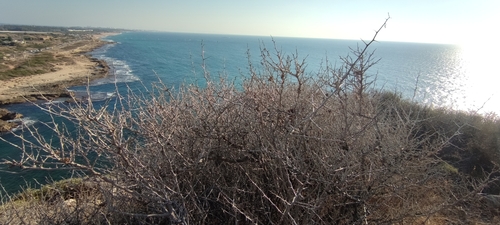
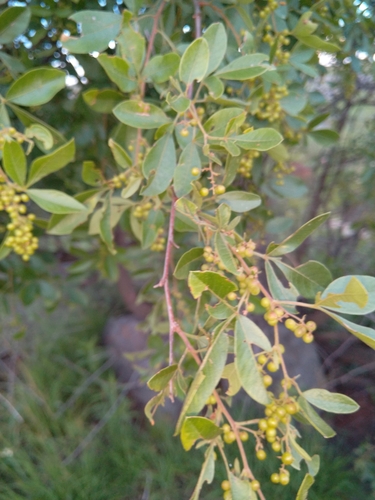
(c) Dave Richardson, some rights reserved (CC BY-NC), uploaded by Dave Richardson
iNaturalist· cc-by-nc
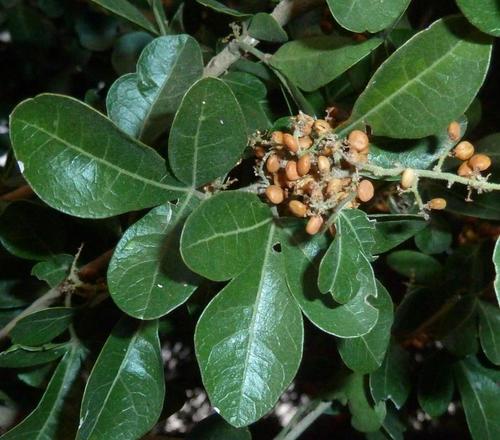
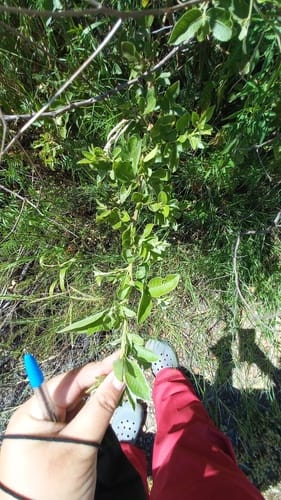
(c) Alex Dreyer, some rights reserved (CC BY-NC), uploaded by Alex Dreyer
iNaturalist· cc-by-nc
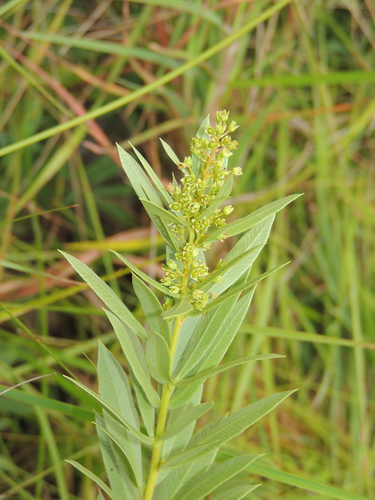
(c) Marian Oliver, some rights reserved (CC BY-NC), uploaded by Marian Oliver
Description
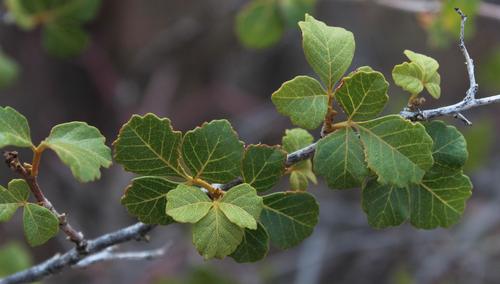
An evergreen shrub or small tree. It has several stems. The leaves have a scent. The bark has spines. The bark is grey and smooth. It grows up to 3-5 m high. The leaves are divided into 3 small leaflets. The edges of the leaves are wavy. The flowers are small and green or cream. They are in heads 5 cm long in the axils of leaves or near the ends of branches. The fruit are shiny and green but turn red when ripe. They are round and 5-6 mm across.
Edible Uses
The round red fruit are eaten fresh (rubbed between the hands to remove the tough skin), used in porridges (husked and soaked in milk for 4 hours), prepared as relishes fresh or dried, and used in beer production.
Traditional Uses
The fruit are eaten. The fruit are rubbed between the hands to remove the tough skin then eaten fresh. They are used for porridges and in relishes. The dried fruit are eaten as a relish. For porridge they are cleaned of their husks and put in milk for 4 hours before eating. They are also used for beer.
Distribution
It is a subtropical plant. It grows on sandy soils or amongst rocks that are neutral or alkaline. In southern Africa it grows between 20-1,250 m altitude. It is often in dry, semi-desert places. It can grow in arid places.
Where It Grows
Africa, Botswana, Lesotho, Namibia, South Africa, Southern Africa,
Other Uses
The bark is a source of tannins.
Synonyms
Also Known As
Njarabessie, Rosyntjienbos, Tgarra
References (13)
- INFOODS:FAO/INFOODS Databases (As Rhus undulata)
- Mannheimer, C. A. & Curtis. B.A. (eds), 2009, Le Roux and Muller's Field Guide to the Trees and Shrubs of Namibia. Windhoek: Macmillan Education Namibia. p 290
- Moffett, R. O., 2007, Name changes in the Old World Rhus and recognition of Searsia (Anacardiaceae). Bothalia 37,2: 165-175 (2007)
- Pl. hort. schoenbr. 3:52, t. 346. 1798 (As Rhus undulata)
- Royal Botanic Gardens, Kew (1999). Survey of Economic Plants for Arid and Semi-Arid Lands (SEPASAL) database. Published on the Internet; http://www.rbgkew.org.uk/ceb/sepasal/internet [Accessed 28th March 2011] (As Rhus undulata)
Show all 13 references Hide references
- Ruiters-Welcome, A. K., 2019, Food plants of southern Africa. Ph.D. thesis. Univ. of Johannesburg p 17
- Sullivan, S., 1998, People plants and practice in drylands: Socio-political and ecological dimensions of resource-use by Damara farmers in north-west Namibia. Ph.D. Univ. College London. (As Rhus undulata)
- van Wyk, Be., & Gericke, N., 2007, People's plants. A Guide to Useful Plants of Southern Africa. Briza. p 56, 110 (As Rhus undulata)
- van Wyk, Br., van Wyk, P, and van Wyk B., 2000, Photographic guide to Trees of Southern Africa. Briza. p 10, (As Rhus undulata)
- van Wyk, B-E., 2011, The potential of South African plants in the development of new food and beverage products. South African Journal of Botany 77 (2011) 857–868
- Wehmeyer, A. S, 1986, Edible Wild Plants of Southern Africa. Data on the Nutrient Contents of over 300 species. (As Rhus undulata)
- Welcome, A. K. & Van Wyk, B.-E., 2019, An inventory and analysis of the food plants of southern Africa. South African Journal of Botany 122 (2019) 136–179
- World Checklist of Useful Plant Species 2020. Royal Botanic Gardens, Kew