Searsia pentheri
(Zahlbr.) Moffett
Common crow-berry
iNaturalist· cc-by-sa
(c) M Kriek, some rights reserved (CC BY-SA), uploaded by M Kriek
iNaturalist· cc-by-sa
(c) M Kriek, some rights reserved (CC BY-SA), uploaded by M Kriek
iNaturalist· cc-by-sa
(c) Andrew Hankey, some rights reserved (CC BY-SA), uploaded by Andrew Hankey
Summary
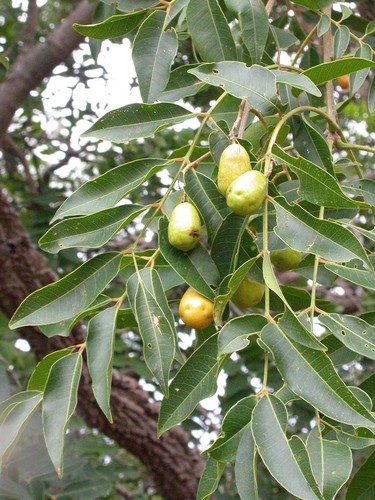
Source: WikipediaSearsia pentheri, the common crowberry (English), gewone kraaibessie (Afrikaans), iNhlokoshiyane (Zulu), or mutasiri (Venda), is a species of tree in the genus Searsia. Frost hardy tree reaching a height of up to 6 metres. The tree is mainly evergreen but loses its leaves in severe winters. It has olive-green foliage with dark brown bark and can be grown in either full sun or semi shade. Small flowers are produced and are followed by masses of shiny, light brown, small edible fruits, which provide a feast for birds. Only female trees produce these fruits though. The tree occurs over large portions of South Africa. It has been planted in Spain.
Description
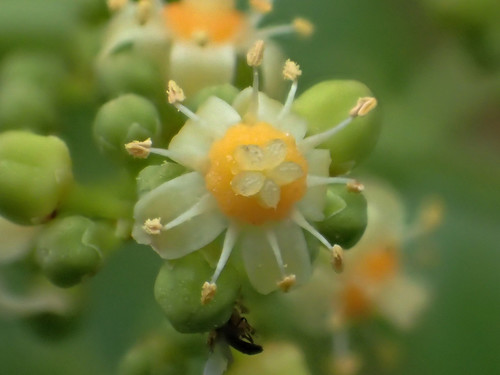
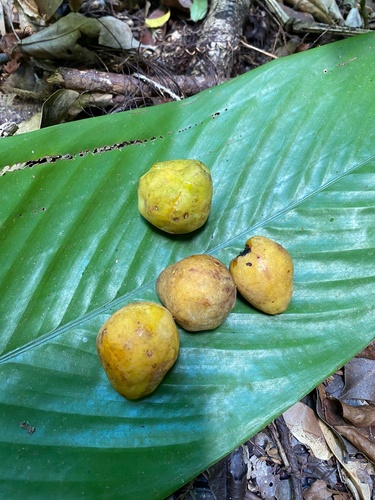
A shrub or small tree. It grows 2-6 m tall. It is densely leafy. They are fine greyish covering. The leaves are small. The leaf stalk is less than 1 cm long. The leaflets taper to the base. They are 2.5 cm long by 1 cm wide. The flowering stalks are mostly along the sides. The fruit are 4 mm across. They are orange or yellow.
Edible Uses
The fruits are eaten raw.
Traditional Uses
The fruit are eaten raw.
This uses section is brief — help expand it
Distribution
It is a tropical plant. It grows on stony ground near seasonally flowing streams. It can grow in arid places.
Where It Grows
Africa, East Africa, Eswatini, Mozambique, South Africa, Southern Africa, Swaziland,
Synonyms
Also Known As
Gewone kraai-bessie, Ihlolokotshane, Inhlokoshiyane, Mabele, Mutsasiri, Sitsatsatsa
References (12)
- Fox, F. W. & Young, M. E. N., 1982, Food from the Veld. Delta Books. p 76 (As Rhus pentheri)
- Joffe, P., 2007, Creative Gardening with Indigenous Plants. A South African Guide. Briza. p 62 (As Rhus pentheri)
- Long, C., 2005, Swaziland's Flora - siSwati names and Uses http://www.sntc.org.sz/flora/ (As Rhus pentheri)
- Moffett, R. O., 2007, Name changes in the Old World Rhus and recognition of Searsia (Anacardiaceae). Bothalia 37,2: 165-175 (2007)
- Ogle & Grivetti, 1985, (As Rhus pentheri)
Show all 12 references Hide references
- Peters, C. R., O'Brien, E. M., and Drummond, R.B., 1992, Edible Wild plants of Sub-saharan Africa. Kew. p 51 (As Rhus pentheri)
- Royal Botanic Gardens, Kew (1999). Survey of Economic Plants for Arid and Semi-Arid Lands (SEPASAL) database. Published on the Internet; http://www.rbgkew.org.uk/ceb/sepasal/internet [Accessed 28th March 2011] (As Rhus pentheri)
- Ruiters-Welcome, A. K., 2019, Food plants of southern Africa. Ph.D. thesis. Univ. of Johannesburg p 16
- Shava, S., 2000, The Use of Indigenous Plants as Food by a Rural Community in the Eastern Cape: an Educational Exploration. Masters Thesis Rhodes University. p 66 (As Rhus pentheri)
- Swaziland's Flora Database http://www.sntc.org.sz/flora (As Rhus pentheri)
- Welcome, A. K. & Van Wyk, B.-E., 2019, An inventory and analysis of the food plants of southern Africa. South African Journal of Botany 122 (2019) 136–179
- World Checklist of Useful Plant Species 2020. Royal Botanic Gardens, Kew