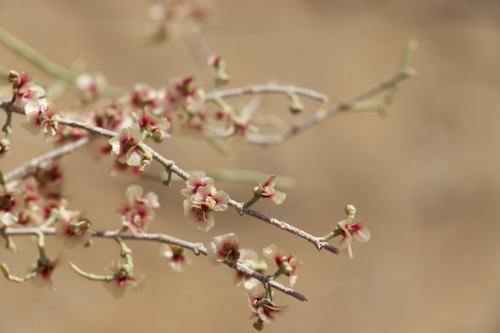
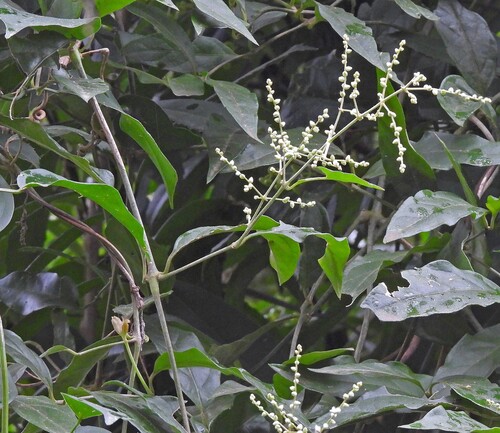
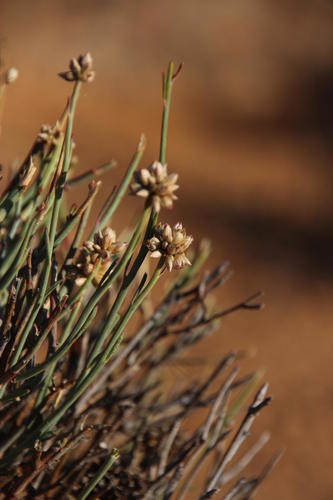
Achyranthes bidentata
Blume
Chaff-flower, Two-toothed amaranthus
iNaturalist· cc-by-sa
(c) harum.koh, some rights reserved (CC BY-SA), uploaded by harum.koh
iNaturalist· cc-by
(c) WATANABE Hitoshi 渡辺仁, some rights reserved (CC BY), uploaded by WATANABE Hitoshi 渡辺仁
iNaturalist· cc-by-nc
(c) sandy-huiping, some rights reserved (CC BY-NC), uploaded by sandy-huiping
Summary
Source: WikipediaAchyranthes bidentata Blume (English common name: ox knee, Chinese: 牛膝 niu xi) is a species of flowering plant in the amaranth family, Amaranthaceae. It occurs in India, Nepal, Korea, China, and Japan. It is the source of the Chinese herbal medicine Huai'niuxi (Chinese: 怀牛膝; pinyin: Huái'niúxī). In Nepal its root juice is used for toothache. Its seeds have been used as a substitute for cereal grains in famine years. The plant is used externally in the treatment of leech bites in Mizoram, India and a decoction as a diuretic. During the Chinese Liang Dynasty, Achyranthes bidentata was used for its abortion effectiveness. Chinese folk doctors would take the juices of crushed up Achyranthes bidentata and insert them into the vagina to induce abortion. This abortive technique was common among folk medicine practitioners in southern China during the Republican period. Achyranthes bidentata is now used for other things such as osteoperosis and arthritis, and known for its anti-inflammatory effects.
Description
A shrub or small tree. It grows 5 m tall. There are prickles along the stem. The leaves are twice divided and there are 8-18 pairs of pinnae. There are up to 50 pairs of pinnules on each pinnae. The flowers are yellow. They are in large clusters at the ends of branches. The pods are flattened.
Edible Uses
The seeds are edible when cooked and make a good substitute for cereal grains in bread-making, a purpose for which they have frequently been used during famine years. The light brown, oblong seed is about 1mm long. Leaves are edible cooked and can be used as a vegetable in the same manner as spinach.
Traditional Uses
The seed are cooked and used in bread. The leaves can be eaten cooked. They are also boiled with egg. The roots are cooked with meat for soup.
This uses section is brief — help expand it
Medicinal Uses
The roots, leaves and stems are widely used in Chinese herbal medicine. The roots contain triterpenoid saponins, sitosterol and sigmasterol, and are anodyne, anti-inflammatory, antirheumatic, bitter, digestive, diuretic, emmenagogue and vasodilator. They act predominantly on the lower half of the body and are used to treat aching back and knees and asthenia of the lower limbs. Research suggests the herb can cause dilation of the cervix and should not be used during pregnancy. Taken internally, it is used to treat hypertension, back pain, blood in the urine, menstrual pain and bleeding. It lowers blood cholesterol levels and is used in the treatment of atherosclerosis. Root juice is used in Nepal to treat toothache, indigestion and is considered a good treatment for asthma. The stem is used as a toothbrush said to benefit the teeth and treat pyorrhoea. The plant can be used fresh or dried. Leaves and stems are harvested in summer and usually crushed for juice or used in tinctures. Roots are harvested from one- or two-year-old plants in autumn or winter and typically dried and ground into powder or used in decoctions.
Known Hazards
Should not be used when pregnant due to potential cervical dilation effects.
Distribution
It is a tropical and subtropical plant. It occurs from 250-2100 m altitude in Papua New Guinea. It grows in shady places and is often in forest. It prefers a rich sandy slightly acidic soil. It is cultivated in North China.
Where It Grows
Angola, Australia, Asia, Bhutan, Cameroon, Central Africa, China, East Africa, Himalayas, India, Indochina, Indonesia, Japan, Korea, Laos, Malawi, Malaysia, Myanmar, Nepal, Northeastern India, Pacific, Pakistan, Papua New Guinea, PNG, Philippines, Russia, SE Asia, Sikkim, Thailand, Vietnam,
Cultivation
Prefers a rich, sandy, slightly acid soil in partial shade. This species is probably not hardy in the colder areas of the country, it tolerates temperatures down to at least -5°c. When grown in a rich soil the roots can be up to 1.2 metres long. Widely cultivated in China, especially in Henan Province, as a medicinal plant and as a food plant.
Propagation
Seed - sow in late spring in a greenhouse. Germination should be fairly rapid. Prick out seedlings into individual pots of fairly rich soil when large enough to handle. It is advisable to grow the plant on in the greenhouse through its first winter, planting out into its permanent position in late spring after the last expected frosts.
Other Uses
Two insect-moulting hormones are found in the roots, which may have potential as an insecticide. The stem is used as a toothbrush said to benefit the teeth and treat pyorrhoea.
Other Information
It is not known if it is used as a food in PNG. It is cultivated in north China.
Notes
It is commonly cultivated in Henan Province in China as a food and medicine. There are 6 Achyranthes species. The grow in tropical and warm temperate regions.
Also Known As
Co suot hai-rang, Datiwan, Kozhivalan, Nguutat, Niuxi, Niu Xi, Ox knee, Sennayuruvi
References (19)
- Bao Bojian; Steve Clemants, Thomas Borsch, Amaranthaceae [Draft], Flora of China
- Bijdr. 545. 1826
- Bircher, A. G. & Bircher, W. H., 2000, Encyclopedia of Fruit Trees and Edible Flowering Plants in Egypt and the Subtropics. AUC Press. p 7
- Brown, D., 2002, The Royal Horticultural Society encyclopedia of Herbs and their uses. DK Books. p 99
- Burkill, I.H., 1966, A Dictionary of the Economic Products of the Malay Peninsula. Ministry of Agriculture and Cooperatives, Kuala Lumpur, Malaysia. Vol 1 (A-H) p 33
Show all 19 references Hide references
- Hedrick, U.P., 1919, (Ed.), Sturtevant's edible plants of the world. p 23
- Kang, Y., et al, 2012, Wild food plants and wild edible fungi in two valleys on the Qinling Mountains (Shaanxi, central China) Journal of Ethnobiology and Ethnomedicine; 9:26
- Kang, Y., et al, 2012, Wild food plants and wild edible fungi of Heihe valley (Qinling Mountains, Shaanxi, central China): Herbophilia and indifference to fruits and mushrooms. Acta Societas Botanicorum Poloniae 81(4):4-5-413
- Kanis, A in Womersley, J.S., (Ed), 1978, Handbooks of the Flora of Papua New Guinea. Melbourne University Press. Vol 1. p 15
- Manandhar, N.P., 2002, Plants and People of Nepal. Timber Press. Portland, Oregon. p 69
- Menninger, E.A., 1977, Edible Nuts of the World. Horticultural Books. Florida p 145
- Narayanan Ratheesh, M. K. et al, 2011, Wild edible plants used by the Kattunaikka, Paniya and Kuruma tribes of Wayanad District, Kerala, India. Journal of Medicinal Plants Research Vol. 5(15), pp. 3520-3529
- Pham-Hoang Ho, 1999, An Illustrated Flora of Vietnam. Nha Xuat Ban Tre. p 730
- Plants for a Future database, The Field, Penpol, Lostwithiel, Cornwall, PL22 0NG, UK. http://www.scs.leeds.ac.uk/pfaf/
- READ
- Saxena, H. O., 1986, Observations on the Ethnobotany of Madhya Pradesh. Bull. Bot. Surv. India. Vol. 28. Nos 1-4 pp 149-156
- Sivakumar, A. & Murugesan, M., 2005, Ethnobotanical Studies of the wild edible plants used by the tribals of the Anaimalai Hills, the Western Ghats. Ancient Science of Life. XXV(2) Oct-Dec.
- World Checklist of Useful Plant Species 2020. Royal Botanic Gardens, Kew
- www.eFloras.org Flora of China