Camellia japonica
L.
Garden Camellia, Japanese Camellia, Mountain tea
iNaturalist· cc-by-nc
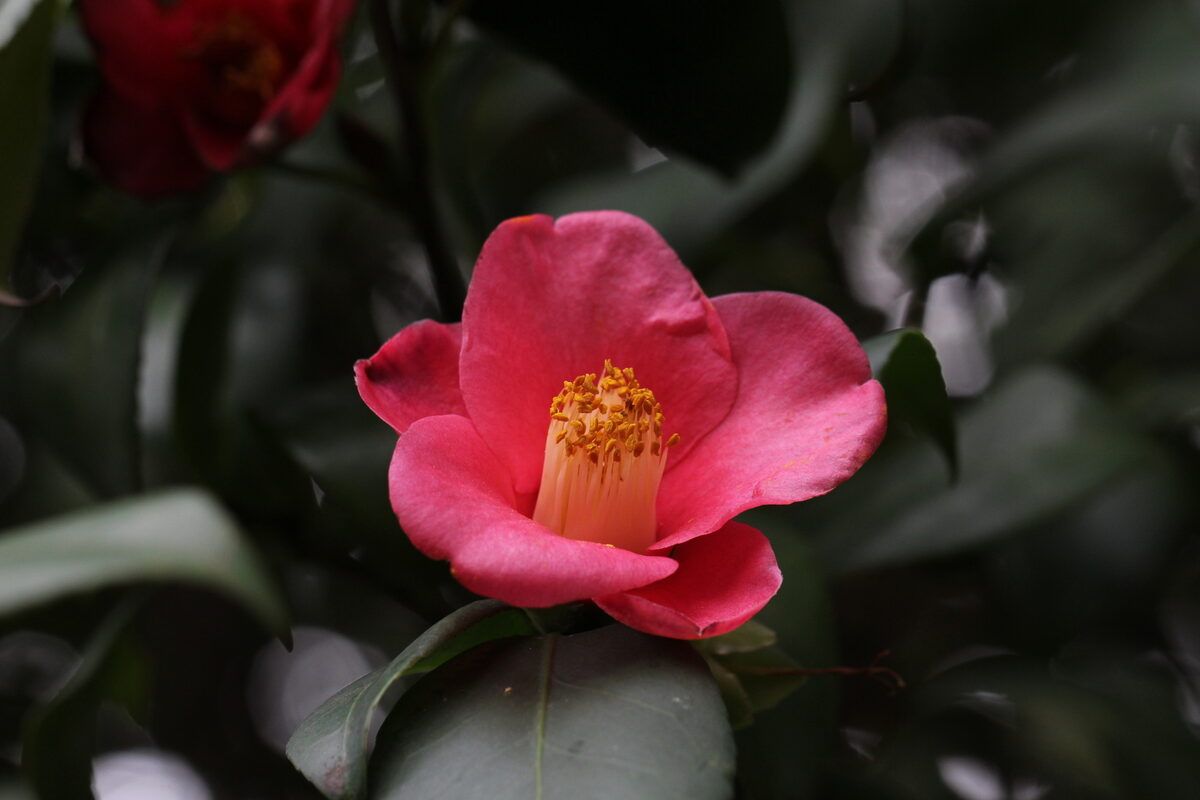
(c) Observações Naturalistas | Bruno Uehara, some rights reserved (CC BY-NC), uploaded by Observações Naturalistas | Bruno Uehara
iNaturalist· cc-by-nc
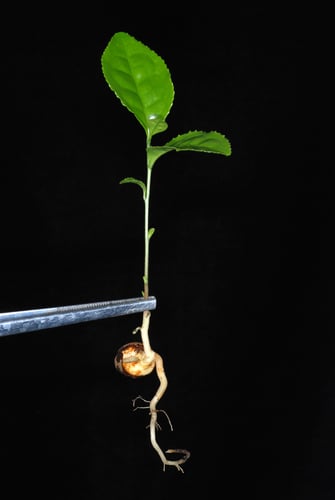
(c) 空猫 T. N, some rights reserved (CC BY-NC)
Summary
Source: WikipediaCamellia japonica, known as common camellia, or Japanese camellia, is a species of flowering plant from the genus Camellia in the tea family Theaceae. It is native to China and Japan, and grows naturally in forests at altitudes of around 300–1,100 metres (980–3,600 ft). There are thousands of cultivars of C. japonica, with many colors and forms of flowers, mainly as garden ornamental plants. The floriculture of Camellia japonica started in China. Its widespread cultivation can be traced back to the Song Dynasty, when 15 varieties of Camellia japonica were recorded in literature.
Description
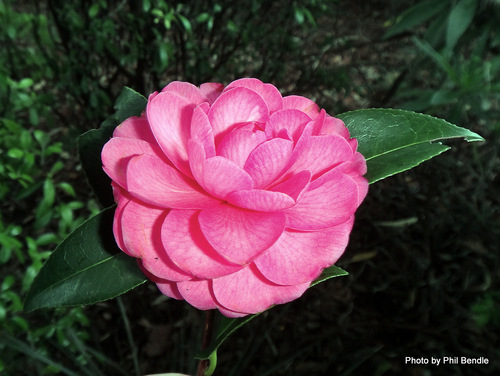
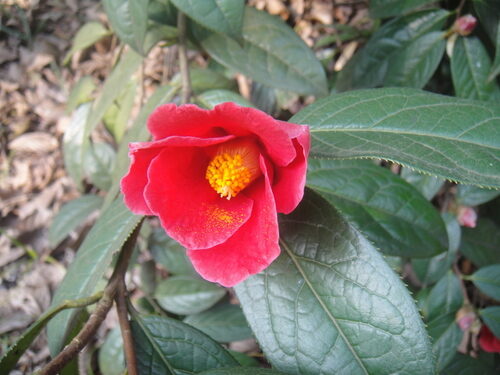
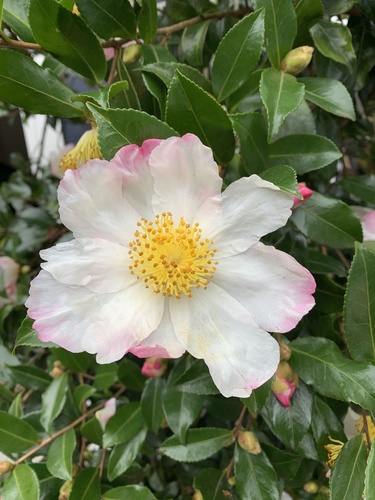
A shrub or small tree. It grows 1.8-7.5 m tall. It spreads 1.8-6 m wide. The leaves are glossy on the top surface and dull and spotted underneath. They are broadly oval and pointed. The flowers are large and red. The fruit vary in size. Many named varieties occur.
Edible Uses
Edible Parts: Flowers Oil Oil Edible Uses: Oil Oil Tea An edible oil is obtained from the seed. It is called 'tsubaki oil'. Dried flowers - cooked. Used as a vegetable or mixed with gelatinous-rice to make a Japanese food called 'mochi'. The leaves are a tea substitute.
Traditional Uses
The leaves are used as a substitute for tea. The seeds used to produce an edible oil. The peppery leaves are eaten fresh. They are also used as a wrapping. The dried flowers are eaten as a vegetable.
Medicinal Uses
Astringent Cancer Haemostatic Salve Tonic The flowers are astringent, antihaemorrhagic, haemostatic, salve and tonic. When mixed with sesame oil they are used in the treatment of burns and scalds. The plant has shown anticancer activity.
Distribution
It is a temperate plant. It is resistant to frost but sensitive to drought. In Japan it grows along river banks and on the edges of forests. It grow in forests between 300-1,100 m above sea level. It suits hardiness zones 8-10. Arboretum Tasmania. They do well with a pH of 4.5-5.5. In Yunnan.
Where It Grows
Africa, Asia, Australia, China, East Africa, Europe, Georgia, Hawaii, India, Indochina, Indonesia, Japan*, Korea, Pacific, Sao Tome and Principe, SE Asia, Slovenia, Spain, Taiwan, Tasmania, USA, Vietnam, Zimbabwe,
Cultivation
Prefers a woodland soil but thrives in a warm open well-drained loam if leafmould is added. A calcifuge plant, preferring a pH around 5. Prefers the partial shade of a light woodland, it also grows well on a north-west aspect and on sunless walls. This is a very cold hardy plant, but it cannot tolerate cold winds. Plants should be given a position shaded from the morning sun in order to protect the flowers from late frosts. Prefers a wet summer and a cool but not very frosty dry winter. Plants are not very self-compatible, self-fertilized flowers produce few seeds and these are of low viability. A very ornamental plant. A large amount of named forms have been developed, mainly for their ornamental value. Many of them tolerate full sun. Camellias are a valuable commercial crop in Asia, where they are cultivated for the oil obtained from their seed. Many of the cultivars grown in Britain do not set seed, unfortunately. The following cultivars have been seen with good crops of seeds:- 'Alba Simplex'; 'Coppelia'; 'Guillio Nuccio'; 'Jupiter'.The sub-species C. japonica macrocarpa. Masam. has larger fruits than the type, looking like small apples. The sub-species C. japonica rusticana (Honda.)Kitamura. is a hardier form from N. Japan where it grows at higher altitudes than the species and withstands long snowy winters.
Propagation
Seed - can be sown as soon as it is ripe in a greenhouse. Stored seed should be pre-soaked for 24 hours in warm water and the hard covering around the micropyle should be filed down to leave a thin covering. It usually germinates in 1 - 3 months at 23°c. Prick out the seedlings into individual pots when they are large enough to handle and grow them on in light shade in the greenhouse for at least their first winter. Plant them out into their permanent positions when they are more than 15cm tall and give them some protection from winter cold for their first year or three outdoors. Cuttings of almost ripe wood, 10 - 15cm with a heel, August/September in a shaded frame. High percentage but slow. Cuttings of firm wood, 7 - 10cm with a heel, end of June in a frame. Keep in a cool greenhouse for the first year. Leaf-bud cuttings, July/August in a frame.
Other Uses
Dye Oil Oil A non-drying oil is obtained from the seed - used as a hair-dressing. The oil consists mainly of olein it is not subject to polymerize or oxidize, nor does it form solids at low temperatures. A green dye is obtained from the pink or red petals. Special Uses Espalier
Notes
There are about 250-300 Camellia species.
Synonyms
Also Known As
Dongbaek-kkambugi, False flax, Gold of pleasure, Japonska kamelija, Kamelia jepang, Mawar musim dingin, Rose of winter, Shancha, Siberian oil seed, Trahoa nhat, Tsitsmati
References (24)
- Ambasta S.P. (Ed.), 2000, The Useful Plants of India. CSIR India. p 99
- Benvenuti, S. & Mazzoncini, M., 2021, The Biodiversity of Edible Flowers: Discovering New Tastes and New Health Benefits. Frontiers in Plant Science Article 569499.
- Bircher, A. G. & Bircher, W. H., 2000, Encyclopedia of Fruit Trees and Edible Flowering Plants in Egypt and the Subtropics. AUC Press. p 76
- Bodkin, F., 1991, Encyclopedia Botanica. Cornstalk publishing, p 207
- Bonet, M. A. & Valles, J., 2002, Use of non-crop food vascular plants in Montseny biosphere reserve (Catalonia, Iberian Peninsula). International Journal of Food Sciences and Nutrition (2002) 53, 225–248
Show all 24 references Hide references
- Brouk, B., 1975, Plants Consumed by Man. Academic Press, London. p 354
- Burkill, I.H., 1966, A Dictionary of the Economic Products of the Malay Peninsula. Ministry of Agriculture and Cooperatives, Kuala Lumpur, Malaysia. Vol 1 (A-H) p 421
- Chen, B. & Qiu, Z., Consumer's Attitudes towards Edible Wild Plants, Ishikawa Prefecture, Japan. p 22 www.hindawi.com/journals/ijfr/aip/872413.pdf
- Cundall, P., (ed.), 2004, Gardening Australia: flora: the gardener's bible. ABC Books. p 294
- Facciola, S., 1998, Cornucopia 2: a Source Book of Edible Plants. Kampong Publications, p 57, 69
- Heywood, V.H., Brummitt, R.K., Culham, A., and Seberg, O. 2007, Flowering Plant Families of the World. Royal Botanical Gardens, Kew. p 318
- Joyce, D., 1998, The Garden Plant Selector. Ryland, Peters and Small. p 128
- Liu, Yi-tao, & Long, Chun-Lin, 2002, Studies on Edible Flowers Consumed by Ethnic Groups in Yunnan. Acta Botanica Yunnanica. 24(1):41-56
- Lord, E.E., & Willis, J.H., 1999, Shrubs and Trees for Australian gardens. Lothian. p 210
- Martin, F.W. & Ruberte, R.M., 1979, Edible Leaves of the Tropics. Antillian College Press, Mayaguez, Puerto Rico. p 107
- Ong, H. G., et al, 2015, Ethnobotany of the wild edible plants gathered in Ulleung Island, South Korea. Genet Resourc Crop Evol. Springer
- Pham-Hoang Ho, 1999, An Illustrated Flora of Vietnam. Nha Xuat Ban Tre. p 427
- Sp. pl. 2:698. 1753
- Staples, G.W. and Herbst, D.R., 2005, A tropical Garden Flora. Bishop Museum Press, Honolulu, Hawaii. p 543
- Sukarya, D. G., (Ed.) 2013, 3,500 Plant Species of the Botanic Gardens of Indonesia. LIPI p 602
- Valder, P., 1999, The Garden Plants of China. Florilegium. p 142
- Woo, Y., et al, 2017, Antioxidant Potential of Selected Korean Edible Plant Extracts. Hindawi BioMed Research International Volume 2017, Article ID 7695606
- World Checklist of Useful Plant Species 2020. Royal Botanic Gardens, Kew
- Young, J., (Ed.), 2001, Botanica's Pocket Trees and Shrubs. Random House. p 179