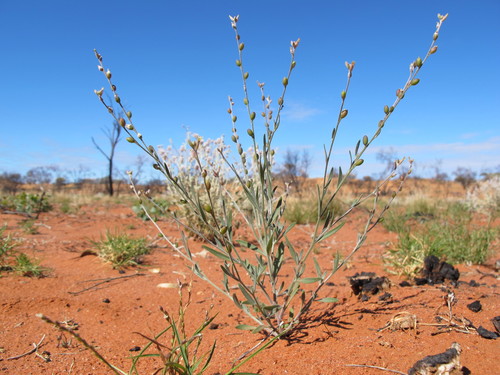
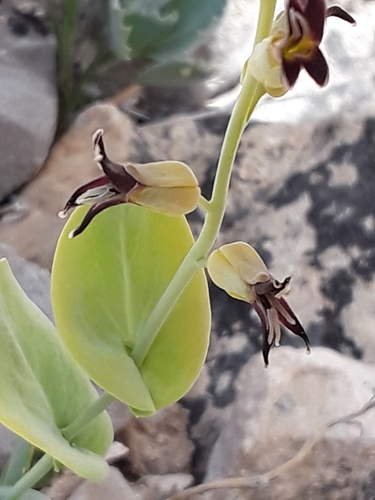
Schouwia purpurea
(Forssk.) Schweinf.
iNaturalist· cc-by-nc
(c) spookyboy, some rights reserved (CC BY-NC)
iNaturalist· cc-by-nc
(c) spookyboy, some rights reserved (CC BY-NC)
iNaturalist· cc-by-nc-nd
(c) Larbi Afoutni, some rights reserved (CC BY-NC-ND), uploaded by Larbi Afoutni
Description
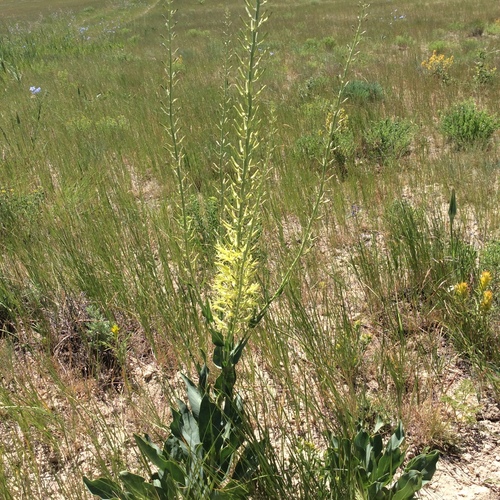
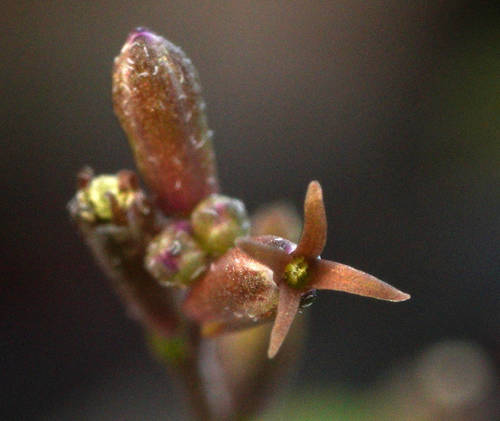
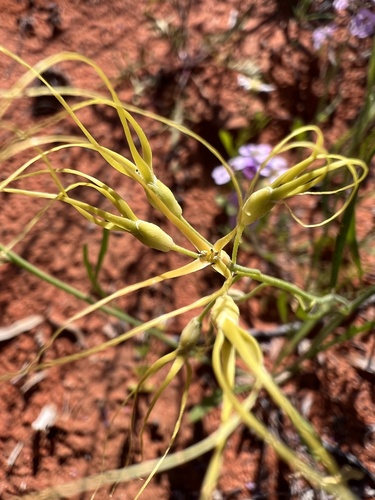
An annual herb. It is erect and grows 1 m tall. The stem becomes woody at the base. There are branches in the upper part. The leaves are simple and alternate. They do not have a leaf stalk and clasp the stem at the base. The leaves are rather fleshy. The leaves are 2-6 cm long by 2-4 cm wide. The leaves become smaller up the plant. The flowers are in a flat topped group. The flowers have both sexes. The fruit is a round pod. It is flattened and has wings. It is 2-4 cm across. It has a beak 1 cm long. It opens with 2 valves. There are many seeds. The seeds are round and 2 mm across.
Edible Uses
The leaves are eaten cooked, dried, or fresh in salads and soups. It is a minor vegetable but locally important in arid regions.
Traditional Uses
The leaves are eaten cooked or dried. The young leaves can be eaten in salads. They are also used in soups.
This uses section is brief — help expand it
Distribution
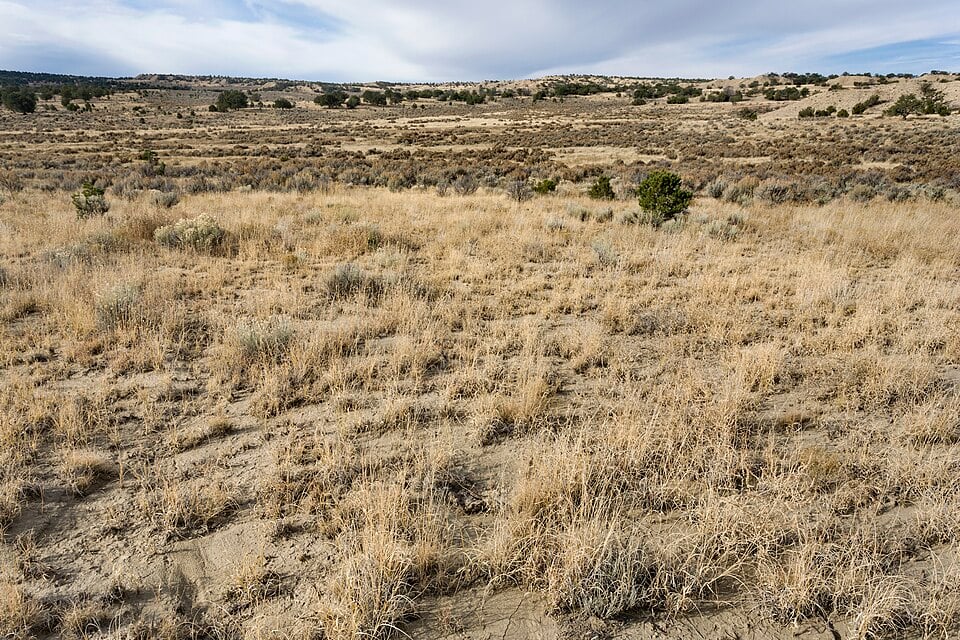
It is a tropical plant. It appears after rains in the Sahara in West Africa. It can grow in arid places. It is a desert and savannah plant. It grows from sea level to 1,500 m above sea level. It grows in the Sahel.
Where It Grows
Africa, Burkina Faso, Djibouti, East Africa, Mali, Mauritania, Mediterranean, Middle East, Morocco, North Africa, Sahara, Sahel, Saudi Arabia, Somalia, West Africa,
Cultivation
Schouwia purpurea is a plant of arid and semiarid areas of the tropics and subtropics of Africa, where it is found at elevations up to 1,500 metres. Schouwia purpurea is of entomological importance since it provides feed and shelter for the desert locust, Schistocerca gregaria, which sometimes develops migrating populations of plague size and may destroy crops completely.
Other Uses
Dry plants are burnt as a fuel.
Other Information
It is a minor vegetable but important locally in arid areas.
Notes
There is only one variable species of Schouwia.
Nutrition
| Part | Moisture | kJ | kcal | Protein | Vit A | Vit C | Iron | Zinc |
|---|---|---|---|---|---|---|---|---|
| Leaves | — | — | 7 | — | — | — | — | — |
Synonyms
Also Known As
Alouat, Jerjir
References (8)
- Burkill, H. M., 1985, The useful plants of west tropical Africa, Vol. 1. Kew.
- Dalziel, J. M., 1937, The Useful plants of west tropical Africa. Crown Agents for the Colonies London.(As Schouwia arabica)
- Grubben, G. J. H. and Denton, O. A. (eds), 2004, Plant Resources of Tropical Africa 2. Vegetables. PROTA, Wageningen, Netherlands. p 454
- Monod, T., (On wild edible plants of Mauritania)
- Nassif, F., & Tanji, A., 2013, Gathered food plants in Morocco: The long forgotten species in Ethnobotanical Research. Life Science Leaflets 3:17-54
Show all 8 references Hide references
- Peters, C. R., O'Brien, E. M., and Drummond, R.B., 1992, Edible Wild plants of Sub-saharan Africa. Kew. p 98 (As Schouwia schimperi)
- Rivera, D. et al, 2006, Gathered Mediterranean Food Plants - Ethnobotanical Investigations and Historical Development, in Heinrich M, Müller WE, Galli C (eds): Local Mediterranean Food Plants and Nutraceuticals. Forum Nutr. Basel, Karger, 2006, vol 59, pp 18–74
- World Checklist of Useful Plant Species 2020. Royal Botanic Gardens, Kew