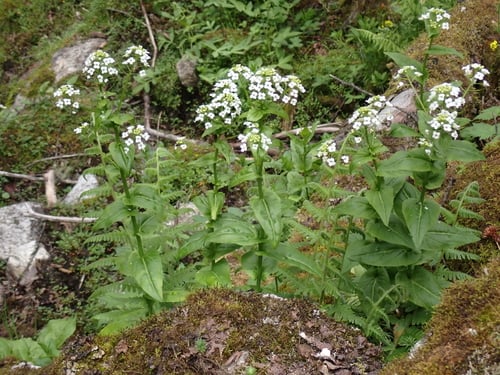
Brassica rapa parachinensis - (L.H.Bailey.)Hanelt.
(L.H.Bailey.)Hanelt.
False Pak Choi
gbif· cc-by-nc
chanmanyi
Description
Brassica rapa parachinensis is a BIENNIAL growing to 0.3 m (1ft). See above for USDA hardiness. It is hardy to UK zone 7 and is not frost tender. It is in flower from May to August. The species is hermaphrodite (has both male and female organs) and is pollinated by Bees. The plant is self-fertile. Suitable for: light (sandy), medium (loamy) and heavy (clay) soils and prefers well-drained soil. Suitable pH: mildly acid, neutral and basic (mildly alkaline) soils. It can grow in semi-shade (light woodland) or no shade. It prefers moist soil.
Edible Uses
Leaves - raw or cooked. They can be eaten at any stage from seedling to mature plant. The leaves are tougher and stronger flavoured than standard Pak choi. The flavour is enhanced after a touch of frost. The leaves are said to be very nutritious, with up to twice the mineral content of Pak choi. Immature flowering stems - cooked like broccoli. A sweet flavour. An edible oil is obtained from the seed.
Distribution
A cultivar of garden origin.
Where It Grows
(Brassica rapa) Albania, Algeria, Bulgaria, Eritrea, Ethiopia, Greece, Iran, Iraq, Italy, Kriti, Lebanon-Syria, Libya, Morocco, North Caucasus, Oman, Palestine, Saudi Arabia, Transcaucasus, Tunisia, Turkey, Yugoslavia.
Cultivation
Succeeds in full sun in a well-drained fertile preferably alkaline soil. Prefers a pH of 5.5 to 7. Prefers a cool moist reasonably fertile soil. The plant is shallow rooted and intolerant of drought, it responds well to a moist fertile soil but succeeds in poorer soils than standard Pak choi. Hardy to about -10°c, the plants stand up well to snow but are less likely to stand up to prolonged winter wet. The prostrate forms are hardier than semi-prostrate forms. The rosette pak choi is widely cultivated in China for its edible leaves, there are several named varieties. It is slower-growing than standard Pak choi, B. rapa chinensis.
Propagation
Seed - sow in situ July/August. Spring sown crops are prone to run quickly to seed if there is a spell of cold weather. Some varieties can also be sown in a cold greenhouse in autumn or early spring to provide leaves overwinter and in late spring.