Culcasia scandens
(Willd.) P. Beauv.
iNaturalist· cc-by-nc-sa
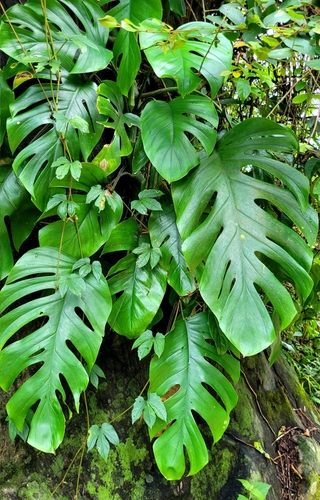
(c) Marco Schmidt, some rights reserved (CC BY-NC-SA), uploaded by Marco Schmidt
iNaturalist· cc-by-nc
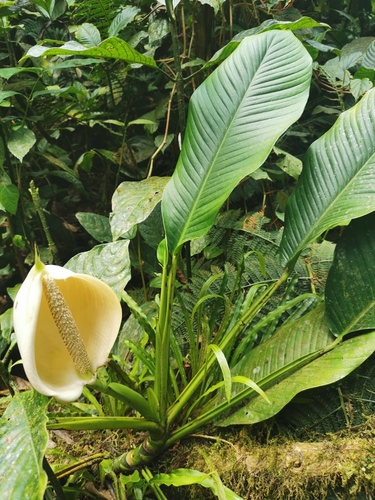
(c) Bart Wursten, some rights reserved (CC BY-NC)
Summary
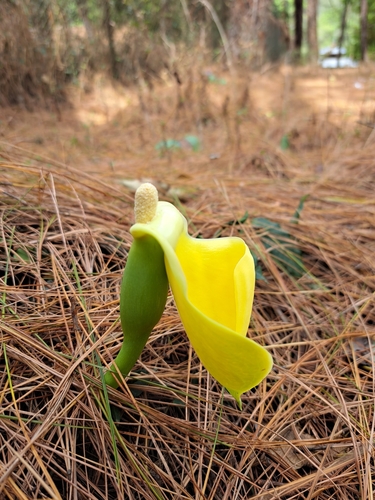
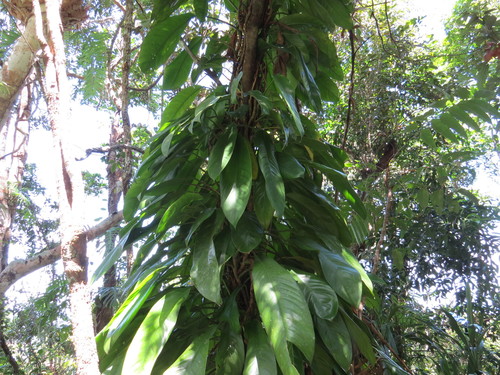
Source: WikipediaCulcasia scandens is an African climbing plant, often epiphytic, with slender, wiry stems, up to 5 m long clinging to tree trunks by means of clasping roots, and growing on forest and stream margins and in savanna. It is native to countries of western tropical Africa from Senegal east and south to Angola. Stems are verrucose or warty and somewhat rubbery. The 1-3 inflorescences are terminal, and peduncles 2.5–6 cm; the spathe is green, mucronate, 2–3.5 cm; the spadix is pale yellow to orange, constricted near the base, often exserted, stipe of about 4 mm; ovary is unilocular and uni-ovulate; fruiting spadix terminating in the male portion; berries red, roughly spherical, 10-12 x 8 mm. The sap, leaves and bark, and infusions, decoctions and pulp prepared from these, are used to treat a variety of ailments and conditions - as analgesic for earache, toothache, tonsillitis and stomach complaints. It is also used as an anti-emetic, for various skin conditions, taken during pregnancy as an anti-abortifacient, and for venereal diseases. The sap is a skin-irritant, rich in alkaloids and leading to its use as a fish poison and as veterinary medicine for goat ailments. Some African tribes mix maize seeds with powdered Culcasia roots and seeds and claim that better crops result, probably due to Culcasia's insecticidal and repellent properties. Leaves are fragrant and a source of coumarin, a perfume ingredient. Extracts from this plant showed no antimicrobial activity against Escherichia coli, Bacillus subtilis, Pseudomonas aeruginosa, Candida albicans, Trichophyton mentagrophytes and Cladosporium resinae. Analysis of the extracts revealed homologous very-long-chain 1,3-alkanediols, homologous series of C31, C33 and C35 alkanols, protoquercitol, methyl -D-fructopyranoside, palmitic acid, stearic acid, linoleic acid, linolenic acid and their methyl esters.
Description
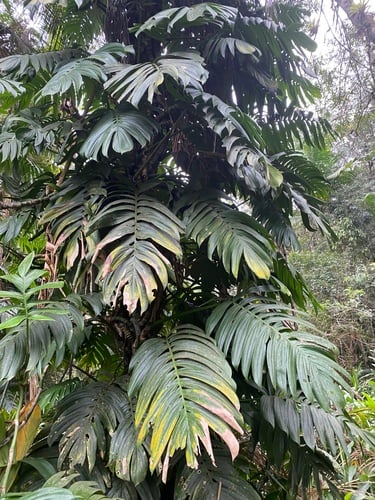
A herb that climbs on other plants. The stems are slender and wiry. They are 2-3 mm across. The leaves are broadly oval and unequal. They are rounded at the base. They are 10-17 cm long and 5-8 cm wide.
Edible Uses
The leaves are cooked to make a tea or drink.
Traditional Uses
The leaves are cooked and used for a drink.
This uses section is brief — help expand it
Medicinal Uses
The leaves are sometimes used in the treatment of stomach-aches. Women in Gabon eat the leaves during pregnancy, cooked with groundnuts or with odika chocolate (the kernel butter of Irvingia gabonensis); they also drink the water in which the leaves have been steeped for several days. A tisane is held in Congo to be anti-abortive and antiemetic. The pulped leaves are used in topical applications as a remedy for headaches, intercostal pain, etc. A dressing of the fresh leaves is put over ulcers. The leaves are made into a douche for treating blennorrhoea. A decoction is used to bathe rachitic children; sap from the leaves is instilled into the ears as a remedy for ear-inflammation and deafness. The ashes of the burnt plant are used to soothe headache. An unnamed alkaloid has been detected in the leaf and stem of Nigerian material.
Known Hazards
The sap is irritant on the skin, and is used as a fish-poison.
Distribution
It is a tropical plant. It grows on the edges of forests and in savannah in West Africa. In Nigeria it grows at 1,440 m above sea level.
Where It Grows
Africa, Cameroon, Central Africa, Côte d'Ivoire, East Africa, Gabon, Guinea, Guinée, Guinea-Bissau, Ivory Coast, Liberia, Malawi, Nigeria, Sao Tome and Principe, Sierra Leone, West Africa, Zambia,
Other Uses
The plant has a scent of coumarin. The leaves and roots are worn around the neck and ears, and sometimes they are powdered and put on the head. Distillation has given good returns of coumarin. The seeds and roots are dried and powdered and mixed with maize seed at the time of sowing. The crop is said to be much increased. This is quite probably due to the plants insecticidal and repellent properties, ensuring that the seed is not eaten, but is allowed to grow.
Also Known As
Muvambayi
References (5)
- Burkill, H. M., 1985, The useful plants of west tropical Africa, Vol. 1. Kew.
- Chapman, J. D. & Chapman, H. M., 2001, The Forest Flora of Taraba and Andamawa States, Nigeria. WWF & University of Canterbury. p 208
- Fowler, D. G., 2007, Zambian Plants: Their Vernacular Names and Uses. Kew. p 64
- Kew Bulletin 21(2), 1967,
- World Checklist of Useful Plant Species 2020. Royal Botanic Gardens, Kew