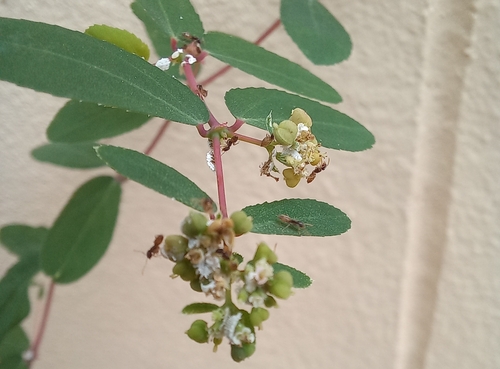
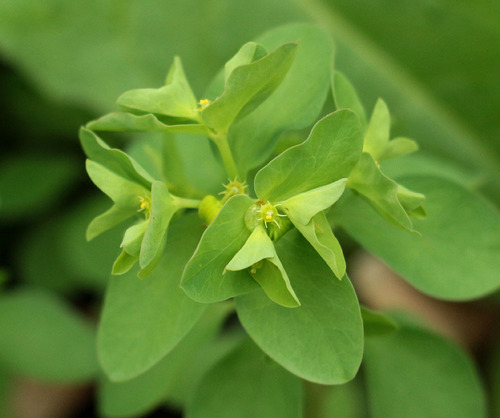
Shirakiopsis elliptica
(Hochst.) Esser
iNaturalist· cc-by-nc
(c) Troos van der Merwe, some rights reserved (CC BY-NC), uploaded by Troos van der Merwe
iNaturalist· cc-by-nc
(c) Troos van der Merwe, some rights reserved (CC BY-NC)
Description
A tropical tree in the Euphorbiaceae family that grows 15 m high in dry places and up to 40 m in damp sites, found in forests and savannah usually along stream banks.
Edible Uses
Fruit - a sweet flavour. The fruit are commonly eaten by birds and said to be edible in Tanzania and Nigeria. However, it is recorded as containing the same white latex that is found in the younger growths and is recorded as toxic. Human consumption of the fruit merits a cautious approach. The slightly feshy, purple to black fruit is a two-lobed drupe 8 - 15mm long and 6 - 8mm wide.
Medicinal Uses
The bark is emetic and purgative. A preparation (from the bark?) is taken as a drastic purge and is known for its toxicity. This is also sometimes taken by draught for the treatment of ascites and leprosy. A bark decoction is used as a strong enema to treat abdominal pain. A stem bark decoction is taken to treat anaemia and persistent headache. A root bark decoction or infusion is taken to treat colic. A bark infusion is used externally to treat guinea worm, scabies and eczema, whilst a decoction is used as a mouthwash to trreat cases of scurvy and stomatitis. The leaves are emetic. A decoction of the leafy twigs is occasionally taken orally to treat leprosy and ascites, in a similar way as extracts of Excoecaria grahamii. A leaf decoction is taken to treat elephantiasis, colic, anaemia and persistent headaches. The leaf juice is taken to treat fever, cough and colds. A leaf-preparation is used to relieve rheumatic pains and also pains in the head, chest, shoulders and back. A preparation of dried leaves is applied to maggot-infested wounds. A leaf extract is applied to abdominal swellings and used as eye drops to treat eye diseases. Externally, a decoction of leafy twigs is used to treat Guinea worm sores. The root is laxative. A root-concoction is prepared as a fomentation to treat enlarged spleen in babies and is taken by draught as a remedy for malaria and to mature abscesses. It is eaten pulped with leaves in water for ridding the body of worms. The leaf or root juice is taken to treat fever, cough and colds. The root is also used to make a cough medicine, whilst the pulped roots, mixed with water, are held to be a cure for stammering. The sap of the root is instilled into painful eyes. A decoction of roots, or the ash, is applied to rheumatic parts of the body. Preliminary tests on whole plants showed the presence of tannins and alkaloids. Crude bark extracts showed moderate bactericidal activity in vitro against Campylobacter jejuni.
Known Hazards
The plant is considered to be very poisonous and a very drastic purgative. A white slightly gummy latex in the fruits, younger twigs and leaves is very caustic to the skin. It is an ingredient of an arrow-poison and has been suspected of criminal use. The bark latex is added to an arrow poison based on Acokanthera schimperi.
Distribution
It is a tropical plant. It grows in forests and savannah usually along stream banks.
Where It Grows
Africa, Burkina Faso, Cameroon, Central Africa, Congo DR, Côte d'Ivoire, East Africa, Ethiopia, Equatorial Guinea, Gabon, Ghana, Guinea, Guinée, Ivory Coast, Mozambique, Nigeria, Sao Tome and Principe, Senegal, Sierra Leone, South Africa, Southern Africa, Uganda, Tanzania, West Africa,
Cultivation
A plant of the moist tropics, where it is found at elevations from 500 - 2,450 metres. It grows best in areas where annual daytime temperatures are within the range 20 - 27°c, but can tolerate 16 - 33°c. It prefers a mean annual rainfall in the range 1,200 - 2,000mm, but tolerates 1,000 - 2,500mm. Requires a sunny position. Prefers a medium to heavy soil of moderate fertility. Prefers a pH in the range 5 - 6.5, tolerating 4.5 - 7. Tolerant of periodic inundation of the soil. Plants respond well to coppicing and pollarding.
Propagation
Seed - should be sown in situ because the plant is difficult to transplant. The seeds can be stored for a long period in a container in a cool and dry room without loss of viability.
Other Uses
A white, slightly gummy latex is present in the younger twigs and leaves. Sticky and caustic, it is used to make a glue and to create body markings. The wood is pale brown, somewhat coarse and fibrous. It is tough, but is said to be not durable in the ground and liable to borer attack. However, the wood has also been reported to contain silicaceous concretions in the medullary rays and it is possible that the presence of these may confer resistance to marine borers if the timber is used in sea-water. The wood is used for making tom-tom drums, in general construction and for purposes where hardness is necessary, such as to make anvils on which bark-cloth is beaten out. The strong stems are used as the main parts in maize storage bins and to make mortars. The wood is used for fuel and to make charcoal.
Synonyms
Also Known As
Aguaya, Badulon, Chleha, Fama dion, Ihotzane, Ketebontore, Korundi, Tatahiro, Tomi, Uhlela
References (4)
- Burkill, H. M., 1985, The useful plants of west tropical Africa, Vol. 2. Kew.
- Fern, K., 2012, Tropical Species Database http://theferns.info/tropical/
- Latham, P & Mbuta, A., 2017, Useful Plants of Central Province, Democratic Republic of Congo. Volume 2. Salvation Army p 173
- World Checklist of Useful Plant Species 2020. Royal Botanic Gardens, Kew