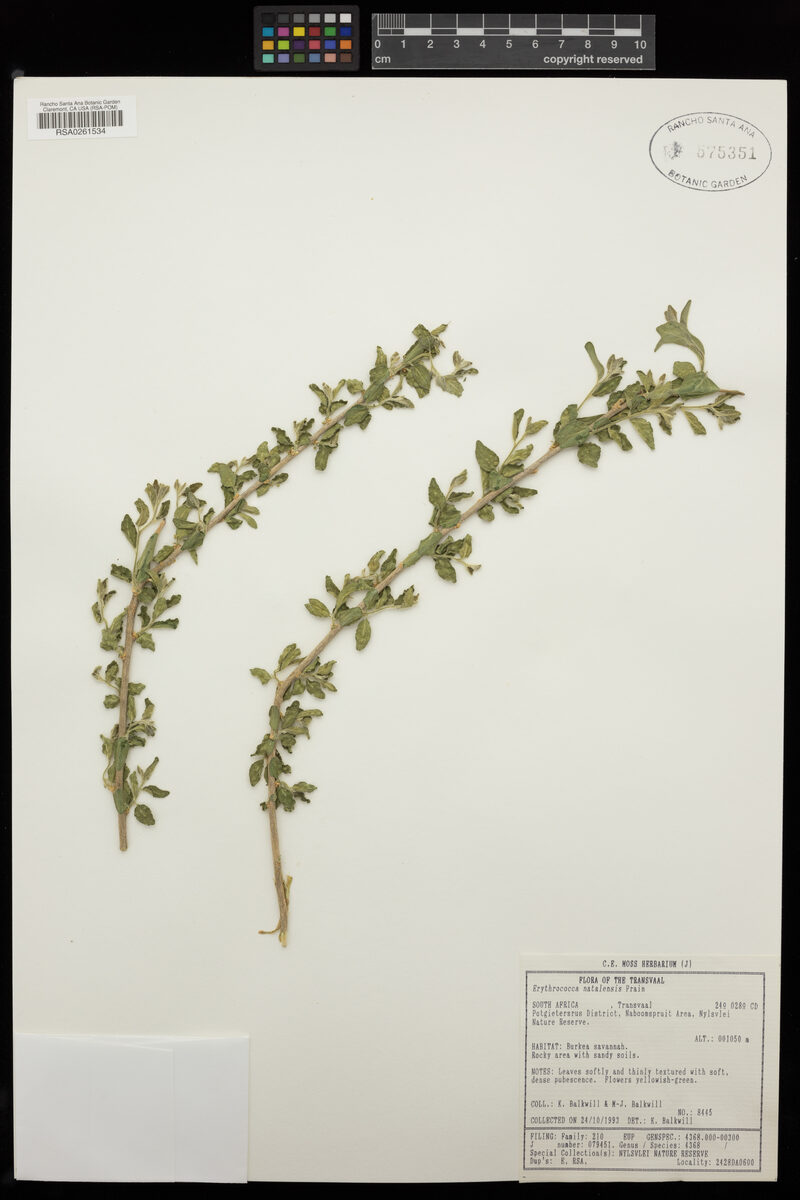
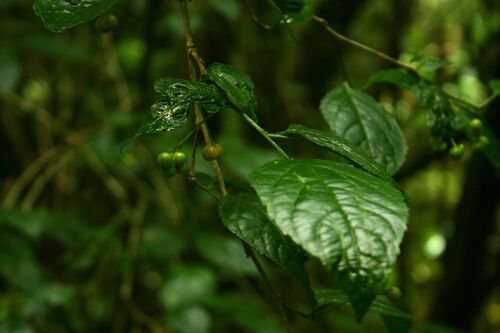
Acalypha siamensis
Oliver ex Gage
Hermit’s Tea
iNaturalist· cc-by-nc-sa
(c) 106611639464075912591, some rights reserved (CC BY-NC-SA), uploaded by 106611639464075912591
iNaturalist· cc-by-sa
(c) Ong Jyh Seng, some rights reserved (CC BY-SA), uploaded by Ong Jyh Seng
iNaturalist· cc-by-nc
(c) Troos van der Merwe, some rights reserved (CC BY-NC), uploaded by Troos van der Merwe
Description
A shrub or small tree. It grows 5 m tall. There are prickles along the stem. The leaves are twice divided and there are 8-18 pairs of pinnae. There are up to 50 pairs of pinnules on each pinnae. The flowers are yellow. They are in large clusters at the ends of branches. The pods are flattened.
Edible Uses
Dried leaves are brewed to make tea.
Traditional Uses
The leaves are dried then used to make tea.
This uses section is brief — help expand it
Medicinal Uses
The leaves are used in traditional medicine to treat fever, bowel complaints and kidney diseases; they are said to have antipyretic properties.
Distribution
A tropical plant. It grows in dry evergreen forests on sandy soil. It grows between 100-400 m above sea level.
Where It Grows
Asia, Cambodia, China, Indochina, Indonesia, Laos, Malaysia, Myanmar, SE Asia, Sri Lanka, Thailand, Vietnam,
Cultivation
Plants can be grown from seeds or by cuttings.
Propagation
Seed - Stem cuttings.
Other Uses
The plant is often cultivated as a hedge plant.
Notes
There are over 450 Acalypha species. They are tropical. There are 225 in tropical America.
Synonyms
Also Known As
Akalifa siam, Chah ru-si, Laphet-nyo, Tae prei, Teh hutan, Teh kampong, Tumput
References (8)
- Bircher, A. G. & Bircher, W. H., 2000, Encyclopedia of Fruit Trees and Edible Flowering Plants in Egypt and the Subtropics. AUC Press. p 5
- Burkill, I.H., 1966, A Dictionary of the Economic Products of the Malay Peninsula. Ministry of Agriculture and Cooperatives, Kuala Lumpur, Malaysia. Vol 1 (A-H) p
- Martin, F.W. & Ruberte, R.M., 1979, Edible Leaves of the Tropics. Antillian College Press, Mayaguez, Puerto Rico. p 106
- Phon, P., 2000, Plants used in Cambodia. © Pauline Dy Phon, Phnom Penh, Cambodia. 5
- Rec. Bot. Surv. India 9:238. 1922
Show all 8 references Hide references
- Samy, J., Sugumaran, M., Lee, K. L. W., 2009, Herbs of Malaysia, Marshall Cavendish. p 31
- Sukarya, D. G., (Ed.) 2013, 3,500 Plant Species of the Botanic Gardens of Indonesia. LIPI p 577
- World Checklist of Useful Plant Species 2020. Royal Botanic Gardens, Kew