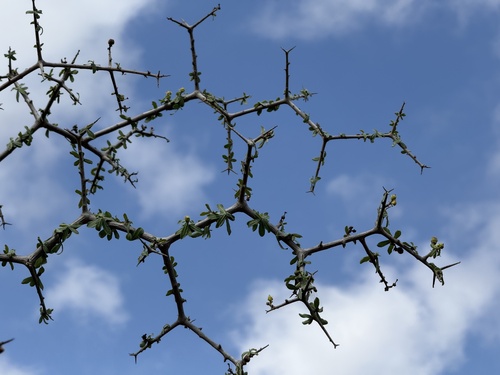
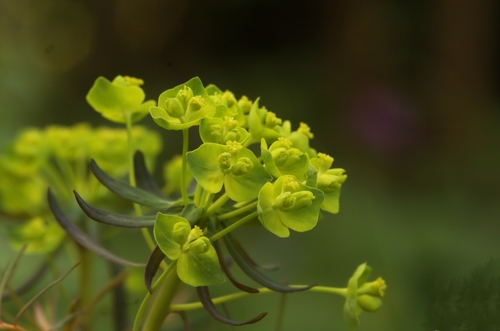
Acalypha ornata
Hochst. ex A Rich.
Zambezi false-nettle
iNaturalist· cc-by-nc
(c) robburrett, some rights reserved (CC BY-NC)
iNaturalist· cc-by-nc
(c) Graeme White, some rights reserved (CC BY-NC), uploaded by Graeme White
Summary
Source: WikipediaAcalypha ornata is a species in the botanical family Euphorbiaceae. In Africa it is widely used as a medicinal plant. The stems are used as fibres for weaving baskets. The leaves are eaten as a vegetable; the plants are also fed to domestic animals. Acalypha ornata is sometimes planted as an ornamental plant.
Description
A shrub or small tree. It grows 5 m tall. There are prickles along the stem. The leaves are twice divided and there are 8-18 pairs of pinnae. There are up to 50 pairs of pinnules on each pinnae. The flowers are yellow. They are in large clusters at the ends of branches. The pods are flattened.
Edible Uses
Young leaves are cooked as a vegetable—either chopped and cooked alone or pounded with other vegetables. The plant is also dried, burned, and processed to produce salt.
Traditional Uses
The young leaves are cooked and eaten as a vegetable. They are chopped and cooked. They are also pounded with other vegetables. The plant is dried, burned and the ash filtered and evaporated and used for salt.
Medicinal Uses
The plant is used in traditional medicine.
Distribution
A tropical plant. It is mostly in thickets and along the edges of rivers. It is at low and medium altitudes. It Malawi it can be between 100-1,300 m altitudes. In Ethiopia it grows between 600-700 m above sea level.
Where It Grows
Africa, Angola, Botswana, Central Africa, East Africa, Eritrea, Ethiopia, Kenya, Malawi, Mozambique, Namibia, Nigeria, South Africa, Southern Africa, Sudan, Tanzania, Uganda, West Africa, Zambia, Zimbabwe,
Cultivation
It can be grown from seeds or by cuttings.
Propagation
Seed - Cuttings
Other Uses
The stems are woven into baskets and fish-traps. The leaves are covered by soft sticky hairs and the bracts similarly covered together forming a cup perhaps act as insect-traps.
Notes
There are over 450 Acalypha species. They are tropical. There are 225 in tropical America. It is used in medicine.
Synonyms
Also Known As
Atinotur, Atiyhomerpap, Chigaga, Kirijaj, Mfulwe, Mukunyukunyu, Nhaucusse, Sinamananelo
References (14)
- Awas, T., 1997, A Study on the Ecology and Ethnobotany of Non-cultivated Food Plants and Wild Relatives of Cultivated crops in Gambella Region, Southwestern Ethiopia. Addis Ababa University. p 48
- Fowler, D. G., 2007, Zambian Plants: Their Vernacular Names and Uses. Kew. p 24
- Grubben, G. J. H. and Denton, O. A. (eds), 2004, Plant Resources of Tropical Africa 2. Vegetables. PROTA, Wageningen, Netherlands. p 559
- Jansen, P.C.M., 2004. Acalypha bipartita Müll.Arg. [Internet] Record from Protabase. Grubben, G.J.H. & Denton, O.A. (Editors). PROTA (Plant Resources of Tropical Africa / Ressources végétales de l’Afrique tropicale), Wageningen, Netherlands. < http://database.prota.org/search.htm>. Accessed 13 October 2009.
- Lulekal, E., et al, 2011, Wild edible plants in Ethiopia: a review on their potential to combat food insecurity. Afrika Focus - Vol. 24, No 2. pp 71-121
Show all 14 references Hide references
- Msuya, T. S., et al, 2010, Availability, Preference and Consumption of Indigenous Foods in the Eastern Arc Mountains, Tanzania, Ecology of Food and Nutrition, 49:3, 208-227
- Pickering, H., & Roe, E., 2009, Wild Flowers of the Victoria Falls Area. Helen Pickering, London. p 60
- Roodt, V., 1998, Trees & Shrubs of the Okavango Delta. Medicinal Uses and Nutritional value. The Shell Field Guide Series: Part 1. Shell Botswana. p 194
- Ruffo, C. K., Birnie, A. & Tengnas, B., 2002, Edible Wild Plants of Tanzania. RELMA p 94
- von Katja Rembold, 2011, Conservation status of the vascular plants in East African rain forests. Dissertation Universitat Koblenz-Landau
- White, F., Dowsett-Lemaire, F. and Chapman, J. D., 2001, Evergreen Forest Flora of Malawi. Kew. p 241
- World Checklist of Useful Plant Species 2020. Royal Botanic Gardens, Kew
- www.zimbabweflora.co.zw 2011
- Yimer, A., et al, 2021, Ethnobotanical study of wild edible plants used by Meinit Ethnic Community at Bench-Maji Zone, Southwest Ethiopia. Research Square. p 6