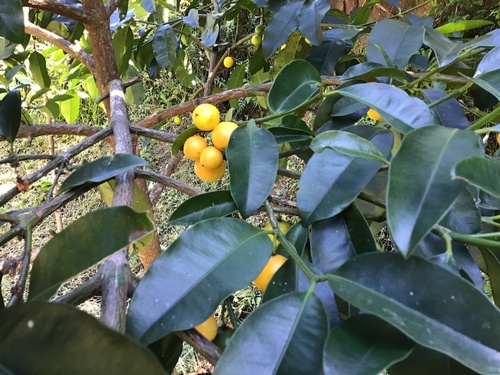
Calophyllum inophyllum
L.
Beauty leaf, Beach Calophyllum
iNaturalist· cc-by-nc
(c) 傻子, some rights reserved (CC BY-NC), uploaded by 傻子
iNaturalist· cc-by-nc
(c) Russell Cumming, some rights reserved (CC BY-NC)
iNaturalist· cc-by-nc
(c) Marcus Athaydes, some rights reserved (CC BY-NC), uploaded by Marcus Athaydes
Summary
Source: WikipediaCalophyllum inophyllum is a large evergreen plant, commonly called tamanu, oil-nut, mastwood, beach calophyllum or beautyleaf. It is native to the Old World Tropics, from Africa through Asia to Australia and Polynesia. Due to its importance as a source of timber for the traditional shipbuilding of large outrigger ships, it has been spread in prehistoric times by the migrations of the Austronesian peoples to the islands of Oceania and Madagascar, along with other members of the genus Calophyllum. It has since been naturalized in regions of the East African coast. It is also a source of the culturally important tamanu oil.
Description
A medium sized tree. It grows up to 20 m tall. The branches spread out. The bark is light yellow-grey and smooth. The leaves are opposite and leathery. They are glossy green. The leaves are oval and 10-15 cm long by 4-6 cm wide. They have many fine side veins which come out at right angles to the midrib. The flowering structure is unbranched and they are in the axils of leaves. The flowers are white and have both sexes. They are 2-2.5 cm across. The fruit is round, ending in a point. It is 2.5 cm across and yellowish. It has a woody layer around the seed.
Edible Uses
The ripe fruit and seeds are eaten fresh, and unripe fruit are pickled. The seed oil is edible after refining and removing toxic components.
Traditional Uses
The oil is edible after refining and removing toxic components. The ripe fruit and seeds are eaten. The unripe fruit are pickled. Caution: The seed, sap and leaves are poisonous.
Medicinal Uses
The seed oil is used in traditional medicine and is sometimes burnt in lamps.
Known Hazards
The seed, sap, and leaves are poisonous and must be avoided.
Distribution
A tropical plant. It is native to tropical Asia and the Pacific. It often grows near water and near the sea shore. It can tolerate salt spray. It can be near mangroves. It needs sandy well drained soil. It grows wild or cultivated on open waste sites on hills, seashores, sandy wastelands; 100(-200) m altitude in China. It grows up to 400 m above sea level in Fiji. It grows in places with an annual average temperature of 18-33°C. It is damaged by drought and frost. It suits hardiness zones 11-12.
Where It Grows
Africa, American Samoa, Andamans, Aruba, Asia, Australia, British Indian Ocean Terr., BIOT, Cambodia, Caroline Islands, China, Chuuk, Cook Islands, Djibouti, East Africa, East Timor, Eritrea, Ethiopia, Fiji, French Polynesia, FSM, Ghana, Guam, Hawaii, India, Indochina, Indonesia, Japan (Ryukyu Is.), Kenya, Kiribati, Laos, Madagascar, Malaysia, Maldives, Marquesas, Marshall Islands, Mascarenes, Micronesia, Mozambique, Myanmar, New Caledonia, Nigeria, Niue, Pacific, Palau, Papua New Guinea, PNG, Philippines, Polynesia, Rotuma, Samoa, SE Asia, Solomon Islands, Somalia, Sri Lanka, Taiwan, Tanzania, Thailand, Timor-Leste, Tokelau, Tonga, Tuvalu, Uganda, USA, Vanuatu, Vietnam, Wallis & Futuna, West Africa, Yap, Zambia,
Cultivation
They are grown from seed which must be sown fresh. Seeds germinate easily but slowly. Seedlings can be transplanted into the field after 5-6 months.
Propagation
Seed - sow in a shaded position in a nursery seedbed. Removal of the endocarp significantly reduces the germination period to about 22 days, it also increases the germination rate and improves seedling growth and development. Natural regeneration usually occurs near the mother tree and provides young plants that can be transplanted to other places.
Other Uses
The bark contains around 15% tannin. Mature and dried seed contains 50 - 60%, occasionally up to 73%, of a bluish yellow to dark green viscous oil with a disagreeable flavour. The oil may contain up to 30% resinous materials. It is used for illumination while the purified oil can be used in soap production and as a carrier oil, skin moisturizer and hair oil in cosmetics. For seed oil extraction, the seeds are shelled. Initially the kernels contain little apparent oil, but after about a month the kernels turn chocolate brown and become sticky with oil. They are chopped, dried, pounded and then boiled. The oil is skimmed from the top of the boiling water. The seeds may also be crushed to a paste and the oil is then drained off. Industrially the oil is extracted by cold expression, and is not refined so as to conserve all medicinal properties. The fruit is crushed to yield an oil that is used to scent coconut oil and is applied to the hair to make it long and black. (Is this a distinct oil from that obtained from the seed?. The stones of the fruit are used as marbles. The sticky sap (latex?) is used for caulking canoes. The old, decayed fruits are skewered on coconut midribs and then burned as a traditional form of lighting. The mature fruit is burned as a mosquito repellent. The heartwood is pinkish to reddish brown; it is clearly demarcated from the 5 - 10cm wide band of pale sapwood. The grain is interlocked, spiral or wavy; the texture moderately coarse and uneven. The wood is medium-weight to moderately heavy; moderately hard; moderately durable, even under water, being resistant to dry wood borers and moderately resistant to fungi and termites. It is somewhat slow to season, with a high risk of distortion and a slight risk of checking; once dry it is stable in service. The wood is often rather difficult to saw, and sawn surfaces tend to be woolly; it is not easy to plane because of spiral or interlocked grain; filling is recommended to obtain a good finish; nailing and screwing are good, but pre-boring is required; gluing is correct for interior use. It is not recommended to use this timber for lengths over 3 metres because it is often bent. Throughout its area of distribution the wood is used for the construction of canoes and small boats, masts, keels, knees and pulley blocks. The wood is also used for construction, carpentry, flooring, stairs, furniture and cabinet work, cart-wheel hubs, vessels and musical instruments. Planted in hedges and as a wind break. The tree is sometimes used in reforestation schemes.
Production
Young seedlings grow rapidly. The tree grows slowly. The seeds yield oil to 20--30%, but seed kernels to 50-60%.
Other Information
It is not known if it is used for food in Papua New Guinea. It is only a very minor or incidental food. It is cultivated.
Notes
There are about 187-200 Calophyllum species. They are evergreen trees of the tropics. The seed oil is fragrant and sometimes burnt in lamps. It is used in medicine.
Nutrition
| Part | Moisture | kJ | kcal | Protein | Vit A | Vit C | Iron | Zinc |
|---|---|---|---|---|---|---|---|---|
| Seed | 27.7 | — | — | 6.4 | — | — | — | — |
| Fruit | — | — | — | — | — | — | — | — |
Synonyms
Also Known As
Ai-sampulo, Alexandrian Laurel, Anganaro, Bagura, Barura, Beach kalofilum, Bentangor bunga, Bitu, Btaches, Fetau, Foraha, Forahabe, Funa, Hefau, Hong hou ke, Honne, Hpang, Isho, Itakamaka, Jijo, Kamani, Kating, Khchoeng, Lukwej, Mutondo, Nagachampa, Nyamplung, Penaga laut, Pinnay, Pohon bintangur, Pohon nyamplung, Pon-hyet, Poon, Poonang, Poonay-oil plant, Pouna, Pua, Pudek, Punaga, Punna, Punnaga, Punnai, Sultanachampa, Surangi, Takamaka, Taruwuka, Te itai, Tilo, Toor asa taukava, Undi, Voakoly, Voakotry, Voalavenona, Vuma
References (67)
- Altschul, S.V.R., 1973, Drugs and Foods from Little-known Plants. Notes in Harvard University Herbaria. Harvard Univ. Press. Massachusetts. no. 2855
- Ambasta S.P. (Ed.), 2000, The Useful Plants of India. CSIR India. p 97
- Barwick, M., 2004, Tropical and Subtropical Trees. A Worldwide Encyclopedic Guide. Thames and Hudson p 82
- Bircher, A. G. & Bircher, W. H., 2000, Encyclopedia of Fruit Trees and Edible Flowering Plants in Egypt and the Subtropics. AUC Press. p 74
- Bodkin, F., 1991, Encyclopedia Botanica. Cornstalk publishing, p 201
Show all 67 references Hide references
- Borrell, O.W., 1989, An Annotated Checklist of the Flora of Kairiru Island, New Guinea. Marcellin College, Victoria Australia. p 82
- Brown, W.H., 1920, Wild Food Plants of the Philippines. Bureau of Forestry Bulletin No. 21 Manila. p 118
- Burkill, H. M., 1985, The useful plants of west tropical Africa, Vol. 2. Kew.
- Burkill, I.H., 1966, A Dictionary of the Economic Products of the Malay Peninsula. Ministry of Agriculture and Cooperatives, Kuala Lumpur, Malaysia. Vol 1 (A-H) p 412
- Cabalion, P. and Morat, P., 1983, Introduction le vegetation, la flore et aux noms vernaculaires de l'ile de Pentcoste (Vanuatu), In: Journal d'agriculture traditionnelle et de botanique appliquee JATBA Vol. 30, 3-4
- Clarke, W.C. & Thaman, R.R.(Eds.), 1993, Agroforestry in the Pacific Islands: Systems for sustainability. United Nations University Press. New York. p 226
- Conn, B.J., (Ed.) 1995, Handbooks of the Flora of Papua New Guinea. Vol 3. Melbourne University Press. p 80
- Cooper, W. and Cooper, W., 2004, Fruits of the Australian Tropical Rainforest. Nokomis Editions, Victoria, Australia. p 122
- Cowie, I, 2006, A Survey of Flora and vegetation of the proposed Jaco-Tutuala-Lore National Park. Timor-Lests (East Timor) www.territorystories.nt/gov.au p 45
- Cundall, P., (ed.), 2004, Gardening Australia: flora: the gardener's bible. ABC Books. p 290
- Elevitch, C.R.(ed.), 2006, Traditional Trees of the Pacific Islands: Their Culture, Environment and Use. Permanent Agriculture Resources, Holualoa, Hawaii. p 183
- Elliot, W.R., & Jones, D.L., 1982, Encyclopedia of Australian Plants suitable for cultivation. Vol 2. Lothian. p 434
- Etherington, K., & Imwold, D., (Eds), 2001, Botanica's Trees & Shrubs. The illustrated A-Z of over 8500 trees and shrubs. Random House, Australia. p 165
- Facciola, S., 1998, Cornucopia 2: a Source Book of Edible Plants. Kampong Publications, p 78
- Flora and Livestock in Coastal Karnataka. 2007, Report. EMPRI p 98
- Flora of China Vol. 13, p 39
- Foreman, D. B., 1971, A checklist of the Vascular Plants of Bougainville with Descriptions of some Common Forest Trees. Botany Bulletin No. 5. Department of Botany. p 82
- Fowler, D. G., 2007, Zambian Plants: Their Vernacular Names and Uses. Kew. p 78
- Franklin, J., Keppel, G., & Whistler, W., 2008, The vegetation and flora of Lakeba, Nayau and Aiwa Islands, Central Lau Group, Fiji. Micronesica 40(1/2): 169–225, 2008
- French, B.R., 2010, Food Plants of Solomon Islands. A Compendium. Food Plants International Inc. p
- Gardner, S., et al, 2000, A Field Guide to Forest Trees of Northern Thailand, Kobfai Publishing Project. p 53
- GTZ 1996, A Guide to some Indigenous Fijian Trees. GTZ Suva. p 79
- Hall, N. et al, 1972, The Use of Trees and Shrubs in the Dry Country of Australia, AGPS, Canberra. p 197
- Havel, J.J., 1975, Forest Botany, Volume 3 Part 2 Botanical taxonomy. Papua New Guinea Department of Forests, p 201
- Hearne, D.A., & Rance, S.J., 1975, Trees for Darwin and Northern Australia. AGPS, Canberra p 37, Pl 10
- Hedrick, U.P., 1919, (Ed.), Sturtevant's edible plants of the world. p 144
- Heywood, V.H., Brummitt, R.K., Culham, A., and Seberg, O. 2007, Flowering Plant Families of the World. Royal Botanical Gardens, Kew. p 103
- Hibbert, M., 2002, The Aussie Plant Finder 2002, Florilegium. p 50
- Hinton, B & B., 1982, A Wilderness in Bloom. Wildflowers of tropical Australia. p 59
- Holliday, I., 1989, A Field Guide to Australian Trees. Hamlyn. p 98
- Jackes, B.R., 2001, Plants of the Tropics. Rainforest to Heath. An Identification Guide. James Cook University. p 47
- Jones D, L, 1986, Ornamental Rainforest Plants in Australia, Reed Books, p 201
- Kitalong, A. H., DeMeo, R. A., & Holm, T., 2013, A Field Guide to the Native Trees of Palau. 2nd edition. USDA p48
- Lazarides, M. & Hince, B., 1993, Handbook of Economic Plants of Australia, CSIRO. p 43
- Lemmens, R.H.M.J., 2005. Calophyllum inophyllum L. [Internet] Record from Protabase. Louppe, D., Oteng-Amoako, A.A. & Brink, M. (Editors). PROTA (Plant Resources of Tropical Africa), Wageningen, Netherlands. < http://database.prota.org/search.htm>. Accessed 14 October 2009.
- Li Xi-wen & Li Jie; Peter F. Stevens, Clusiaceae [Draft], Flora of China
- Liefting, A., et al, Samoan plant names. http://en.wikipedia.org
- Maiden, J. H., 1889, The Useful Native Plants of Australia (including Tasmania). The Technology Museum of NSW, Sydney. p 12
- Nicholson, N & H., 1996, Australian Rainforest Plants 2, Terania Rainforest Publishing. NSW. p 15
- Parham, B. E. V., 1971, The Vegetation of the Tokelau Islands with special reference to the Plants of Nukunonu Atoll. New Zealand Journal of Botany. 9:4, 576-609
- Parham, B. E. V., 1972, Plants of Samoa. New Zealand Department of Scientific and Industrial Research. Information Series. No. 85 p 32
- Peekel, P.G., 1984, (Translation E.E.Henty), Flora of the Bismarck Archipelago for Naturalists, Division of Botany, Lae, PNG. p 377, 379
- Pham-Hoang Ho, 1999, An Illustrated Flora of Vietnam. Nha Xuat Ban Tre. p 457
- Scarth-Johnson, V., 2000, National Treasures. Flowering Plants of Cooktown and Northern Australia. Vera Scarth-Johnson Gallery Association. Cooktown, Australia. p 37
- Selvam, V., 2007, Trees and shrubs of the Maldives. RAP Publication No. 2007/12 p 48
- Smith, A.C., 1981, Flora Vitiensis Nova, Lawaii, Kuai, Hawaii, Volume 2 p 336
- Soerianegara, I. & Lemmens, R. H. M. L., (Eds.) 1993, Timber trees: Major commercial timbers. Plant Resources of South-East Asia. Wageningen. No. 5(1). p 124
- Sp. pl. 1:513. 1753
- Staples, G.W. and Herbst, D.R., 2005, A tropical Garden Flora. Bishop Museum Press, Honolulu, Hawaii. p 237 (Drawing)
- Sujanapal, P., & Sankaran, K. V., 2016, Common Plants of Maldives. FAO & Kerala FRI, p 67
- Sukarya, D. G., (Ed.) 2013, 3,500 Plant Species of the Botanic Gardens of Indonesia. LIPI p 173
- Thaman, R. R., 1987, Plants of Kiribati: A listing and analysis of vernacular names. Atoll Research Bulletin No. 296
- Thaman, R. R, 2016, The flora of Tuvalu. Atoll Research Bulletin No. 611. Smithsonian Institute p 76
- Tiwi Plants and Animals. 2001, Aboriginal flora and fauna knowledge from Bathurst and Melville Islands, northern Australia. Northern Territory Botanical Bulletin; No. 24 p 33
- Topp, J. M. W., 1988, An Annotated Check List of the Flora of Diego Garcia, British Ocean Territory. Atoll Research Bulletin No. 313
- Townsend, K., 1994, Across the Top. Gardening with Australian Plants in the tropics. Society for Growing Australian Plants, Townsville Branch Inc. p 116
- Trimanto, & Hapsari L., 2016, Botanical survey in thirteen montane forests of Bawean Island Nature Reserve, East Java Indonesia: Conservation status, bioprospecting and potential tourism. Biodiversitas 17: 832-846.
- World Checklist of Useful Plant Species 2020. Royal Botanic Gardens, Kew
- www.worldagroforestrycentre.org/sea/products/afdbases/af/asp/SpeciesInfo.asp?SpID=2
- www.worldagroforestrycentre.org/treedb/
- Yuncker, T.G., 1959, Plants of Tonga, Bernice P. Bishop Museum, Hawaii, Bulletin 220. p 187
- Zeven, A. C. & de West, J. M. J., 1982, Dictionary of cultivated plants and their regions of diversity. Wageningen. p 56