Jasminum multipartitum
Hochst.
Starry wild jasmine
iNaturalist· cc-by-nc
(c) Igmar Grewar, some rights reserved (CC BY-NC), uploaded by Igmar Grewar
iNaturalist· cc0
no rights reserved
Summary
Source: WikipediaJasminum multipartitum, the starry wild jasmine, African jasmine, or imfohlafohlane, is a species of jasmine, in the family Oleaceae, that is native to Southern Africa.
Description
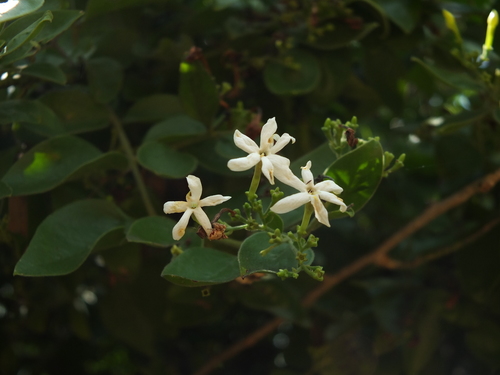
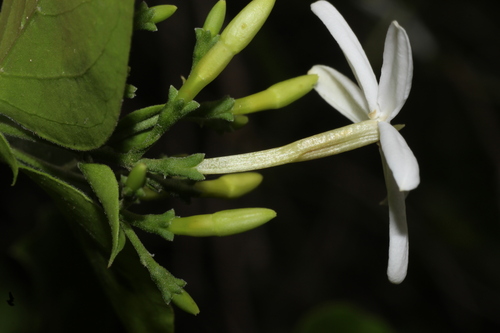
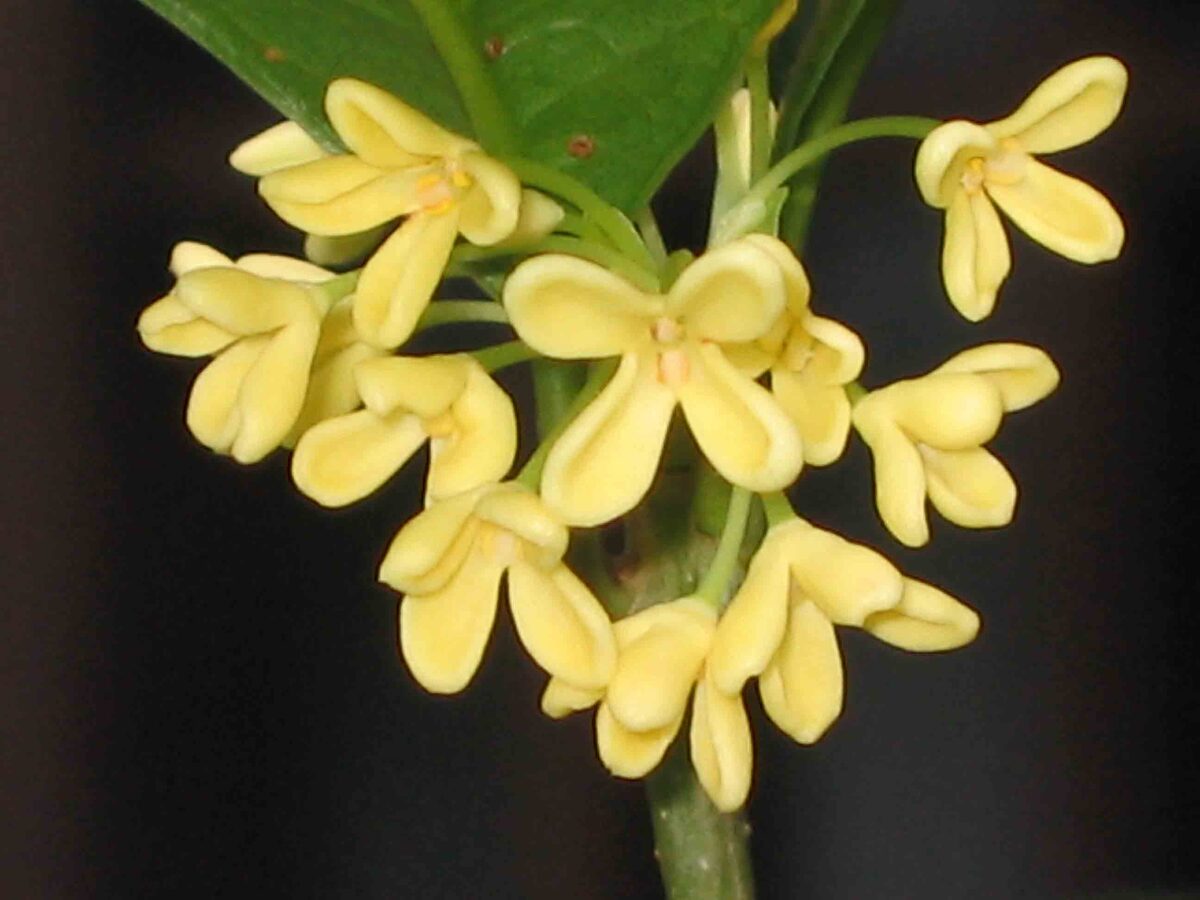
A climber or shrub. It can be 3 m tall. The leaves are opposite and simple. They are narrowly oval and can be 4.5 cm long by 3 cm wide. They are pointed at the tip. The leaves are dark green. The flowers are white and pink underneath. They occur in large groups. They have a scent. The fruit are small and shiny black. The fruit usually have 2 lobes.
Edible Uses
The leaves can be made into tea, and the fruit is edible, traditionally used as a famine food.
Distribution
It is a subtropical plant. It is best in fertile, well-drained soil. It grows in woodland and rocky slopes. In Brisbane Botanical Gardens.
Where It Grows
Africa, Australia, East Africa, Eswatini, Mozambique, South Africa, Southern Africa, Swaziland, Zambia, Zimbabwe,
Cultivation
Plants can be grown from seeds or cuttings.
Other Information
The fruit is a famine food.
Synonyms
Also Known As
Muvwipyo
References (8)
- Fox, F. W. & Young, M. E. N., 1982, Food from the Veld. Delta Books. p 283
- https://growwild.co.za Edible Indigenous plants
- Joffe, P., 2007, Creative Gardening with Indigenous Plants. A South African Guide. Briza. p 355
- Long, C., 2005, Swaziland's Flora - siSwati names and Uses http://www.sntc.org.sz/flora/
- Ruiters-Welcome, A. K., 2019, Food plants of southern Africa. Ph.D. thesis. Univ. of Johannesburg p 82
Show all 8 references Hide references
- Schmidt, E., Lotter, M., & McCleland, W., 2007, Trees and shrubs of Mpumalanga and Kruger National Park. Jacana Media p 532
- Welcome, A. K. & Van Wyk, B.-E., 2019, An inventory and analysis of the food plants of southern Africa. South African Journal of Botany 122 (2019) 136–179
- World Checklist of Useful Plant Species 2020. Royal Botanic Gardens, Kew