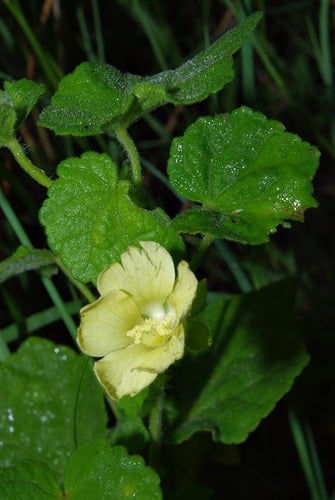
Callirhoe involucrata
(Torr. & A. Gray.) A. Gray.
Poppy mallow, Buffalo rose
iNaturalist· cc-by-nc
(c) Pauline Singleton, some rights reserved (CC BY-NC), uploaded by Pauline Singleton
iNaturalist· cc-by-nc
(c) Diana-Terry Hibbitts, some rights reserved (CC BY-NC), uploaded by Diana-Terry Hibbitts
iNaturalist· cc-by-nc
(c) Linda Jo Conn, some rights reserved (CC BY-NC), uploaded by Linda Jo Conn
Summary
Source: WikipediaCallirhoe involucrata is a species of flowering plant in the mallow family known by the common names purple poppy-mallow, winecup and buffalo rose. It is native to the Great Plains of the United States and adjacent areas in northern Mexico. The leaves and stems die back in winter, showing at most a small rosette of green leaves immediately above the root crown.
Description
A low growing sprawling plant. It keeps growing from year to year. It grows 15-30 cm high and spreads 30-60 cm wide. The root is large and tapers. The stems lie along the ground. They are hairy and 15 cm long. The leaves have 3 to 7 lobes. The leaves are 2.5-5 cm long. The flowers are red or purple. They are on long erect stems.
Edible Uses
Edible Parts: Leaves Root Edible Uses: Root - cooked. The root is long and tapering, it is sweet and starchy with a pleasant taste somewhat like that of a sweet potato. Leaves - cooked. A pleasant flavour with a mucilaginous texture, they are good for thickening soups.
Traditional Uses
The root is cooked and eaten. It can also be fried. It can be dried and ground into flour. This can be used to thicken soups and casseroles. The leaves are used to thicken soup.
Medicinal Uses
Anodyne A decoction of the root is used to treat internal pain. The root was also dried, then burnt and the smoke either inhaled or allowed to bathe the affected part of the body.
Distribution
It is a temperate plant. It grows on mountain slopes and in warm dry areas. It is resistant to drought. It will grow in a range of soils. It suits hardiness zones 5-8.
Where It Grows
Australia, Europe, France, Mexico, North America, Tasmania, USA,
Cultivation
Plants can be grown by seeds or division of the root.
Propagation
Seed - sow outdoors or in a cold frame. Plants resent root disturbance so the seed is best sown in situ in April, though the slugs will have a field day if you do not protect the plants. If seed is in short supply then sow it in pots in a cold frame, putting a few seeds in each pot, and plant the pots out in early summer once the plants have put on at least 15cm of growth. Germination usually takes place within 1 - 6 months at 15°c. Cuttings of young basal shoots in a frame in sand. Harvest the shoots when they are about 10cm long with plenty of underground stem. Pot them up into individual pots and keep them in light shade in a cold frame or greenhouse until they are rooting well. Plant them out in the summer. Division. With care since the plant resents root disturbance. We have found that it is best not to disturb this plant and so do not try to divide it, relying instead on taking basal cuttings since these do not disturb the main clump.
Other Uses
None known Special Uses Food Forest
Notes
There are 9 Callirhoe species.
Also Known As
Low poppy mallow, Prairie poppy mallow, Purple poppy mallow, Wine cups
References (14)
- Beckstrom-Sternberg, Stephen M., and James A. Duke. "The Foodplant Database." http://probe.nalusda.gov:8300/cgi-bin/browse/foodplantdb.(ACEDB version 4.0 - data version July 1994)
- Bircher, A. G. & Bircher, W. H., 2000, Encyclopedia of Fruit Trees and Edible Flowering Plants in Egypt and the Subtropics. AUC Press. p 74
- Cundall, P., (ed.), 2004, Gardening Australia: flora: the gardener's bible. ABC Books. p 283
- Esperanca, M. J., 1988. Surviving in the wild. A glance at the wild plants and their uses. Vol. 2. p 352
- Facciola, S., 1998, Cornucopia 2: a Source Book of Edible Plants. Kampong Publications, p 147
Show all 14 references Hide references
- Hedrick, U.P., 1919, (Ed.), Sturtevant's edible plants of the world. p 143
- Jackes, D. A., Edible Forest Gardens
- Jordan, J., et al, 2006, Vascular Plants Utilized by the Plains Apache in Southwestern Oklahoma, Publications of the Oklahoma Biological Survey. 2nd Series. Volume 7: 24-33, 2006
- Kermath, B. M., et al, 2014, Food Plants in the Americas: A survey of the domesticated, cultivated and wild plants used for Human food in North, Central and South America and the Caribbean. On line draft. p 163
- Lim, T. K., 2015, Edible Medicinal and Non Medicinal Plants. Volume 9, Modified Stems, Roots, Bulbs. Springer p 21
- Mem. Amer. Acad. Arts ser. 2, 4:16. 1849 (Pl. fendler.)
- Plants for a Future database, The Field, Penpol, Lostwithiel, Cornwall, PL22 0NG, UK. http://www.scs.leeds.ac.uk/pfaf/
- Tozer, F., 2007, The Uses of Wild Plants. Green Man Publishing. p 50
- Wild Edible Plants of the Whitmire Wildflower Garden. Missouri Botanical Gardens.