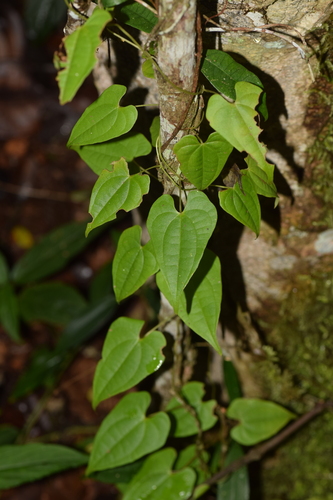
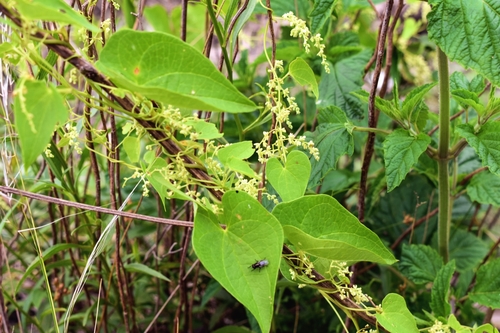
Dioscorea dregeana
(Kunth) T. Durand & Schinz
Wild yam
iNaturalist· cc-by-nc
(c) Ricky Taylor, some rights reserved (CC BY-NC), uploaded by Ricky Taylor
iNaturalist· cc-by-nc
(c) Reliance Nenzhelele, some rights reserved (CC BY-NC)
iNaturalist· cc-by-nc
(c) Mark Kluge, some rights reserved (CC BY-NC), uploaded by Mark Kluge
Summary
Source: WikipediaDioscorea dregeana, the wild yam, is a perennial creeper that is native to the eastern parts of southern Africa. It is commonly used and traded as a traditional medicine, or muti.
Description
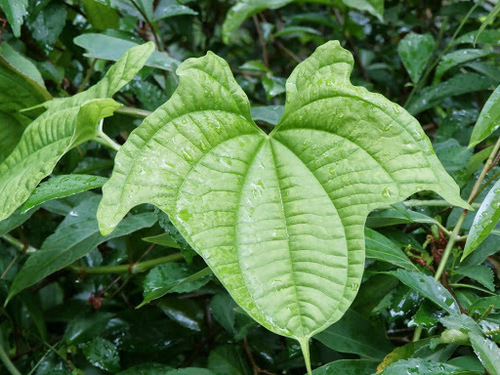
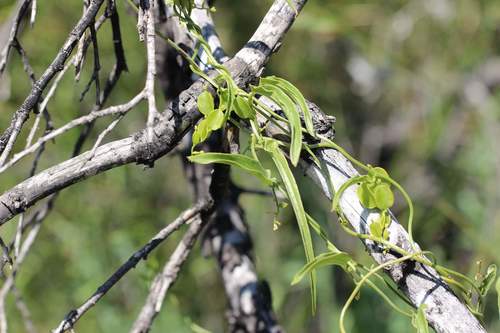
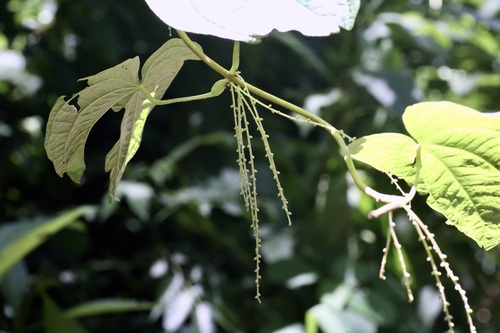
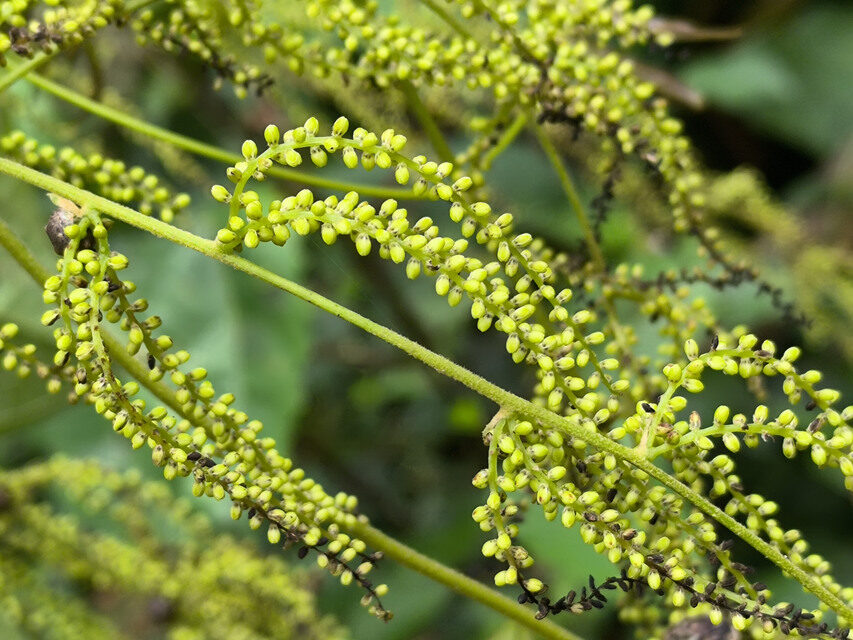
A yam. It is a climbing herb. The stems are angular and downy. It has bulbs. The tuber is large and 30 cm across. There can be a cluster of tubers. The leaves are alternate with 3 leaflets. They are round and hairy underneath. Male and female flowers are on separate plants. Male flowers are green and female flowers are white. They are in small hanging clusters in the axils or leaves. The stems are spiny. It can grow 15 m high. The fruit are winged and 4 cm long.
Edible Uses
The tubers are eaten as a famine food and sold in local markets. The peeled tubers must be leached in water for several days and then boiled and mixed with milk or maize porridge.
Traditional Uses
Caution: The tubers are poisonous without extensive preparation. The peeled tubers are leached in water for several days to remove the water soluble poison. They are then boiled and mixed with milk or maize porridge.
Known Hazards
The tubers are poisonous without extensive preparation and contain water-soluble toxins that must be removed by leaching.
Distribution
It is a subtropical plant. It grows in hot arid areas. It grows in woodland. It grows between 275-1,400 m above sea level. It can grow in arid places.
Where It Grows
Africa, Eswatini, Namibia, South Africa, Southern Africa, Swaziland,
Other Information
A famine food. It is sold in local markets.
Also Known As
Imgcolo, Ingxolo, Ndiyaza
References (7)
- Fox, F. W. & Young, M. E. N., 1982, Food from the Veld. Delta Books. p 180
- Long, C., 2005, Swaziland's Flora - siSwati names and Uses http://www.sntc.org.sz/flora/
- Plowes, N. J. & Taylor, F. W., 1997, The Processing of Indigenous Fruits and other Wildfoods of Southern Africa. in Smartt, L. & Haq. (Eds) Domestication, Production and Utilization of New Crops. ICUC p 190
- Royal Botanic Gardens, Kew (1999). Survey of Economic Plants for Arid and Semi-Arid Lands (SEPASAL) database. Published on the Internet; http://www.rbgkew.org.uk/ceb/sepasal/internet [Accessed 16th April 2011]
- Ruiters-Welcome, A. K., 2019, Food plants of southern Africa. Ph.D. thesis. Univ. of Johannesburg p 51
Show all 7 references Hide references
- Welcome, A. K. & Van Wyk, B.-E., 2019, An inventory and analysis of the food plants of southern Africa. South African Journal of Botany 122 (2019) 136–179
- World Checklist of Useful Plant Species 2020. Royal Botanic Gardens, Kew