Dioscorea praehensilis
Benth.
Forest yam, Bush yam
wikimedia· cc0
Howard, W.; Lowe, E. J. (via Wikimedia Commons)
gbif· cc-by-sa
Ibrahima MANDE
gbif· cc-by-sa
Ibrahima MANDE
gbif· cc-by-sa
Ibrahima MANDE
Summary
Source: WikipediaDioscorea praehensilis is a species of yam in the genus Dioscorea native to Africa. It is the wild progenitor of the West African domesticated crops Dioscorea rotundata and Dioscorea cayennensis. It is a liana with an edible tuber root found in African rainforests and seasonal tropical forests. The roots reach their maximum starch reserves during the dry season. The species renews its stems every year at the start of the rainy season.
Description
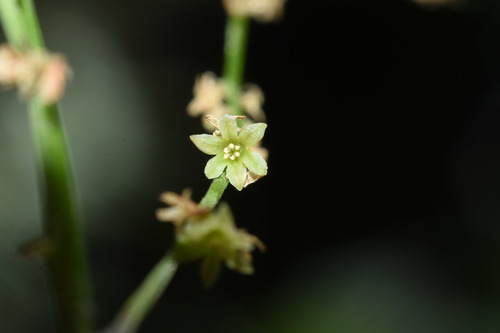
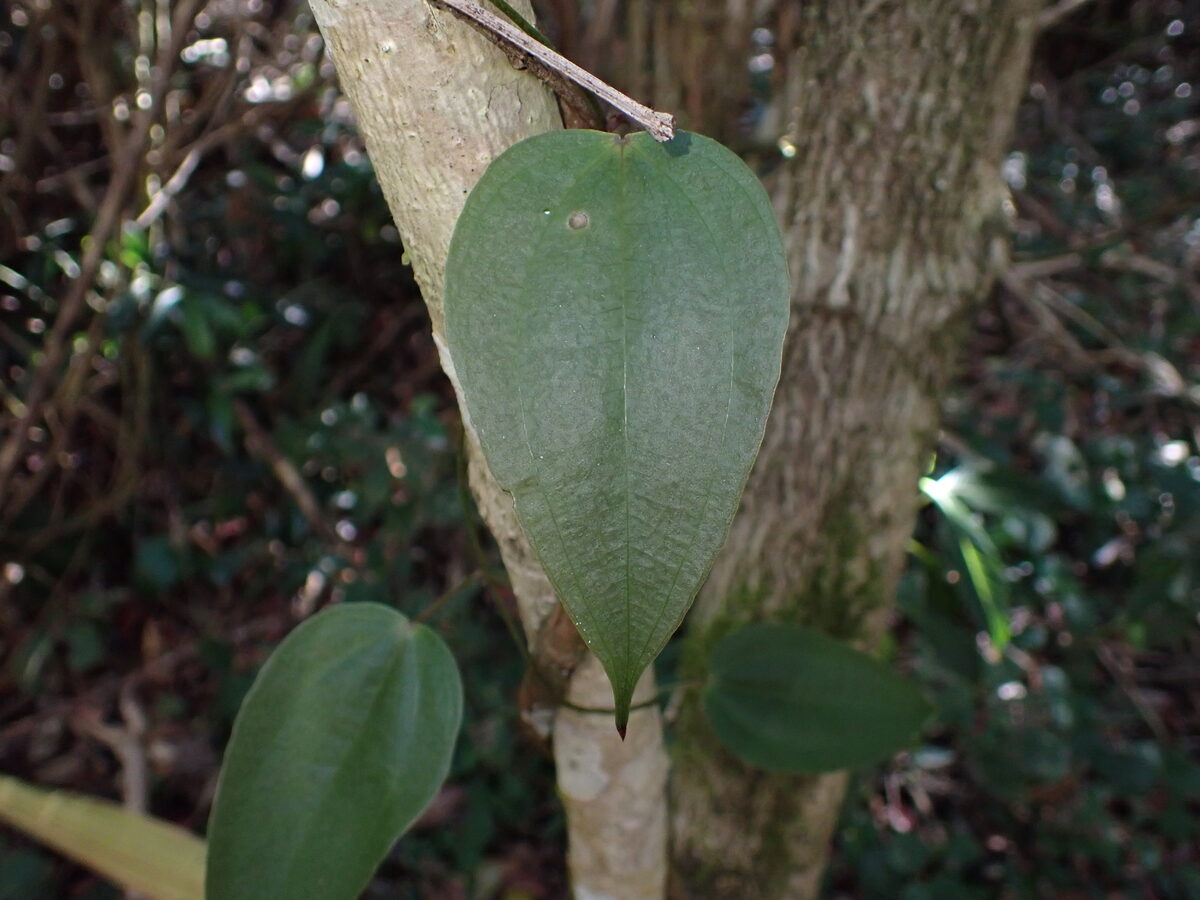
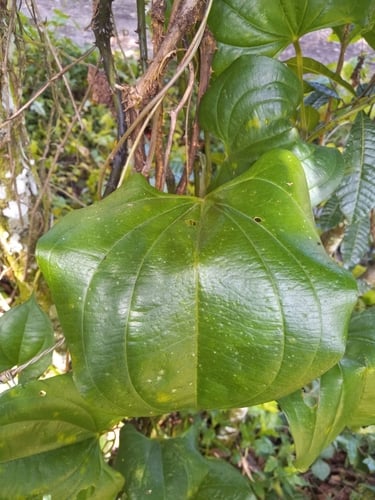
A yam. It is a climbing herb. The vines are 8-15 m long. It produces one tuber each year. This is 5 cm across and 60 cm long. It extends down into the ground. The stems twine to the right. It has pale brown prickles. These are more common near the base. The leaves are opposite. They are 4-10 cm long by 3-5 cm wide. They are heart shaped at the base. The leaves are entire and taper to the tip. The tip can be long. The tubers develop annually. The flowers are in a spike in the axils of leaves. Male and female flowers are separate and female flowers hang down.
Edible Uses
The tubers are cooked and eaten as a starchy staple, though they can be bitter and require careful preparation—peeling and soaking before use. Young tubers are preferred. The young leaves are also eaten.
Traditional Uses
The tubers are cooked and eaten as a starchy staple. The tubers can be bitter and then need careful preparation. They need to be peeled and soaked before using. Young tubers are chosen. The young leaves are also recorded as eaten. (Caution)
Medicinal Uses
The boiled tuber is taken in order to accelerate childbirth, and sometimes to relieve rheumatism. An infusion prepared from the older stem is used to treat stomach complaints, urethral discharge and oedema.
Known Hazards
The tubers can be bitter and require careful preparation. Young leaves should be used with caution.
Distribution
A tropical plant. It grows in forest and grassland. In Central Africa it grows from 600-1,700 m altitude. It grows in drier areas. In Malawi it grows at 600-700 m altitude. In Tanzania it grows between 800-1,800 m above sea level It grows in areas with rainfall between 1,400-2,400 mm. It is best in humus rich soil.
Where It Grows
Africa, Angola, Benin, Burkina Faso, Cameroon, Central Africa, Central African Republic, CAR, Congo DR, Congo R, Côte d'Ivoire, East Africa, Ethiopia, Gabon, Gambia, Ghana, Guinea, Guinée, Guinea-Bissau, Ivory Coast, Liberia, Malawi, Mali, Mozambique, Nigeria, Rwanda, Senegal, Sierra Leone, Southern Africa, Tanzania, Togo, Uganda, West Africa, Zambia, Zimbabwe,
Cultivation
A piece of the tuber is used for replanting. It is best with a support to climb over.
Production
Tubers are harvested soon after the end of the rainy season. They can be sliced, dried and powdered and stored for several months.
Other Information
It is the most important edible yam of Southern Africa. It is a staple food in Benin. It is cultivated.
Notes
There are about 650 species of Dioscorea.
Synonyms
Also Known As
Aduaka, Amakolongo, Amejko, Amengese, Anga, Ayu, Barafe, Batafo-nto, Begpegu, Bga, Biatenda, Bilungu, Bisadi, Bosondi, Busa, Canhambo, Dian-fasaka, Dolohom, Doyar daji, Endale, Entut, Esia, Etete, Fasaka, Ikoni, Ikuse, Inhame, Itiguligwa, Itugu, Kango, Kawon, Kia makaka, Kigonzo, Kisadi, Kiya, Kobo, Kpegu, Lilungu, Luliga, Mitoto, Modo, Mole, Mpama, Mulugu, Muoli, Mupama, N'pabe, Ndiga, Ndoo, Nsende za nkaka, Nsende za sadi, Nyambi ala, Saba, Sapa, Senssa, Sinsa, Sopere, Tite, Umpabe, Welo
References (47)
- Abbiw, D.K., 1990, Useful Plants of Ghana. West African uses of wild and cultivated plants. Intermediate Technology Publications and the Royal Botanic Gardens, Kew. p 27
- Avouhou, H. T., et al, 2012, Ethnobotanical Factors Influencing the Use and Management of Wild Edible Plants in Agricultural Environments in Benin. Ethnobotany Research & Applications Vol 10:571-592
- Awas, T., 1997, A Study on the Ecology and Ethnobotany of Non-cultivated Food Plants and Wild Relatives of Cultivated crops in Gambella Region, Southwestern Ethiopia. Addis Ababa University. p 78
- Balemie, K., & Kebebew, F., 2006, Ethnobotanical study of wild edible plants in Derashe and Kucha Districts, South Ethiopia. Journal of Ethnobiology and Ethnomedicine.
- Berihun, T. & Molla, E., 2017, Study on the Diversity and Use of Wild Edible Plants in Bullen District Northwest Ethiopia. Hindawi Journal of Botany. Article ID 8383468
Show all 47 references Hide references
- Billong Fils, P. E., et al, 2020, Ethnobotanical survey of wild edible plants used by Baka people in southeastern Cameroon. Journal or Ethnobiology and Ethnomedicine. 16:64 p 7
- Bongers, F. et al (Eds), Forest Climbing Plants of West Africa: Diversity, Ecology and Management. CABI
- Bruschi, P., et al, 2014, Traditional use of plants in a rural community of Mozambique and possible links with Miombo degradation and harvesting sustainability. Journal of Ethnobiology and Ethnomedicine. 2014, 10:59
- Burkill, H. M., 1985, The useful plants of west tropical Africa, Vol. 1. Kew.
- Busson, 1965, (As Dioscorea odoratissima)
- Codjia, J. T. C., et al, 2003, Diversity and local valorisation of vegetal edible products in Benin. Cahiers Agricultures 12:1-12
- Dalziel, J. M., 1937, The Useful plants of west tropical Africa. Crown Agents for the Colonies London.
- Eilu, G. & Bukenya-Ziraba, R., 2004, Local Use of Climbing Plants of Budongo Forest Reserve, Western Uganda. Journal of Ethnobiology 24(2): 307-327 (As Dioscorea odoratissima)
- Gallois, S., et al, 2020, Methodological priorities in assessing wild edible plant knowledge and use – a case study among the Baka in Cameroon.
- Grivetti, L. E., 1980, Agricultural development: present and potential role of edible wild plants. Part 2: Sub-Saharan Africa, Report to the Department of State Agency for International Development. p 32
- Grubben, G. J. H. and Denton, O. A. (eds), 2004, Plant Resources of Tropical Africa 2. Vegetables. PROTA, Wageningen, Netherlands. p 287
- Hahn, K., et al, 2018, The Use of Wild Plants for Food: a National Scale Analysis for Burkina Faso (West Africa) Flora et Vegetatio Sudano-Sambesica 21, 25-33
- J. D. Hooker & G. Bentham in W. J. Hooker, Niger Fl. 536. 1849
- Idohou, I., et al, 2013, National inventory and prioritization of crop wild relatives: case study for Benin. Genet Resour Crop Evol (2013) 60:1337–1352
- Jardin, C., 1970, List of Foods Used In Africa, FAO Nutrition Information Document Series No 2.p 14 (Also as Dioscorea liebrechtsiana), p 13 (As Dioscorea angustiflora)
- Koni, J. M. & Bostein, K., 2008, Noms et usages des plantes utiles chez les Nsong, DR Congo. University of Gothenburg. Department of Oriental and African Languages. p 32
- Latham, P., 2004, Useful Plants of Bas-Congo province. Salvation Army & DFID p 112
- Lautenschläger, T., et al, 2018, First large-scale ethnobotanical survey in the province of Uíge, northern Angola. Journal of Ethnobiology and Ethnomedicine (2018) 14:51
- Lulekal, E., et al, 2011, Wild edible plants in Ethiopia: a review on their potential to combat food insecurity. Afrika Focus - Vol. 24, No 2. pp 71-121
- Malaisse, F., 1997, Se nourrir en floret claire africaine. Approche ecologique et nutritionnelle. CTA., p 61 (Also as Dioscorea liebrechtsiana)
- Mawunu, M., et al, 2022, Ethnobotanical uses of wild edible plants of Mucuba municipality, Angola. Natural Resources for Human Health. 2022, 0:1-10
- Nkeoua, G. & Boundzanga, G. C., 1999, Donnees sur les produits forestieres non ligneux en Republique du Congo. FAO. p 25 (Also as Dioscorea liebrechtsiana)
- Nyadanu, D., et al, 2015, Agro-biodiversity and challenges of on-farm conservation: the case of plant genetic resources of neglected and underutilized crop species in Ghana. Genet. Resourc. Crop Evol. 62(7):
- Peters, C. R., O'Brien, E. M., and Drummond, R.B., 1992, Edible Wild plants of Sub-saharan Africa. Kew. p 17 (Also as Dioscorea odoratissima)
- Ruffo, C. K., Birnie, A. & Tengnas, B., 2002, Edible Wild Plants of Tanzania. RELMA p 274 (As Dioscorea odoratissima)
- Sato, H., 2001, The potential of edible wild yams and yam-like plants as a staple food resource in the African Tropical Rain Forest. African Study Monographs Suppl. 26:123-134
- Senbeta, F. et al, 2013, Diversity of Useful Plants in the Coffee Forests of Ethiopia. Ethnobotany Research & Applications 11:049-069
- Tebkew, M. et al, 2014, Underutilized wild edible plants in the Chilga District, northwestern Ethiopia: focus on wild woody plants. Agriculture & Food Security 3:12
- Tebkew, M., et al, 2018, Uses of wild edible plants in Quara district, northwest Ethiopia: implication for forest management. Agriculture and Food Security (2018) 7:12
- Terashima, H., & Ichikawa, M., 2003, A comparative ethnobotany of the Mbuti and Efe hunter-gatherers in the Ituri Forest, Democratic Republic of Congo. African Study Monographs, 24 (1, 2): 1-168, March 2003
- Termote, C., et al, 2011, Eating from the wild: Turumbu, Mbole and Bali traditional knowledge of non-cultivated edible plants, District Tshopo, DRCongo, Gen Resourc Crop Evol. 58:585-618
- Tugume, P. & Nyakoojo, C., 2020, Traditional use of wild edible plants in the communities adjacent to Mabira Central Forest Reserve, Uganda. Ethnobotany Research & Applications 20:15 (2020) (As Dioscorea odoratissima)
- von Katja Rembold, 2011, Conservation status of the vascular plants in East African rain forests. Dissertation Universitat Koblenz-Landau p 165
- White, F., Dowsett-Lemaire, F. and Chapman, J. D., 2001, Evergreen Forest Flora of Malawi. Kew. p 97 (As Dioscorea odoratissima)
- Wiersema, J. H. & Leon, B., 2013, World Economic Plants. A Standard Reference CRC Press. 2nd Ed. p 248
- Wilkin, P., 2001, Dioscoreaceae of South-Central Africa. Kew Bulletin, Vol. 56, No. 2 (2001), pp 361-404
- World Checklist of Useful Plant Species 2020. Royal Botanic Gardens, Kew
- Yamada, T., 1999, A report of the Ethnobotany of the Nyindu in the Eastern part of the former Zaire. African Study Monographs 20(1):1-72
- Yasuoka, H., 2006, Long-Term Foraging Expeditions (Molongo) among the Baka Hunter-Gatherers in the Northwestern Congo Basin, with Special Reference to the "Wild Yam Question". Human Ecology, Vol. 34, No. 2, April 2006, pp 275 ff
- Yasuoka, H., 2009, Concentrated Distribution of Wild Yam Patches: Historical Ecology and the Subsistence of African Rainforest Hunter-Gatherers. Human Ecology 37:577-587
- Yimer, A., et al, 2021, Ethnobotanical study of wild edible plants used by Meinit Ethnic Community at Bench-Maji Zone, Southwest Ethiopia. Research Square. p 6
- Zeven, A. C. & de West, J. M. J., 1982, Dictionary of cultivated plants and their regions of diversity. Wageningen. p 125 (Also as Dioscorea liebrechtsiana)