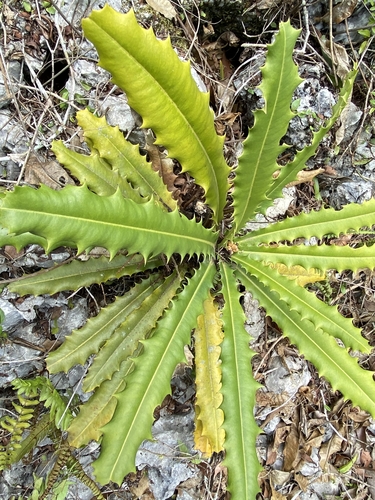
Primula involucrata
Wall. ex Duby
wikimedia· cc-by-sa
Wikimedia Commons - Svarði2
wikimedia· cc-by-sa
Wikimedia Commons - Svarði2
Summary
A perennial reaching 30 cm tall and 20 cm wide. Hardy to UK zone 5. Flowering occurs July to August, with seed ripening August to September. The hermaphroditic plant is insect-pollinated. It adapts to sandy, loamy, and heavy clay soils, tolerates mildly acid to mildly alkaline pH, grows in semi-shade, and prefers moist to wet soil.
Description
A herb. It keeps growing from year to year. The leaves form a ring. The leaves are oval and 1-4 cm long by 5-22 cm wide. The base is wedge shaped or heart shaped. There are 2-6 flowers in a group. They are white, pink or purple.
Edible Uses
None known.
Traditional Uses
The fresh leaves are cooked and eaten as a vegetable.
This uses section is brief — help expand it
Medicinal Uses
In Tibetan medicine the entire plant is used, said to have a sweet and bitter taste with a cooling potency. It is considered antidysenteric, anti-inflammatory and febrifuge, and is used in the treatment of contagious diseases and dysentery.
Distribution
It is a temperate plant. It grows in wet meadows between 3,000-4,500 m above sea level in SW China.
Where It Grows
Asia, Bhutan, China, Himalayas, India, Myanmar, Nepal, Northeastern India, SE Asia, Sikkim,
Cultivation
Prefers a moist position in partial shade, such as along the edge of a stream or in a woodland garden. In such a position the plant is usually long-lived. If conditions are too dry the plant may become dormant by late summer. Grows well in heavy clay soils. The flowers have a delicious sweet honey perfume.
Propagation
Seed is best sown as soon as ripe in a cold frame. Stored seed can be sown in early spring in a cold frame — germination is inhibited by temperatures above 20°C. When large enough to handle, prick seedlings into individual pots and grow on in a greenhouse through their first winter. Plant out into permanent positions in late spring or early summer, after the last expected frosts. Divide in autumn, ideally every other year.
Other Uses
None known.
References (1)
- Bhattarai, S and Chaudary, R. P., 2009, Wild Edible Plants Used by the People of Manang District, Central Nepal. Ecology of Food and Nutrition, 48:1-20