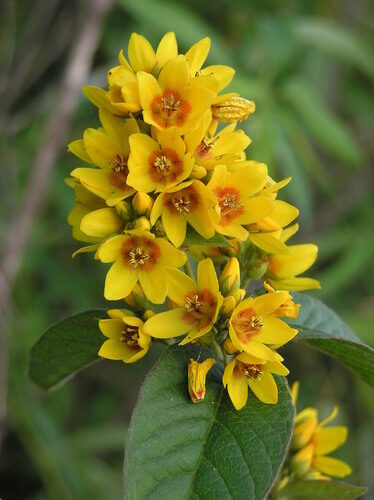
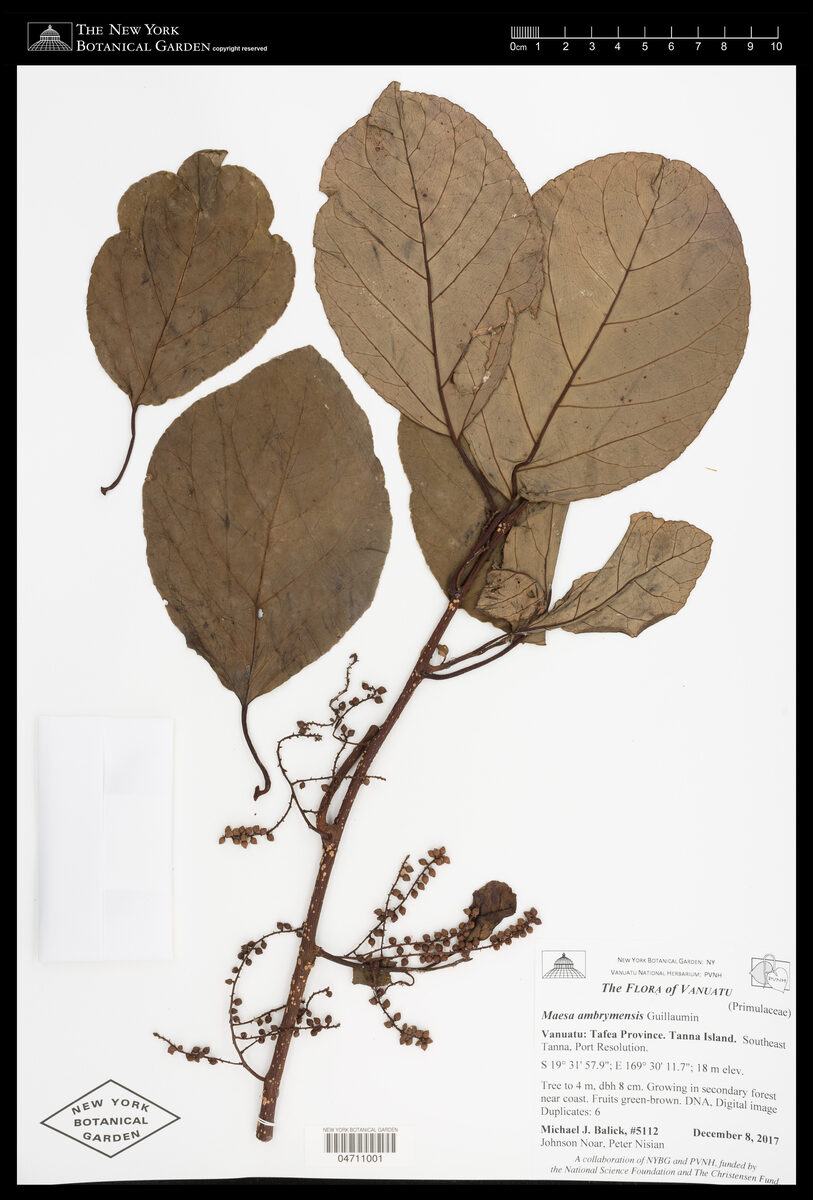
Embelia sessiliflora
Kurz.
Sour chicken vine
gbif· cc-by
Royal Botanic Gardens, Kew
gbif· cc-by-nc-sa
MBG
gbif· cc-by-nc-sa
MBG
Description
A tropical plant in the Primulaceae family, also known as sour chicken vine.
This description is brief — help expand it
Edible Uses
The fruit and leaves are eaten.
Traditional Uses
Fruit, Leaves,
This uses section is brief — help expand it
Cultivation
Primulaceae
Production
A shrub or climber. There is a soft covering on the young branches and flowers. The branches are angled with sharp ridges along them. The branches are 2-3 mm thick. The leaf stalk is 5-10 mm long. The leaf blade is oblong and 5-12 cm long by 2.2-4.5 cm wide. They are papery. The base is rounded and extends along the leaf stalk. It tapers to a short tip. There are 18-27 side veins each side of the midrib. The flowering stalk is at the end of the branch and is shaped like a pyramid. It is 5-15 cm long. The flowers are greenish white. The fruit is round and red. It is 3-4 mm across.
Synonyms
Also Known As
Duan geng suan teng zi, Laoqiu, Ma-die, Soh-jew-tenksai
References (7)
- Anderson, E. F., 1993, Plants and people of the Golden Triangle. Dioscorides Press. p 210 (As Embelia stricta)
- Chen Jie, Pipoly 3, J.J., Myrsinaceae. Flora of China.
- Hu, Shiu-ying, 2005, Food Plants of China. The Chinese University Press. p 616
- Jeeva, S., 2009, Horticultural potential of wild edible fruits used by the Khasi tribes of Meghalaya. Journal or Horticulture and Forestry Vol. 1(9) pp. 182-192
- Sawian, J. T., et al, 2007, Wild edible plants of Meghalaya, North-east India. Natural Product Radiance Vol. 6(5): p 416
Show all 7 references Hide references
- Singh, H.B., Arora R.K.,1978, Wild edible Plants of India. Indian Council of Agricultural Research, New Delhi. p 59
- Xu, You-Kai, et al, 2004, Wild Vegetable Resources and Market Survey in Xishuangbanna, Southwest China. Economic Botany. 58(4): 647-667.