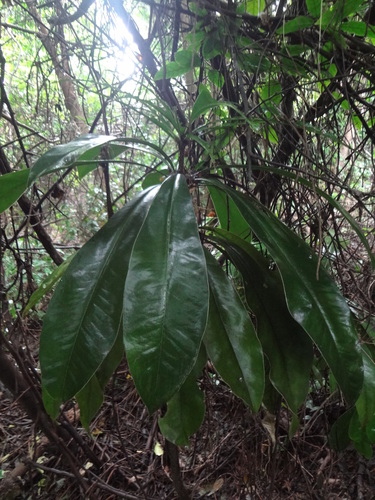
Embelia subcoriacea
(C. B. Clarke) Mez
Large-leaved embelia
gbif· cc-by
Moscow State University (copyright is managed by Dr. Alexey P. Seregin)
gbif· cc-by
Moscow State University (copyright is managed by Dr. Alexey P. Seregin)
gbif· cc-by
Royal Botanic Gardens, Kew
Description
A straggling shrub or small tree. It can be a climber. It grows 3-5 m high. The leaves are narrowly oval. They are 8-15 cm long by 4-6 cm wide. They taper to the tip and the base is wedge shaped. The flowers are of one sex and small. They are 3 mm long. They are in groups 3-5 cm long in the axils of leaves. The fruit are red and round but flattened. They are 1 cm across.
Edible Uses
The fruit are sweet-sour and eaten fresh with added sugar, or used to impart a sour taste. The leaves are cooked and eaten as a vegetable.
Traditional Uses
The fruit are sweet-sour and eaten fresh with added sugar. They are also used to impart a sour taste. The leaves are cooked and eaten as a vegetable.
Distribution
A tropical plant. It grows in Yunnan in China between 1,400-2,300 m altitude.
Where It Grows
Asia, China, Himalayas, India, Indochina, Laos, Myanmar, Northeastern India, SE Asia, Thailand, Vietnam,
Notes
There are about 140 Embelia species. Also put in the family Myrsinaceae.
Also Known As
Alqyulhav, Jermi-masi, Ob-ab, Poimuri tenga, Re dai, Tling, Trimeng, Trimong ruibe
References (13)
- Ambasta, S.P. (Ed.), 2000, The Useful Plants of India. CSIR India. p 194
- Dobriyal, M. J. R. & Dobriyal, R., 2014, Non Wood Forest Produce an Option for Ethnic Food and Nutritional Security in India. Int. J. of Usuf. Mngt. 15(1):17-37
- Hani Medicine of Xishuangbanna, 1999, p 71
- Hu, Shiu-ying, 2005, Food Plants of China. The Chinese University Press. p 616
- Lalfakzuala, R., 2007, Ethnobotanical usages of plants in western Mizoram. Indian Journal of Traditional Knowledge. Vol 6(3) pp 480-493
Show all 13 references Hide references
- Luo, B., et al, 2019, Wild edible plants collected by Hani from terraced rice paddy agroecosystem in Honghe Prefecture, Yunnan, China. Journal of Ethnobiology and Ethnomedicine 15:56
- Patiri, B. & Borah, A., 2007, Wild Edible Plants of Assam. Geethaki Publishers. p 76
- Pegu, R., et al, 2013, Ethnobotanical study of Wild Edible Plants in Poba Reserved Forest, Assam, India. Research Journal of Agriculture and Forestry Sciences 1(3):1-10
- Sarma, H., et al, 2010, Updated Estimates of Wild Edible and Threatened Plants of Assam: A Meta-analysis. International Journal of Botany 6(4): 414-423
- Sawian, J. T., et al, 2007, Wild edible plants of Meghalaya, North-east India. Natural Product Radiance Vol. 6(5): p 416
- Singh, H.B., Arora R.K., 1978, Wild edible Plants of India. Indian Council of Agricultural Research, New Delhi. p 25
- Somnasang, P., Moreno, G and Chusil K., 1998, Indigenous knowledge of wild hunting and gathering in north-east Thailand. Food and Nutrition Bulletin 19(4) p 359f
- Wild edible plants of Himachal Pradesh