Calamus caryotoides
C. Martius
Fish-tail lawyer cane
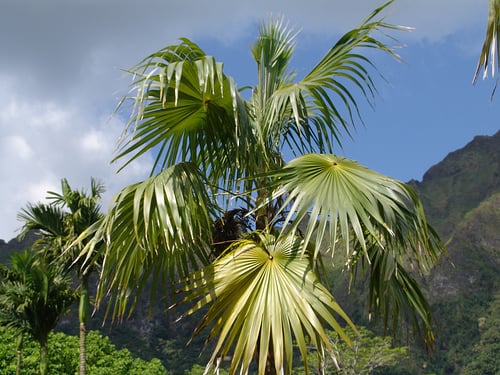
iNaturalist· cc-by
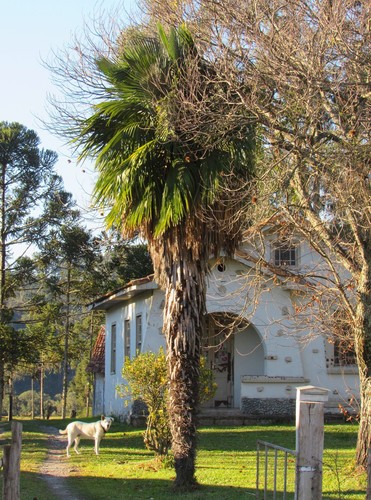
(c) Tom Field, some rights reserved (CC BY), uploaded by Tom Field
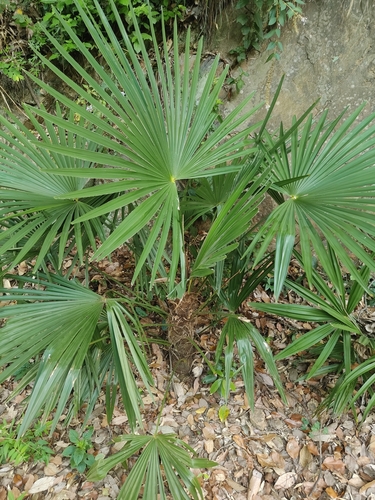
iNaturalist· cc-by-nc
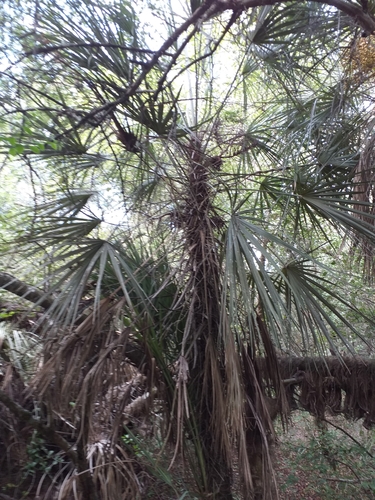
(c) ryanthughes, some rights reserved (CC BY-NC)
Summary
Source: WikipediaCalamus caryotoides, commonly known as fish-tail lawyer cane, is a climbing palm native to Queensland, Australia. Its habitat is rainforest and monsoon forest.
Description
A tall slender climbing palm or rattan. It can have one or many stems. It forms clumps and forms a tangled thicket. Vines can be 15 m long. The stems have needle-like spines. It has whip-like climbing structures which develop for the top of the leaf sheath opposite the stalk. These can be 1-2.5 cm long and have hooks which curve backwards. It has feather-like leaves. These are distributed along the stem at fairly wide intervals. The leaflets are wedge shaped with the end pair united to form a fish tail. The leaves are 20-70 cm long with 6-12 pairs of shiny, pale green leaflets. These are 10-20 cm long by 4-6 cm wide. They have jagged tips. The flowering stalk is long and hangs downwards. It is 1-2.5 cm long with a few short branches. Several flowering stalks are often present at the same time. Male and female flowers are on separate plants, The flowers are cream and 2-4 mm across. The fruit are cream when ripe and round. They are 8-13 mm across and covered with overlapping scales. They have a thin outer coat. This is edible. It contains a single seed. The seed is 8 mm by 6 mm.
Edible Uses
Although we have no specific information for this species, many members of this genus have potentially edible young shoots. Indeed, in Laos the shoots are considered to be a delicacy and over half the species growing there are said to be cooked and eaten as a vegetable. The top 100cm of the plant is used. If the leaf sheaths are left in place until just before cooking then the shoot will remain fresh for up to one week.
Traditional Uses
The fleshy layer around the seed is eaten.
This uses section is brief — help expand it
Medicinal Uses
Young shoots are eaten to cure a headache.
Known Hazards
Very frost sensitive when young.
Distribution
It is a tropical plant. It grows along the edges of drier rainforests. They do best with a warm, well-drained site. Light shade is good and the soil should be rich. They are very frost sensitive when young. In Northeast Australia they grow from sea level to 1,000 m altitude. They can grow in warm temperate frost free places. In the Cairns Botanical Gardens. It suits hardiness zones 9-12. Mt Cootha Botanical Gardens.
Where It Grows
Asia, Australia*, Indonesia, SE Asia,
Cultivation
Plants are grown from seed. Seed usually grow within 6 months. Seedlings and suckers are difficult to transplant.
Propagation
Seed - it has a fairly short viability and is best sown as soon as it is ripe.
Other Uses
The slender stems are used in basket making. The long and slender stems of Calamus species are put to various uses according to their size, length, flexibility, elasticity and toughness. The most slender canes are employed entire for binding purposes, and in making chairs, blinds, mats, wicker or basketwork, fishing implements, etc. Twisted together, they make very strong cables. The largest and more resistent canes are used entire as cables, the framework of wicker chairs etc. Usually, however, for many purposes the stems are split throughout their length into 2 - 4 or more strips from which the inner soft brittle and spongy portion is removed by means of a knife or same other instrument, so as to leave the external portion, which is hard, tough, flexible, elastic and has its outer surface very clean and smooth as if it had been varnished. Strips vary in width according to the use to which they are to be put. Those for delicate work, such as the network of furniture, small bags, hats, etc, are from 1 - 3mm wide; those employed as lashings in native housebuilding or in fastening the removable head of the Malay axe to its handle are from 5-6 mm wide. Collecting and preparing the stems is very simple. The stem is cut near the ground and detached from the trees by taking a strong hold of its base and thus pulling down the entire plant with its leaves. The most recent growth at the top of the plant is removed and then, handling it from the upper end, the stem is forcibly drawn in the opposite direction between two pieces of wood, thus removing the spiny coverings. It is then cut into lengths of about 5 metres, each piece is bent into two equal parts and the stems are fastened into bundles ready for market. The most valued stems are not thicker than a man's little finger and have a fine polished straw-yellow glassy surface.
Production
They are fast growing. In Australia, fruiting occurs from April to December.
Notes
There are 375-400 Calamus species. There are 175 species in tropical Asia.
Also Known As
Rotan ekor ikan
References (19)
- Blomberry, A. & Rodd, T., 1982, Palms. An informative practical guide. Angus & Robertson. p 70
- Bodkin, F., 1991, Encyclopedia Botanica. Cornstalk publishing, p 188
- Cooper W & Cooper W T, 1994, Fruits of the Rain Forest. RD Press p 60
- Cooper, W. and Cooper, W., 2004, Fruits of the Australian Tropical Rainforest. Nokomis Editions, Victoria, Australia. p 69
- Cronin, L., 1989, The Concise Australian Flora. Reed. p 232
Show all 19 references Hide references
- Cronin, L., 2000, Australian Palms, Ferns, Cycads and Pandans. Cronin Publications. p 70
- Cundall, P., (ed.), 2004, Gardening Australia: flora: the gardener's bible. ABC Books. p 278
- Elliot, W.R., & Jones, D.L., 1982, Encyclopedia of Australian Plants suitable for cultivation. Vol 2. Lothian. p 404
- Jackes, B.R., 2001, Plants of the Tropics. Rainforest to Heath. An Identification Guide. James Cook University. p 42
- Jones, D.L. & Gray, B., 1977, Australian Climbing Plants. Reed. p 81
- Jones D, L, 1986, Ornamental Rainforest Plants in Australia, Reed Books, p 326
- Jones, D.L., 1994, Palms throughout the World. Smithtonian Institution, Washington. p 156
- Jones, D.L., 2000, Palms of Australia 3rd edition. Reed/New Holland. p 80
- Nicholson, N & H., 1994, Australian Rainforest Plants 4, Terania Rainforest Publishing. NSW. p 19
- Ratcliffe D & P., 1987, Australian Native Plants for Indoors. Little Hills press. p 65
- Riffle, R.L. & Craft, P., 2003, An Encyclopedia of Cultivated Palms. Timber Press. p 284
- Sukarya, D. G., (Ed.) 2013, 3,500 Plant Species of the Botanic Gardens of Indonesia. LIPI p 761
- Townsend, K., 1994, Across the Top. Gardening with Australian Plants in the tropics. Society for Growing Australian Plants, Townsville Branch Inc. p 110
- Tucker, R., 1988, The Palms of Subequatorial Queensland. Palm and Cycad Society of Australia, Milton, Queensland. p 34