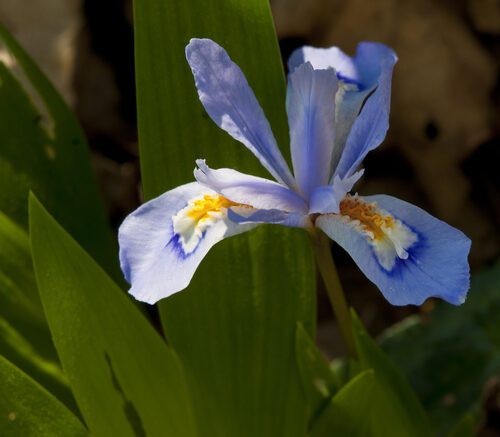
Afrosolen otaviensis
(R. C. Foster) Goldblatt & Manning
gbif· cc-by-sa
GBIF
gbif· cc0
President and Fellows of Harvard College
gbif· cc0
President and Fellows of Harvard College
Description
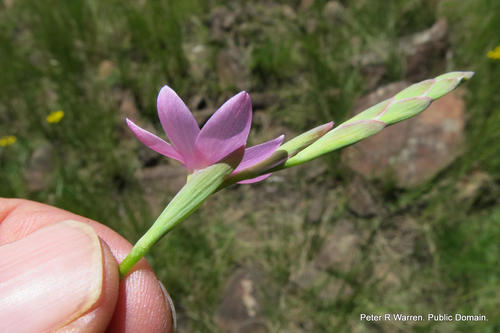
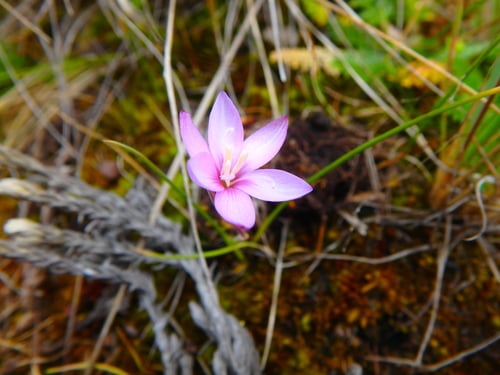
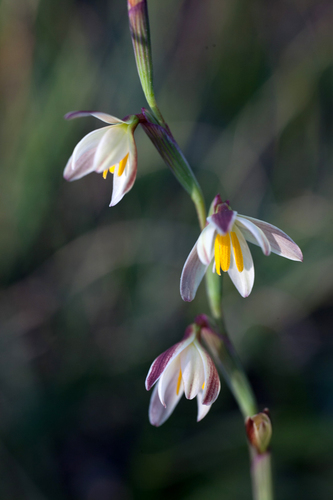
A small herb. It keeps growing from year to year. It grows 50 cm high. It has a small tuber about 1 cm long and this forms about 20 cm underground. It is covered with brown scales. The flowers are white with a purple centre. They have a tube 5 cm long.
Edible Uses
The tuber is dried, peeled of its scales, pounded, and cooked into porridge.
Traditional Uses
The tuber is dried, pounded and cooked. The scales are removed. It is then added to porridge.
This uses section is brief — help expand it
Distribution
It is a subtropical plant. It grows between sea level and 1,800 m above sea level. It can grow in stony and sandy loam soils. It can grow in arid places.
Where It Grows
Africa, Angola, Namibia, Southern Africa,
Synonyms
Also Known As
Onzondungua, Sekke
References (3)
- Leger, S., 1997, A Description of Today's Use of Plants in West Bushmanland (Namibia). German Development Service. PO Box 220035, 14061 Berlin, Germany. http://www.sigridleger.de/book/ (As Lapeirousia otaviensis)
- Royal Botanic Gardens, Kew (1999). Survey of Economic Plants for Arid and Semi-Arid Lands (SEPASAL) database. Published on the Internet; http://www.rbgkew.org.uk/ceb/sepasal/internet [Accessed 19th April 2011] (As Lapeirousia otaviensis)
- World Checklist of Useful Plant Species 2020. Royal Botanic Gardens, Kew