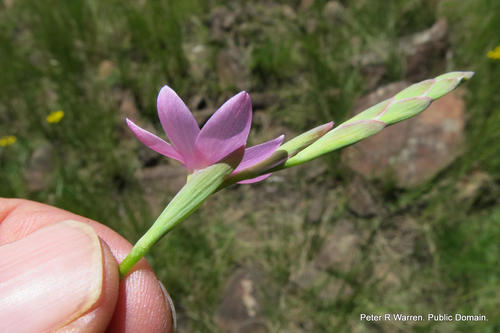
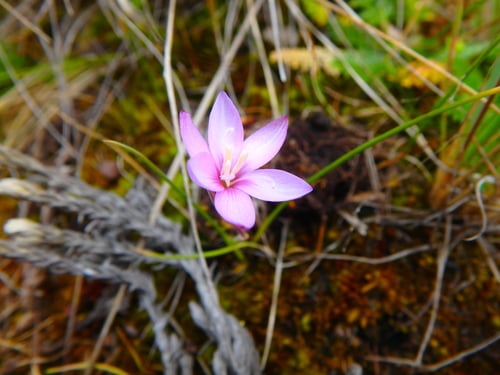
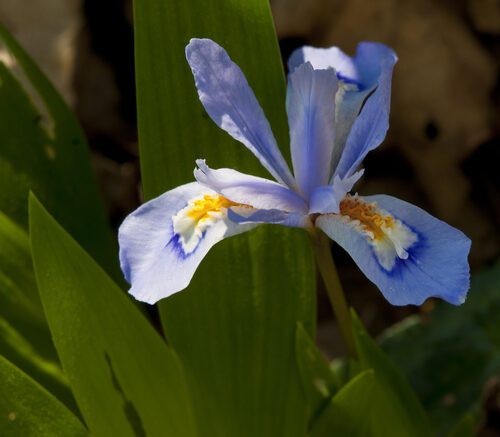
Iris setosa
Pall.
Beachhead Iris, Canada beachhead iris, Wild flag
iNaturalist· cc-by
(c) Connie Taylor, some rights reserved (CC BY), uploaded by Connie Taylor
iNaturalist· cc-by-nc
(c) J. Burke Korol, some rights reserved (CC BY-NC), uploaded by J. Burke Korol
iNaturalist· cc-by-nc
(c) Harry Hill, some rights reserved (CC BY-NC), uploaded by Harry Hill
Description
Iris setosa is a PERENNIAL growing to 0.6 m (2ft) by 1 m (3ft 3in) at a medium rate. See above for USDA hardiness. It is hardy to UK zone 5 and is not frost tender. It is in flower in June, and the seeds ripen in August. The species is hermaphrodite (has both male and female organs) and is pollinated by Insects. The plant is self-fertile. Suitable for: light (sandy) and medium (loamy) soils. Suitable pH: mildly acid and neutral soils and can grow in saline soils. It can grow in semi-shade (light woodland) or no shade. It prefers moist or wet soil.
Edible Uses
Coffee. Root - yields an edible starch. Caution is advised, see the notes above on toxicity. Roasted and ground seed is a coffee substitute.
Medicinal Uses
LaxativeA decoction of the root is used as a laxative.
Known Hazards
Many plants in this genus are thought to be poisonous if ingested, so caution is advised. The roots are especially likely to be toxic. Plants can cause skin irritations and allergies in some people.
Distribution
Northwestern N. America, coastal regions of E. Asia to Japan.
Where It Grows
TEMPERATE ASIA: Russian Federation-Eastern Siberia (Eastern Siberia), Russian Federation (Habarovskij kraj, Primorye, Amur, Kamcatskij kraj, Magadanskaja oblast, Sakhalin), China (Jilin Sheng (east)), Korea, Japan NORTHERN AMERICA: Canada (Yukon), United States (Alaska, British Columbia)
Cultivation
Prefers a well-drained moist soil but succeeds in most soils. Dislikes lime and dry soils. The form from N. Hokkaido does not require an acid soil. Cultivated for its edible root in Japan. Many named forms have been selected for their ornamental value. Members of this genus are rarely if ever troubled by browsing deer or rabbits.
Propagation
Seed - best sown as soon as it is ripe in a cold frame. Stored seed should be sown as early in the year as possible in a cold frame. Prick out the seedlings into individual pots when they are large enough to handle and grow them on in the greenhouse or cold frame for their first year. Plant out into their permanent positions in late spring or early summer. Division, best done in September after flowering. Very easy, larger clumps can be replanted direct into their permanent positions, though it is best to pot up smaller clumps and grow them on in a cold frame until they are rooting well. Plant them out in the spring.
Other Uses
DyeA dye is obtained from the petals, but the colour is not specified.