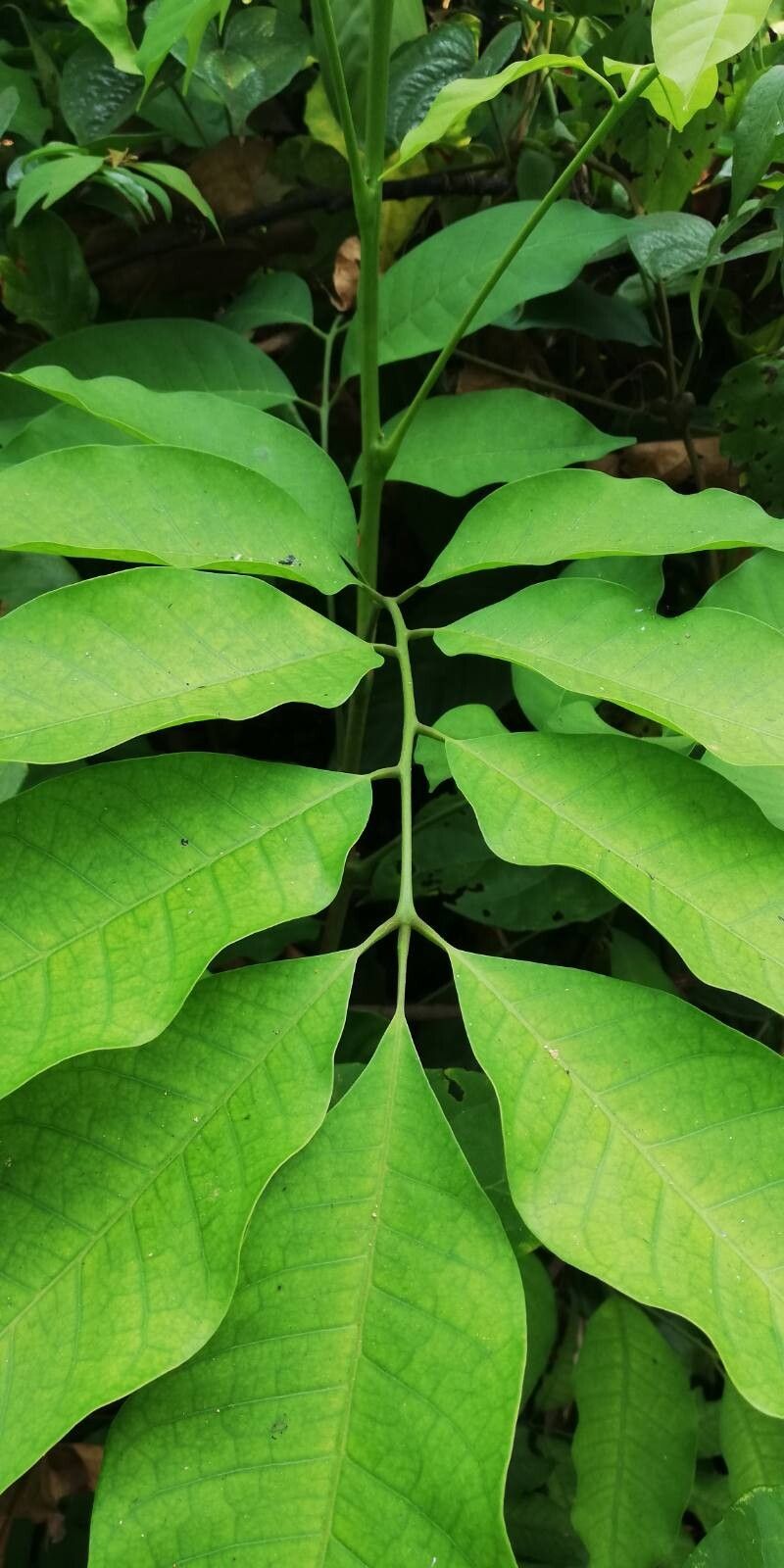
Lepidotrichilia volkensii
(Gurke) J.-F. Leroy
iNaturalist· cc-by-nc
(c) Bart Wursten, some rights reserved (CC BY-NC), uploaded by Bart Wursten
iNaturalist· cc-by-nc
(c) Bart Wursten, some rights reserved (CC BY-NC)
Description
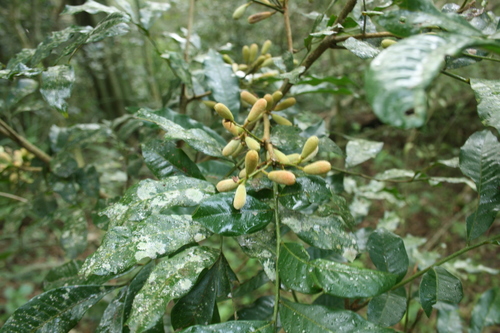
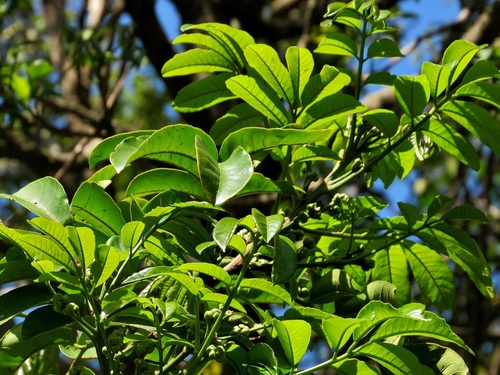
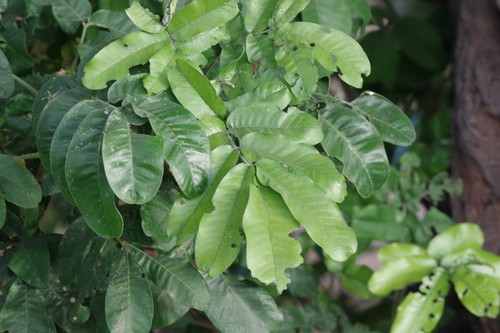
A shrub or tree. It keeps is leaves throughout the year. It grows up to 20 m tall. The trunk is often fluted. The bark is smooth and grey. The inner bark is red. The crown is spreading. The leaves are alternate and has 7-11 pairs of leaflets with a leaflet at the end. The leaflets are narrowly oval and 5-20 cm long by 2-8 cm wide. The flowers are in a group 25 cm long. They have yellowish-brown hairs. The fruit is a flattened round berry. It is 7-15 mm across. It has 2-3 seeds. They are 2-3 mm long.
Edible Uses
The fruit is eaten raw.
Traditional Uses
The fruit is eaten raw.
This uses section is brief — help expand it
Medicinal Uses
The sesquiterpenoid voleneol has been isolated from the plant.
Distribution
It is a tropical plant. It grows in mountain forest between 1,500-2,400 m altitude. It is in areas where the rainfall is 1,500-2,000 mm per year.
Where It Grows
Africa, Burundi, Central Africa, Congo, East Africa, Ethiopia, Malawi, Rwanda, Sudan, Tanzania, Uganda, Zambia,
Cultivation
Plants can be grown from seed. Self sown plants can be transplanted. Seeds can only be stored for a short time.
Propagation
Seed - it has a short period of viability and so should be sown as soon as it is ripe. The seed does not need pretreatment.
Other Uses
The whitish heartwood is hard, with a fine texture. The wood is used for local construction and to make spoons and tool handles. The wood is used for fuel and to make charcoal.
Notes
There are 4 Lepidotrichilia species in Africa.
Synonyms
Also Known As
Kijang, Umugayigayi, Xabbicho
References (6)
- Awas, T., 1997, A Study on the Ecology and Ethnobotany of Non-cultivated Food Plants and Wild Relatives of Cultivated crops in Gambella Region, Southwestern Ethiopia. Addis Ababa University. p 57
- Lemmens, R.H.M.J., 2008. Lepidotrichilia volkensii (Gürke) J.-F.Leroy. [Internet] Record from Protabase. Louppe, D., Oteng-Amoako, A.A. & Brink, M. (Editors). PROTA (Plant Resources of Tropical Africa), Wageningen, Netherlands. < http://database.prota.org/search.htm>. Accessed 16 October 2009.
- Lulekal, E., et al, 2011, Wild edible plants in Ethiopia: a review on their potential to combat food insecurity. Afrika Focus - Vol. 24, No 2. pp 71-121
- Sina, B. & Degu, H. D., 2015, Knowledge and use of Wild Edible Plants in the Hula District of the Sidama Zone. International Journal of Bio-resource and Stress Management 6(3):352-365
- White, F., Dowsett-Lemaire, F. and Chapman, J. D., 2001, Evergreen Forest Flora of Malawi. Kew. p 365
Show all 6 references Hide references
- World Checklist of Useful Plant Species 2020. Royal Botanic Gardens, Kew