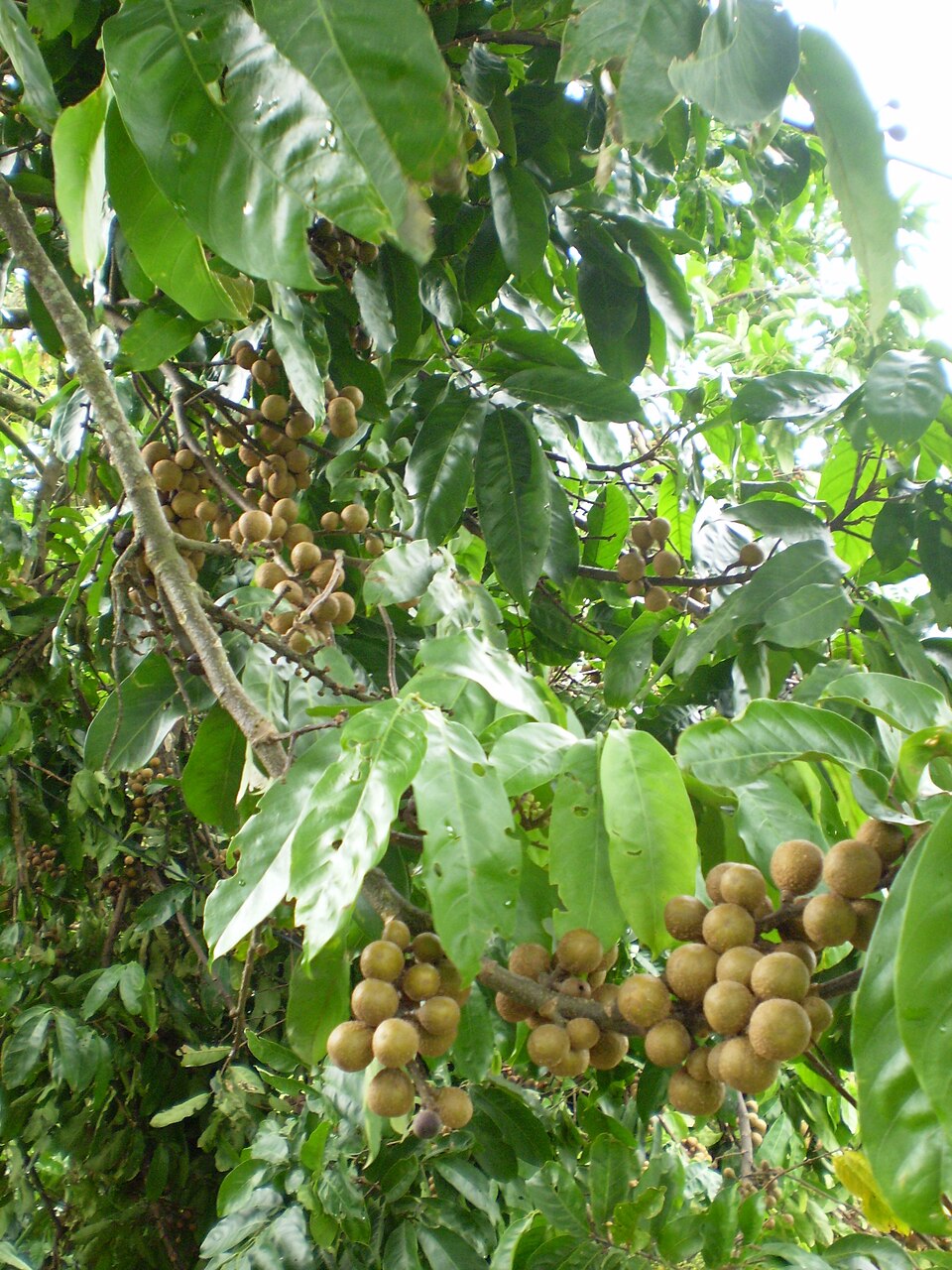
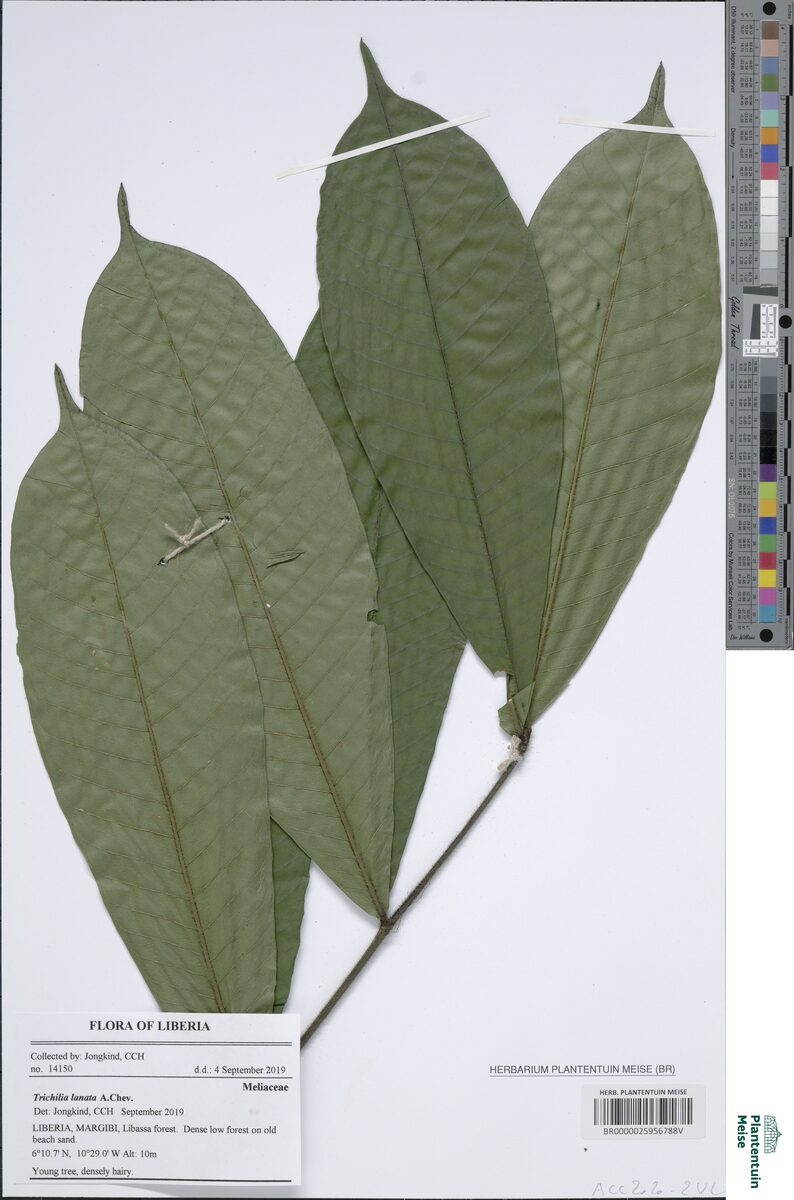
Trichilia emetica
Vahl
Banket mahogany, Natal mahogany, Cape mahogany
iNaturalist· cc-by-nc
(c) Craig Peter, some rights reserved (CC BY-NC), uploaded by Craig Peter
iNaturalist· cc-by-nc
(c) Dewald du Plessis, some rights reserved (CC BY-NC)
iNaturalist· cc-by-nc
(c) Norbaya Durr, some rights reserved (CC BY-NC)
Summary
Source: WikipediaTrichilia emetica is a tree in the family Meliaceae, commonly known as the Natal mahogany. It is an evergreen tree, with handsome glossy dark green leaves and a wide spreading crown. Its sweet-scented flowers attract bees and birds.
Description
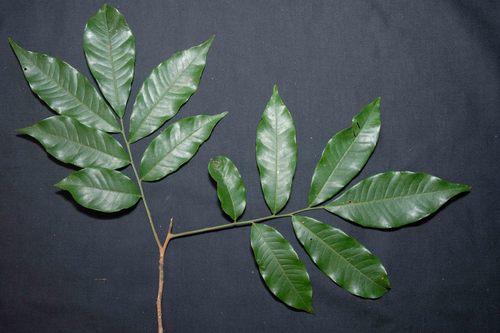
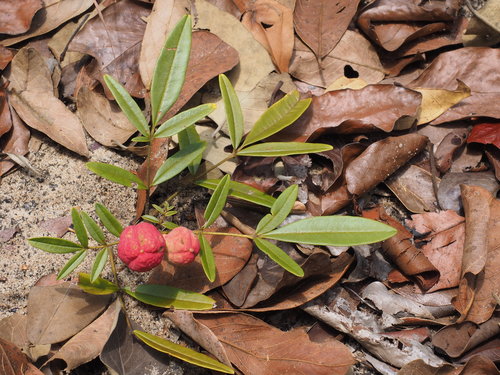
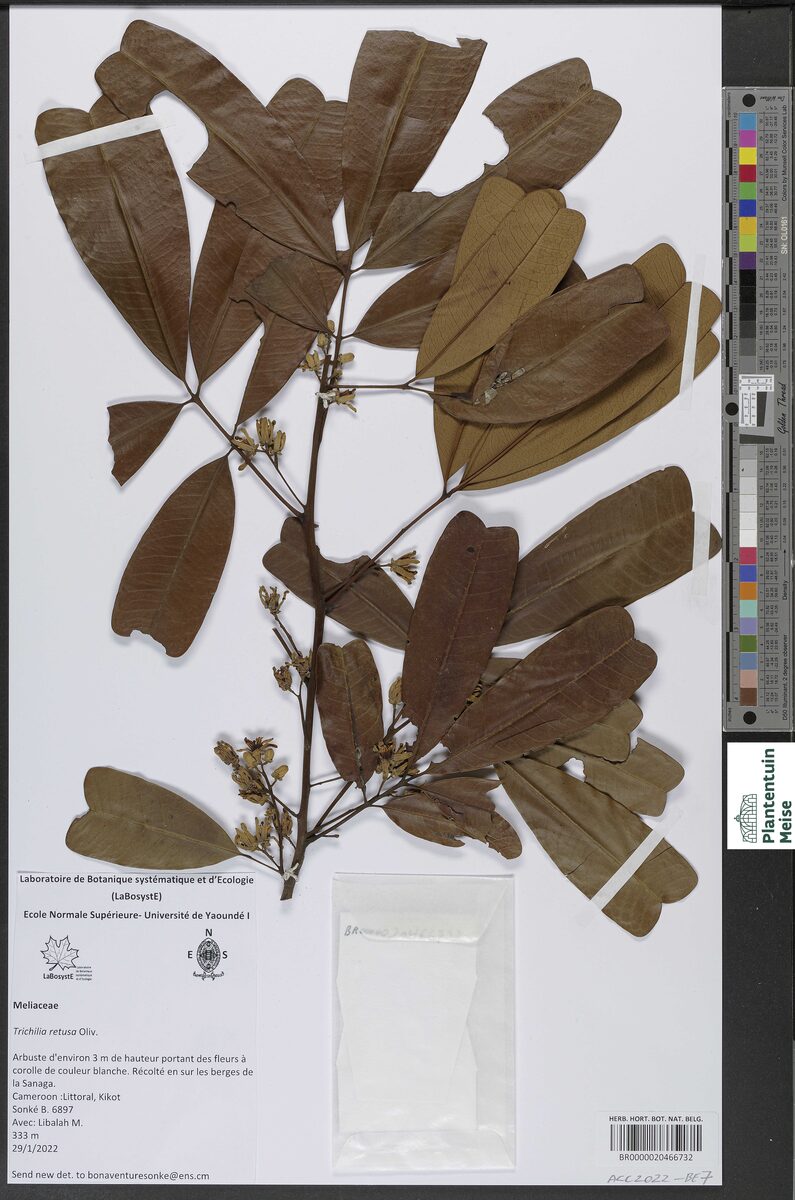
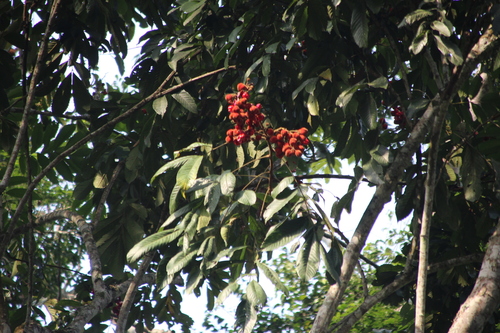
A large tree. It is evergreen. It grows 8-20 m high. The crown is round and widespreading. The leaves have 4-5 pairs of leaflets and one at the end. They are oblong and 12 cm long by 5.5 cm wide. They are dark green and glossy above and have short hairs underneath. The leaf stalk is 7-12 cm long. The flowers are creamy-green. The petals are 1.6 cm long. They occur in sort branched heads in the axils of leaves. These are about 5 cm long. The fruit is an almost round creamy-brown capsule. It is 2.5-3 cm across. They split into 2-3 valves. The seeds are black and covered with a red seed coat (aril).
Edible Uses
A sweet, milky, drinkable liquid is extracted from the arils. The fleshy seed envelope can be chewed as a substitute for kola. Skinned seeds may be eaten raw or soaked in water and ground, with the resulting liquid mixed into spinach dishes. The seedcoat is poisonous and must be removed. An edible oil is obtained from the fleshy seed envelope (the sarcotesta) by squeezing the seeds in water; the resulting fatty suspension is used for cooking. Oil extracted from the seed kernel itself is not edible due to its excessive bitterness.
Traditional Uses
CAUTION: The seeds are reported to be poisonous. The oil extracted from the seeds, without the coat, is used. Hot water is poured over the seeds and they are left to soak for a few hours then rubbed between the hands. A sweet milky liquid is extracted from the layer around the seeds. It is used as a drink or added to food. The flesh of the fruit is eaten. The fleshy layer or aril around the seeds is separated from the seeds, are soaked and cooked with sweet potato or squash.
Medicinal Uses
The leaves can be used as an antidote for irritation caused by the buffalo bean. Bark is used to treat pneumonia. A macerate of the root bark treats epilepsy and leprosy. Pieces or powdered bark soaked in warm water are used as an emetic or enema for intestinal ailments — only in small doses, as the effect can be violent. The bark also treats skin complaints. The roots are purgative and are used for colds, infertility and inducing labour in pregnant women. Powdered root treats cirrhosis, river blindness, ascariasis and dysmenorrhoea. A combined bark and root decoction addresses colds, pneumonia and intestinal disorders including hepatitis. A bitter medicinal oil, made by boiling ground seed in water, is taken orally to relieve rheumatism. Applied externally, the oil treats leprosy, sores, ringworm, other parasites and skin diseases.
Known Hazards
The seed coat is extremely poisonous. The seeds are poisonous and the poisonous compounds seem to be concentrated in the seedcoat.
Distribution
A tropical plant. It grows at medium to low altitudes in forests along rivers and near the coast. In East Africa it grows from sea level to 1,835 m altitude. In West Africa it grows in the savannah. It grows in areas with a rainfall above 550 mm. It can tolerate drought. It cannot tolerate frost. It can grow in arid places.
Where It Grows
Africa, Benin, Botswana, Burkina Faso, Cameroon, Cape Verde, Central Africa, Chad, Congo, East Africa, Eritrea, Eswatini, Ethiopia, Ghana, Guinea, Guinée, Guinea-Bissau, Kenya, Liberia, Malawi, Mali, Middle East, Mozambique, Namibia, Nigeria, Saudi Arabia, Senegal, Somalia, South Africa, Southern Africa, Sudan, Swaziland, Tanzania, Uganda, West Africa, Yemen, Zambia, Zimbabwe,
Cultivation
It grows best in areas where annual daytime temperatures fall within the range 19 - 31°c. It prefers a mean annual rainfall in the range 600 - 2,300mm. Succeeds in sun or shade. Prefers a well-drained, rich alluvial or sandy soil and a high water table. Established plants are very drought tolerant. A fast-growing species, increasing in height by up to 1 metre a year in colder areas and 2 metres in warmer areas. Under optimal conditions trees start producing fruit when 6 - 8 years old. Seed yields of individual trees vary greatly per tree and per year and range from 20 - 180 kg/year, averaging 45 - 65 kg. The tree responds well to coppicing and also produces suckers. A dioecious species, both male and female forms need to be grown if fruit and seed are required. It is able to tolerate moderate winter drought and slight frost.
Propagation
Seed is best sown as soon as it is ripe. Remove the surrounding aril by macerating the seed in water, then sow immediately — either directly in situ or into nursery bags. Germination typically occurs within 10–20 days, and seedlings can be planted out 6–8 months later. Propagation is also possible from cuttings taken from one-year-old coppice shoots, by layering, or from root suckers.
Other Uses
The plant assists significantly in soil conservation and is widely planted as a windbreak in urban and rural areas, and used in reforestation projects. The pressed seedcake remaining after oil extraction has an approximate protein content of 16% and is suitable as a fertiliser. The plant is regarded as an indicator of areas with palatable grass species. Two distinct oils come from the seed: the oil from the fleshy seed envelope, known as Mafura oil, is edible and produces a good finish on wood surfaces; the oil from the kernel, called Mafura butter, is too bitter to eat and is used for making candles. Commercially, both oils are often extracted together. The fleshy envelope contains 14–51% oil; the kernel contains 68% oil. Combined, the oils are excellent for soap-making and are sometimes used as a cosmetic or for preserving foodstuffs. The leaves can be used as soap, and aqueous leaf extracts show pronounced antifungal properties against several plant pathogens. Crushed seed mixed at a dosage of 1% almost completely protected cowpea seed from storage pests. A pinkish dye is obtained from the bark. The wood is used as chewsticks for oral hygiene. The wood is typically pinkish with little distinction between sapwood and heartwood — soft, light yet firm, and works well. It is vulnerable to borers and should be treated accordingly. It produces attractive furniture that darkens with oil, and is good for shelving, carvings, musical instruments, household articles, tool handles and spears. Trees with long, straight trunks are traditionally used for dugout canoes. The wood is widely used as fuel.
Production
It is fast growing. In Tanzania fruit can be collected from April to July and November to December. Dried seeds can be stored for several months.
Other Information
It is a commonly used fruit in Mozambique. Seed are sold commercially.
Nutrition
| Part | Moisture | kJ | kcal | Protein | Vit A | Vit C | Iron | Zinc |
|---|---|---|---|---|---|---|---|---|
| Seeds dried | 6 | 2165 | 518 | 10.4 | — | — | 1.3 | — |
| Aril dried | 10.3 | 2149 | 514 | 5.8 | — | — | 7.8 | — |
| Seeds | 49 | 1368 | 327 | 4.9 | — | 18.2 | 1.7 | 1.2 |
Synonyms
Also Known As
Bitterwood, Bululu, Chipindura, Cucho, Dipugedi, Ixolo, Mafura, Mafurreira, Marba, Mchekeri, Mchengo, Mchenya, Mkhudlu, Mnwamaji, Moboba, Mothothwan, Mothowani, Movava, Mshunguti, Msichici, Msikidzi, Msikitsi, Mtutu, Muchichiri, Munyantse, Mururi, Musikili, Musukidi, Mutshikili, Muwamaji, Mutuhu, Muzaramanga, Ndilolo, Nkuhlu, Pilivili, Roka, Rooiessenhout, Tihuhlu, Tinkuhlu, Umkhuhlu, Umsikili, Umtshitshivi, Vungu
References (56)
- Abbiw, D.K., 1990, Useful Plants of Ghana. West African uses of wild and cultivated plants. Intermediate Technology Publications and the Royal Botanic Gardens, Kew. p 48
- Allen, D. J., 2007, Wildflowers and Common Trees of East Africa. Camerapix Publishers p 128
- Bekele-Tesemma A., Birnie, A., & Tengnas, B., 1993, Useful Trees and Shrubs for Ethiopia. Regional Soil Conservation Unit. Technical Handbook No 5. p 436
- Boll. Soc. Bot. Ital. 1923:115. 1923 (Trichilia roka)
- Bonou, A., et al, 2013, Valeur economique des Produits Forestiers Non Ligneux (PFNL) au Benin. Editions Universitaires Europeennes p 91
Show all 56 references Hide references
- Bunderson, W. T. et al, 2002, Common Agroforestry Species in Malawi. Malawi Agroforestry Extension Project, Pubication No. 46, Lilongwe. p 38
- Burkill, H. M., 1985, The useful plants of west tropical Africa, Vol. 4. Kew.
- Busson, 1965,
- Cunningham, 1985,
- Dalziel, J. M., 1937, The Useful plants of west tropical Africa. Crown Agents for the Colonies London.
- Dharani, N., 2002, Field Guide to common Trees & Shrubs of East Africa. Struik. p 181
- Duarte, M. C., et al, 2022, Diversity of Useful Plants in Cabo Verde Islands: A Biogeographic and Conservation Perspective. Plants 2022, 11, 1313 p 14
- Engelter, C. & Wehmeyer, A. S., 1970, Fatty Acid Composition of Oils of Some Edible Seeds of Wild Plants. Journal of Agricultural and Food Chemistry. 18(1): 25-26
- Exell, A.W. et al, (Ed), 1963, Flora Zambesiaca Vol 2 Part 1 Crown Agents, London. p 299
- FAO. 1983, Food and fruit-bearing forest species 1: Examples from Eastern Africa. FAO Food and Forestry Paper 44/1 p 111 (As Trichilia roka)
- Fowler, D. G., 2007, Zambian Plants: Their Vernacular Names and Uses. Kew. p 47
- Fox, F. W. & Young, M. E. N., 1982, Food from the Veld. Delta Books. p 264
- Grivetti, L. E., 1980, Agricultural development: present and potential role of edible wild plants. Part 2: Sub-Saharan Africa, Report to the Department of State Agency for International Development. p 72
- Gueye, M., et al, 2014, Wild Fruits Traditionally Gathered by the Malinke Ethnic Group in the Edge of Niokolo Koba Park (Senegal). American Journal of Plant Sciences 5, 1306-1317
- https://growwild.co.za Edible Indigenous plants
- Hwang, L. C., et al, 2020, Traditional Botanical Uses of Non-Timber Forest Products (NTFP) in Seven Counties in Liberia. ACS Symposium Series; American Chemical Society: Washington, DC, 2020.
- INFOODS:FAO/INFOODS Databases
- Jardin, C., 1970, List of Foods Used In Africa, FAO Nutrition Information Document Series No 2.p 48, 165
- JSTOR Global Plants edible
- Keay, R.W.J., 1989, Trees of Nigeria. Clarendon Press, Oxford. p 348
- Le Houerou, H. N., (Ed.), 1980, Browse in Africa. The current state of knowledge. International Livestock Centre for Africa, Ethiopia. p 163 (As Trichilia roka)
- Long, C., 2005, Swaziland's Flora - siSwati names and Uses http://www.sntc.org.sz/flora/
- Lovett, J. C. et al, Field Guide to the Moist Forest Trees of Tanzania. p 101
- Magwede, K., van Wyk, B.-E., & van Wyk, A. E., 2019, An inventory of Vhavenḓa useful plants. South African Journal of Botany 122 (2019) 57–89
- Mbuya, L.P., Msanga, H.P., Ruffo, C.K., Birnie, A & Tengnas, B., 1994, Useful Trees and Shrubs for Tanzania. Regional Soil Conservation Unit. Technical Handbook No 6. p 492
- Menninger, E.A., 1977, Edible Nuts of the World. Horticultural Books. Florida p 122
- Morgan, W. T. W., 1981, Ethnobotany of the Turkana: Use of plants by a Pastoral People and Their Livestock in Kenya. Economic Botany 35(1):96-130
- Mutie, F. M., et al, 2023, Important Medicinal and Food Taxa (Orders and Families) in Kenya, Based on Three Quantitative Approaches. Plants 2023, 12, 1145
- Ogle & Grivetti, 1985,
- Palgrave, K.C., 1996, Trees of Southern Africa. Struik Publishers. p 385
- Peters, C. R., O'Brien, E. M., and Drummond, R.B., 1992, Edible Wild plants of Sub-saharan Africa. Kew. p 146
- Royal Botanic Gardens, Kew (1999). Survey of Economic Plants for Arid and Semi-Arid Lands (SEPASAL) database. Published on the Internet; http://www.rbgkew.org.uk/ceb/sepasal/internet [Accessed 3rd May 2011]
- Ruffo, C. K., Birnie, A. & Tengnas, B., 2002, Edible Wild Plants of Tanzania. RELMA p 674
- Ruiters-Welcome, A. K., 2019, Food plants of southern Africa. Ph.D. thesis. Univ. of Johannesburg p 78
- Scudder, 1962, 1971,
- Segnon, A. C. and Achigan-Dako, E. G., 2014, Comparative analysis of diversity and utilization of edible plants in arid and semi-arid areas in Benin. Journal of Ethnobiology and Ethnomedicine. 10:80
- Symb. bot. 1:31. 1790
- Swaziland's Flora Database http://www.sntc.org.sz/flora
- Tredgold, M.H., 1986, Food Plants of Zimbabwe. Mambo Press. p 129
- van Wyk, B, van Wyk, P, and van Wyk B., 2000, Photographic guide to Trees of Southern Africa. Briza. p 311
- Van Wyk, Br. and van Wyk P., 2009, Field Guide to Trees of Southern Africa. Struik Nature. p 472
- van Wyk, Be, & Gericke, N., 2007, People's plants. A Guide to Useful Plants of Southern Africa. Briza. p 26
- van Wyk, B-E., 2011, The potential of South African plants in the development of new food and beverage products. South African Journal of Botany 77 (2011) 857–868
- Venter, F & J., 2009, Making the most of Indigenous Trees. Briza. p 286
- Wehmeyer, A. S, 1986, Edible Wild Plants of Southern Africa. Data on the Nutrient Contents of over 300 species
- Welcome, A. K. & Van Wyk, B.-E., 2019, An inventory and analysis of the food plants of southern Africa. South African Journal of Botany 122 (2019) 136–179
- White, F., Dowsett-Lemaire, F. and Chapman, J. D., 2001, Evergreen Forest Flora of Malawi. Kew. p 366
- Williamson, J., 2005, Useful Plants of Malawi. 3rd. Edition. Mdadzi Book Trust. p 249
- Wilson, A. L. & Downs, C. T., 2012, Fruit nutritional composition and non-nutritive traits of indigenous South African tree species. South African Journal of Botany. 78:30-36
- World Checklist of Useful Plant Species 2020. Royal Botanic Gardens, Kew
- www.worldagroforestrycentre.org/treedb/